
You
A little poem written at my shrine this midnight when I should have been meditating...
God-man, grandfather, secret friend
Pharaonic in your silences and stares
Elusive in your maddening love
Absconding with my freedom
Boycotting my dreams
You prowl at the edge of my everything
Propped in my heart like some saint
Watchful as a sphinx, indifferent as stone
Soul-guide, envoy, enigma
Keeper of my keys, puppeteer
Tugging at my strings,
Maestro of my anguishes and cries,
Trailblazer, bright comet, my strange valentine
Embedded deep like a thorn.
You’re constant, meticulous, relentless
Playing at your tricks and graces
You cast me away, then
My confidante, draw me near.
Is it true that your love’s so deep?
Watch over me tonight
Rock this wretched crib when I sleep.
– Jogyata.

When Daylight Comes
If you leave here in the dark, rouse yourself protesting from a warm bed, pick up a friend, head out on quiet night roads to the west, you can be at Karekare before sun-up. This is a lovely place I am often drawn to, a holy place for me that soothes the spirit – a huge canopy of sky slowly coloring in at daybreak, silver rumpled folds of sea, a long mile-wide shoreline of tidal flats, dunes, swamplands and secret lakes, paradise of wildfowl and timid animals.
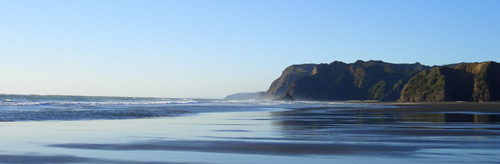
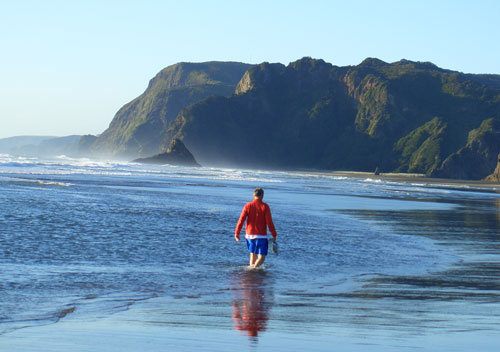
Down the endless shoreline you can amble for hours, never see another human being. You feel unburdened here, immersed in eternity, a speck in this sweep of distance. You can pray to your God, sit on a sandhill and weep at your life and your memories, meditate to the seas cadences that are soft and rhythmic, beguiling. This is a place to be alone in – as of a shrine where Mother Nature is your only companion. Rough poetry that you won’t bother to polish or revisit comes easily and you scrawl lines on a piece of paper. You look at the dawn sky and talk to your Beloved without effort or guile – you are all sincerity, just yourself, babbling in the dawn at this great shrine of God.
When Daylight Comes
When daylight comes
you roam the crinkled shores
stride out to a beckoning emptiness.
Wednesday’s sun flares up
from the crook of grey hills.
Your footprints weave
the virgin wastes like an aimless drunk,
beetle across this wilderness of rumpled dunes.
The sands are a map
and last night’s other lives
have left their feeble tracks and tiny stories:
claw prints of a bittern
soft paws, a rabbit under moonlight,
stitch marks of a swift predator–
millipede, night hunter on the prowl–
the strutting bold stride of a pheasant.
And here a tiny death–
bumbling epic wanderings
of a sand beetle, ponderous
and purposeless, speared
by a beak at dawn.
Sunrise scatters golden light.
Frail thing of flesh, you lift
stick arms in supplication
captive to a sky of cirrus charms
eyes raised up
to it’s tousled random beauty.
Might some grace yet come?
Subdued by sea mists
the dawn sun stares,
a tamed red Gorgon’s eye.
You come here sometimes
comforted by seas that measure time.
– Jogyata.
Heartland
Last week two visiting New York friends, Bipin and Mridanga, accompanied us to a favorite spot in the mountains for three days, a six hour drive down through New Zealand's central North Island. At the tiny rural settlement of Raetihi we take a back road out of town, a slow ride south down a bony, narrow gravel road that winds down to the Whanganui River, snakes through scrubland, hill farms, valleys clad in the variegated olive greens of native forest and bisected by dark ravines. Arriving an hour and a half later, weary from the corrugated road, at our destination the The Flying Fox. Here two cabins await you over a river and your only access is by a small box car suspended from a single wire cable.
At The Flying Fox you should leave behind your cell phone, laptop, wristwatch, your urban toys, all the things that imprison you in your orderly life and your old self, all your mind baggage too. The river is the living edge and boundary of another world and when you cross it you must be open to new things which may or may not be to your liking. Nature is powerful here and dominates, the river brooding and alive and concealing in it's depths animistic forces; the forest that encircles you a dark wall that confronts you with yourself, the limits of your daring, the subtle menaces that populate your imagination. Here wilderness meets the wild places of your mind. You might shrink a little for it can humble you, turn you inside out, these strange and trackless folds of hills and deep bottomed valleys where you sense elemental forces, the indifference of nature, the precariousness of life.
But the mountains are also an antidote to the world we always occupy, a world wholly constructed by man, and wild nature will restore some balance, fill you with awe, offer a gateway which if you dare pass through will deepen you and make you more human and whole. Here you can make connections to other realities, other parts of yourself, become filled with wonder and surprise.
At dusk we slip down the river, moving quietly along an animal trail through the forest and sidle up into clearings – two shy black fallow deer melt away into the trees. A young foal lingers near the cottages, tall and gangly and rib-skinny – we try to befriend her with apples but she keeps her distance. The mother's white bones, still partly clad in her tawny hide, are filling up with grass down on the river flats where, a while ago, she lay down and died.
Light drains out of the land, the colors decompose into dark hues of gunmetal sky and inky black forest. During the long night you can hear only the quiet river and the native owl, ruru the message-bringer, calling from the ridge lines and dark folds of hills. By my bed an enchanting Poetry of James K. Baxter volume – at the end of one poem he writes with that sometimes melancholy air which these landscapes can induce:
"What is a man
This glittering dung-fed fly
Who burrows in foul earth?
All; Jehovah's sky
And earth like millstones grind us small."
At dawn we meditate and head out early on a five hour hike back into the forest. Cicadas are trilling high up in the canopies of black beech; a hawk rides the thermals, head swiveling as it scans for carrion or prey. Well back in the ranges, we drop down into a steep sided valley that should take us back to the main river. Down one spur, a big black and tan wild boar bursts out of waist high fern, clearly annoyed by our intrusion and snorting in warning. He comes up the ridge towards me and stops only ten metres away, still barely visible, while I'm glancing round for a close and climbable tree. Then, unchallenged, he moves around the side of the spur and slips away, grunting in irritation. The ravines at the bottom of these valleys are carved deep out of soft pale sandstones by heavy winter rains and form steep sided chasms that can be death traps. If you are navigating through the forest by these perilous waterways you can find your way down steep drop-offs, but might at any point reach an impassable vertical fall – then find you cannot get back up the steep chutes you've descended. Such errors may be costly...
But we work carefully down and finally reach the main valley. In spring this river with it's sombre moods and 1,000 years of Maori history fills up with yellow floating kowhai flowers, a beautiful and scented miracle that snakes down from the central volcanic highlands of the central North Island on its long journey to the sea.
A week later I overnight in the small hydro town of Turangi, stay with a family known for as long as I can remember. Their daughter Raewyn with whom I shared our long ago childhood is honouring her mother's birthday in style and I am a secret guest. Other guests arrive that night – helicopter pilots, river guides, characters and personalities who live unusual lives, some surprises from my own safari guiding days of decades past – and I am hugged warmly by a stream of people, mostly strangers. I meet riders and horse trainers from the Lord of the Rings movie set – Raewyn's daughter was a stunt rider and doubled for some of the less accomplished stars on horseback.
That night before the birthday party I sleep in a room filled with photos – Raewyn's deceased father in plus-fours and braces in 1949, wielding a shotgun and a clutch of unfortunate pheasants; formal and unsmiling family portraits of long departed kin; endless snaps of horse jumps, three generations of the family's equestrians bottoms up and primly correct over barrels and brush hedges and railing fences; coy snaps of grinning relatives and of ourselves in a far off time.
With a start I notice a photo of myself with five river rafting clients from the mid-70's – on my right the ill-fated German hunter Bernhardt Stoll posing with his .270 Mannlicher and signature pince-nez glasses. A month after that expedition he swam ashore for help from a disabled boat in the headwaters of a Borneo river – a returning search party wades ashore ten days later only to find his remains, his rusting Mannlicher, the oddball glasses and his white bones. It appeared he had been eaten, though the culprits were never found.
In my room trophies line the walls, jostle for space – 1st prize, Waimarino Women's Open Jump; 2nd prize, New Zealand Show Jumping National Champs; a medley of dressage medals and honors. At the end of my bed a thirteen point stuffed stag's head leans against the curtain, the long white tines gleaming like pale daggers in the moonlight. The glass eye watches me, bland and forgiving and unperturbed.
Next day the birthday celebrant clatters down out of leaden skies in the grandson's helicopter – pilot Rob executes a few festive jigs and turns before settling carefully down on the grass lawn. Four kilted pipers play the bagpipes as all the guests form a gauntlet's guard of honour. Speeches follow, a huge meal, charge your glasses, spontaneous songs sung by uninhibited, merry guests, a table groaning with gifts. Hiding to avoid karaoke. And standing outside in mist and light drizzle, catching up with folks from an almost forgotten part of life.
I look at these people that I so liked thirty and more years ago – and still like them now. Is it a measure of how little we have changed or of how much we have in common? Destiny has led us along very different pathways, yet we return together after so long apart to find that friendships have endured, our destination the same.
Raewyn tells me of her parent's comical first meeting on the inter-islander ferry in 1900 and something. They had met and played cards together on the top boat-deck during the five hour crossing, a random meeting of two strangers. A poor hand at poker, Bob loses his travel money and then wagers his coat, hat, shirt, trousers, shoes in quick succession against Alpha's own wardrobe, an outrageous turn of events. Ill-luck dogged him and he endured varying states of undress till they dock at the port of Picton where he steps bravely ashore, bare-chested in that winter morning and clad only in long johns and one shoe and sock. But that eccentric daring-do won him loyalty and love and so began their life together.
I am moved by the heart power of these ingenuous and friendly people, by their spirit and kindness. God plays hide and seek in every human life and sure enough there He is in the warm smiling eyes and generosity of these people from our heartland.
"Friendship is the butterfly-play in the life-dance of today's Truth-seekers and tomorrow's God-lovers."
– Sri Chinmoy.
– Jogyata.
A Wedding and A Funeral
On the long (painful) flight from the U.S. to Auckland recently I was remembering some people from my long ago, and penned this little semi-autobiographical story...
In his three days in America Brad Anders attended first a wedding and then a funeral, the marriage of one relative and the burial of another, neither close to him but reason enough to pry himself out of his going nowhere life for a short vacation. Both experiences left him in somber mood, the wedding for its unsettling sense of something lost, his long ago unrequited loves still tugging, the funeral for it’s stark reminder of mortality, his nineteen year old niece Annie lying almost ludicrously dolled up for all to see in an open casket, quite radiant though definitely not breathing and shortly thereafter reduced in the undertakers furnace to a small mound of grey ash, a portion of which was later placed ceremoniously in his hands, a small unmarked casket, for keepsake or scattering.
In an almost empty funeral parlor Brad contemplated his departed niece. Rigor mortis had begun to undo the mortician’s careful toil, the cute final smile tightening at one corner into an almost quizzical grin, the portrait of a happy exit betrayed by sagging flesh, a drooping eyelids half wink. A single tear of brown fluid stained the mascara’d cheek; and partially visible, one milky blue eye, a dead cod’s stare. Trussed up though in her prettiest finery, a red dress to counterpoint the pallid laced hands and sleek golden hair. Staring at her as though to memorise her face or wrest some close-by secret, some answer to his own incomprehension.
Later, wandering, he purchased a book on North American Indian folklore, brooded over a chapter that leaned heavily in favour of a deterministic universe, each person assigned so many breaths in their lifetime, though by whose decree or what the author did not say.
Brad did some touristy things, visited galleries, beaches, malls, embarked on a city bus tour patronized by elderly silver haired retirees, his niece’s troubling ashes all the while in his carry-all. At Laguna beach while the entire bus competed for the single roadside restroom he strolled along the sand and scattered Annie’s scorched and elemental remnants, pitted grey granules like tiny meteorites, a little furtively with so many strollers around, placing their small plastic container respectfully in a rubbish bin and here severing all further connections with his kin.
Next day the wedding – and reunion with an entirely forgotten uncle. Under a huge marquee his father’s brother slumped at a table littered with wine bottles, a carnage of leftovers, wedding cake gored by sated guests then tossed aside, dismembered poultry. Brad smirked at a sudden fantasy, his distended host visibly widening at the girth as though inflated by an invisible bicycle pump, gape-eyed in merriment like a bloated frog; better still, envisaging him as a drunken medieval knight carousing at an oaken table, swilling coarse wine and tearing flesh from the drumsticks of slain huge fowl, tossing these to snarling wolfhounds, half beast himself in his rancid matted deer hide and pleasured grunting. Smiling at his uncle, though in collusion with his own pleasing imagery.
Out on the dance floor a relentless local band ran Elvis hits, the wedding guests a melee of jostling revelers, ties and jackets surrendering to too much lunch, shrieking wives and predatory husbands liberated from their marital shackles and intent on misbehaviour.
Now a huge hand clamped onto his shoulder and he turned to greet another drunken relative, a blast in his ear “Bradford, stone the crows! Long- time-no-see! Remember your cousin Jay?” Almost smothered in a hard embrace of dark suit and alcoholic breath. Cousin Jay weaving his way to the bathroom. “We’ve gotta lot to catch up on. Be right back!” Brad escaping out of the marquee mayhem and narcotic dreams of happiness into sunlight, real air, a calm suburban street.
On the long-haul flight home Brad scanned his book of North American Indian myths and legends, made plans. Shortly after takeoff a sound like a cricket ball hitting a wall was heard – the captain shortly after announced a rare collision with a large seabird. Nothing to worry about – everyone relax. A tea trolley wheeled along the aisle then he dozed, a troubled half sleep. Dreamed of a vengeful and battered seabird tearing open the exit hatch, passengers sucked out of the stricken jet, the plane falling like a shot duck trailing feathers, a rain of plastic frozen meals, carry-ons, drink trolleys, seat cushions and dollar bills, the slow parabola of confetti trash hemorrhaging out of the doomed plane like detergent bubbles streaming from a kid’s plastic bottle.
Other images and feelings floated up like debris from a shipwreck, mostly absurd, his uncle’s pink bald head; his own shadow striding before him across the wrinkled wasteland and yellow sunset at Laguna Beach; himself in grey shorts as a school boy, holding his dead mother’s cold claw hand under her blanket; the triumphant, vengeful seabird steering the holed jet down into the sea; then Annie’s dead blue eye and knowing smile. Had she simply used up her allocated quota of so many breaths, her departure ordained by some implacable Destiny?
He marveled at the brevity of her life, the surprise of it, remembered her on a farm gate aged ten, her unkempt yellow hair swinging across the green backdrop of hills and sky, a swathe of luminous silk as she teetered, dared herself, twirled on the wooden fence. Fallen now as though in slow motion across the short span of ensuing years, into this cheap plywood box despite the mother’s upraised supplicating hands. The images swelled in his mind, these two reference points of her life, the gleeful pirouettes of her childhood and now this last cheerless valediction, the remembered halo of golden hair now ceremonially gelled into an unlovely perfection, hard and brittle as spun glass.
Over Sydney, uninterested in views of shoreline petrol bunkers, storage silos and sprawling suburbs, Brad watched a ‘Welcome to Australia’ video until the wheels thumped hard, ran the gauntlet of immigration, then upstairs sat in the unyielding plastic chairs and gazed out through acres of window at take-offs and landings, other lives in flight, saw past this the cheerful indifferent blue of sky, felt his own years flying away against the matrix of emptiness.
He wondered what he could honestly say if some judging, censorial God asked him what he had achieved or learnt in his life, felt overwhelmed by a big nothingness and answered nothing, nothing. Sat bolt upright now and tried to keep his mind still, watched his slow breath and wondered if it was true what they said, that you have a finite and predetermined number allocated to you, only so many in-breaths and out-breaths to circumscribe your life.
His onward flight was called and he walked to the gate, empty as a hollow reed, pondering what he could do if he had only five hundred breaths left- something heraldic, final? – counted upwards and searched his thoughts desperately, mind surging ahead of the ebb and flow of flesh, a race to find something definitive before the air flowed slowly out of his lungs for the last time.
On the crest of his 500th breath, they were still hauling out over the dull grey sea, banking east into sunlight that splintered golden cabin light, last leg home, and he let the counting carry him beyond his last breath to wherever it was he would go. Far below an arrowhead of gulls moved slowly over the sea and something of himself stirred in beauty and hope. Beneath the wedge of wandering birds the long skeins of ocean moved against the land and broke. I wish I could sit at a window and watch the sky all day he thought. I wish I knew how many breaths were left and what to use them for. Then suddenly, strangely, at last wept for his niece Annie, remembering the mascara’d cheeks and gelled hair, the lonely blue eye seeking kinship or tenderness, feeling in his pockets the last granules of her, Annie’s cruel and hard remains.
– Jogyata.
In Praise of Whites
I bought myself a pair of whites
The year was '87
They shone resplendent, clean and bright
I thought I'd gone to Heaven.
I thought "let's see how tough these are"
I played a game of soccer
Oh God the mess, I could've wept
I flung them in my locker.
A week went by, I couldn't sleep
I even phoned my mother
"My boy" she said "just trust your whites,
They're sturdy like no other."
I listened to her sage advice
My doubts I had to squash
I took them to the laundromat
Committed to 'The Wash'.
I watched the minutes ticking by
My heart was all aflutter
First wash, then rinse, then spin, Oh God.
My knees had turned to butter.
I wrung my hands, I looked on high
"Oh Lord, I may erred!"
The wash attendant hung her head
For clearly she concurred.
At last the fateful moment came
I lifted up the lid
Oh yippee yippee yippee yay!
I chortled like a kid.
My whites were spotless, gleaming white
As pure as winter snow
"Oh Lord!" I cried, "a miracle!"
My face was all aglow.
So brothers dear, revere your whites
My words you mustn't mock
And should you yearn for extra grace
Just wear them round the clock.
And when 'tis time to leave this world
And no one can arouse ya
Ensure your mortal frame is clad
In-yes-your laundered trousa.
Yes, when the soul has fled the cage
Winged upward to the light
Make sure you're scrubbed up, buffed and clean
Angelic all in white.
And when the good Lord finds the time
To have a tête-à-tête
Be sure you're free of curry stains
For God's sake don't forget!
– Jogyata.
Tea With A Neighbour
Sometimes I spend half an hour with a ninety-year-old neighbour two doors along on my street. Some say she is a little mad but her human face, the polite masks and conventions of behavior, have simply been stripped away by time. I had a cup of tea with her the other day and she shared some photo albums with me. A recent life of brave travel, taking refuge from loneliness in perpetual motion. Here she is in Hanoi, a solo journey aged eighty-eight, with a boa constrictor wrapped around her neck against a backdrop of dark green jungle; and here in Kukup, Johor, aged eighty-seven, stepping off a game fishing boat with a beaming Indian guide; and now in Singapore last year, in a wheelchair and aged eighty-nine, dark glasses, mad lady tourist laughing with a group of Asians in a fruit market.
Other snaps from much earlier, pushing a pram with her first daughter, and sepia brown shots of now deceased family. The long trajectory of a life encompassing so many pleasures and pains, albums of memories that might be best discarded. She has outlived all her children and her seamed face shows the hurts of this. She tiptoes among nihilistic trapdoors that might open up at any moment to an unbearable nothingness, an emptiness like a worm hole into a dark universe. No returning from that breathless place. She treasures her photos, a sanctuary and consolation prize and evidence too of some lingering structure and purpose in the waning years, though they open bleeding wounds-relishes too the solace of company, a reprieve, and grasps my arm pleadingly when I move to go. The albums tumble off her knees like falling lapdogs.
She writes sometimes and I ask her to show me. She hesitates, and we both know that the truths that really matter to us, the feelings that we experience most deeply we can never write about nor ever confide to others, not even to a diary. And only rarely might there be an empathetic heart close enough to set aside masks and masquerades. And who would she write for – or do these self-revelations not require a reader, more a confessional whispered to a blind and deaf universe or to a silent, complicit God?
True candor falls outside the protocols of human society and we are never free enough of self-consciousness and our personal public fictions to reveal much of ourselves to others. Yet she promises to show me her written words though our real self-truths, unspoken things, silent hurts, the elusiveness of all that was most meaningful, we often take in silence to our graves. 'Next time', she promises, an inducement to come back, though I will visit again with or without her opened diaries. She looks at me, seeing me as I am with the clear, dispassionate eyes of someone who is past dissembling. I give her a little aphorism of Sri Chinmoy's on a card and depart:
My Lord,
Do teach me only one thing:
How to love the world
The way You love me.
– Jogyata.
Quiet Christmas
It's strange, this Christmas period. My very first in New Zealand for fifteen years. Our Sri Chinmoy Centre family has vanished away to relatives down country, an odd ritual here like some seasonal homing instinct, a migratory impulse, reflexive and unquestioned and honed through childhoods of summers, of holidays in small, warm seaside settlements where an uncle owns a bach, and Santa visitations. They have vanished as unexpectedly as characters suddenly written out of a play – you are left, a little bewildered on stage, without cast, character, plot or purpose. One or two still come to the centre, often late at night to meditate.
Susebika passes my door like a wraith – unnoticed even by the usually treacherous, creaking floorboards, light as a gossamer leaf on a summer breeze. Others are like elephants, their tread exciting a whole symphony of squeakings and creakings from the joists; even the walls tremble at their purposeful, thunderous strides. How much of themselves they express in the simple act of movement, like a topographical map detailing subtleties of inner landscapes – consciousness and self consciousness, mood, sensibility, intent, or in equal measure their absence.
I have accepted my purposelessness with calm, a seasonal quirk in this vacuum between a waning old year and the resurgent vigour of the almost new. Today a walk downtown – I live only a few hundred yards from Central Auckland but visit seldom, a stranger to my own city. The people are in almost equal part Asian, Caucasian, Polynesian, Maori, Indian and one sees in their children the emergence of a new racial type born of intermarriage between white and brown – children with black hair, Asian or Polynesian skin tones, but green or blue eyes, a sapphires mineral gaze. It's hard not to feel disconnected from this world of shopping and food, a visitor from another planet, skating across the surface of life but not capable of immersion anymore. I pass a camping/outdoors shop and a twinge from my long ago draws me in – coveting a splendid pair of hiking boots, an unattainable alpine sleeping bag at $900, wishing I was up on Mt. Makorako again with one or two friends, Christmas under a clear cold sky garrisoned with sprawling stars.
In a bookshop carrying Sri Chinmoy's titles, I sit down and browse in a corner, sprawling in a deep armchair with an indulgent drink. Upstairs, saturnalian sounds and laughter from the Caledonian Society, it's kilted members winding up for an extended New Year party. Opening up Yoga and the Spiritual Life at a random page, pressed open on a table of etiolated poppies and a bowl of complementary cashew nuts.
My kind Guru reminds me:
God is in you, God looks exactly like you. Right now, you are God veiled. You have put on a mask, but I see through the mask. In the future, you will be the God unveiled. You will take off the mask and we shall see you as God manifested, the open God.
– Jogyata.
- ‹ previous
- 94 of 125
- next ›

Except where explicitly stated otherwise, the contents of this site are licensed under a Creative Commons Attribution-NonCommercial-NoDerivs 3.0 Unported License. read more »
SriChinmoyCentre.org is a Vasudeva Server project.