Earthquake
At first it was a laugh
the vase, trembling
then tiptoeing across the mantelpiece
and you caught the tumbling flowers
just in time
and that tiny hairline fracture
in the plaster, roof to floor –
I dreamed of magma, pouring through
the cracks, a white-hot underworld and fire.
We pored over maps, yes the fault-line
somewhere right beneath,
imagining the giant plates grinding
shockwaves tumbling houses,
fleeing cattle, death
waiting for the hills to
undulate like waves
the jutting prows of continents collide
and unseen carapace of earth
cliffs five miles high and right below
moving, moving, an inch or two
to change or waste our lives.
All night long we listened.
The radio talked about the Big One, a pulse
metronomed inside my fingers, counting down.
The cicadas had fallen silent and the moon
flared in your witless, reassuring smile.
I tasted fear, planned my exit
from the falling shattered walls,
waited for the dawn.
– Jogyata.

Enhancing Our Literary Heritage
On occasuns that are numerus
– it's really rather humerous –
We get quite lost in sillines
And literary dilliness
And ponder on apostrofies
And quibble on apostasies
Of grammar and syntacticals
And colons, get fanatical.
The object's to communikate
Not nitpick, mutter, obfuscate
And if I choose to spel 'you' yu
And 'cat' as kat or 'queue' as cue
Or something else that may seem mocking
Or ignorant and deeply shocking
Then let's not live life fecklesslie
Let's live a little recklessly
And step outside the stifling box
Of 'can' and 'can't', I say a pox
On those who always bend their knee
To grammar, long live Heresie
And I say (tho' it may seem treasun)
Let's have some fun, abandun reasun
Run rampint thru decorum's 'ought'
And 'should' and 'must', let's not be corght
By stodgie rools and regulations
Hurrah for de-sanc-tif-if-ication
And if this seems ikonoclastic
Or verging on the plain bombastik
Then dot your 'i's and cross your 't's
And go your way and others pleeze
But me I luv mixed metafors
And always feel the better for
My gaucheries and malaprops
Ineptitudes and missed full stops
I'll choose another road.
And when I'm far too old for scrabble
Inventing great new words like 'zabble'
I'll still get joy mispelling names
And you can tut-tut, point and blame.
The fire that warms arthritik knees
Kindled by the dictionairy
Thesauruses will feed the flames
While I rejoice in Pictionairy.
– Jogyata.
Enhancing Our Literary Heritage
How wonderfully rich and absorbing our English language is, how perfectly it can contain and express the nonsense that goes on inside our hearts and heads.
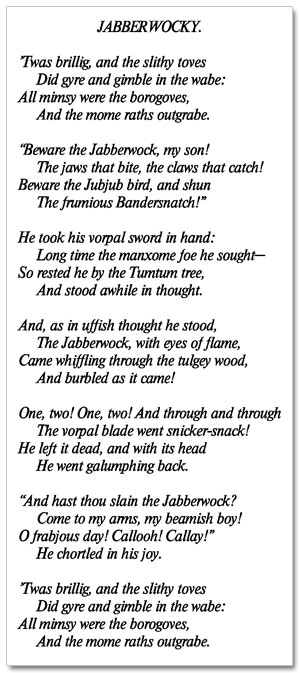
Happily too, it's not static and fossilized but evolving, and one should be forgiven, like Lewis Carroll in the Jabberwocky, for hastening its enrichment with pleasing inventions of one's own. I enjoy introducing new words, shamelessly contrived and shrewdly presented into the culture of the coffee bar below my little residence in Auckland's Karangahape Road – although suspicious, the owner enjoys our little game and even recirculates our newly coined audacities among his clients himself, winking conspiratorially each time we sneak an invention into the conversation.
My friend and fellow collaborator Shardul is also dedicated to refurbishing and restocking our language and I do believe the literary heritage of our nation has in some small way been enhanced by our joint efforts. It's fun also to misspell, ignore conventions and ride roughshod over the protocols of our language quite frequently as well, just to stop things getting too stuffy. I feel a small illustrative poem is called for here...
Enhancing Our Literary Heritage
 On occasuns that are numerus
– it's really rather humerous –
We get quite lost in sillines
And literary dilliness
And ponder on apostrofies
And quibble on apostasies
Of grammar and syntacticals
And colons, get fanatical.
The object's to communikate
Not nitpick, mutter, obfuscate
And if I choose to spel 'you' yu
And 'cat' as kat or 'queue' as cue
Or something else that may seem mocking
Or ignorant and deeply shocking
Then let's not live life fecklesslie
Let's live a little recklessly
And step outside the stifling box
Of 'can' and 'can't', I say a pox
On those who always bend their knee
To grammar, long live Heresie
And I say (tho' it may seem treasun)
Let's have some fun, abandun reasun
Run rampint thru decorum's 'ought'
And 'should' and 'must', let's not be corght
By stodgie rools and regulations
Hurrah for de-sanc-tif-if-ication
And if this seems ikonoclastic
Or verging on the plain bombastik
Then dot your 'i's and cross your 't's
And go your way and others pleeze
But me I luv mixed metafors
And always feel the better for
My gaucheries and malaprops
Ineptitudes and missed full stops
I'll choose another road.
And when I'm far too old for scrabble
Inventing great new words like 'zabble'
I'll still get joy mispelling names
And you can tut-tut, point and blame.
The fire that warms arthritik knees
Kindled by the dictionairy
Thesauruses will feed the flames
While I rejoice in Pictionairy.
– Jogyata.
In Praise of White Trousers
What a strange race we are!
 For millions of years our ancestors contentedly roamed the planet clad only in Mother Nature's minimalist finery – in the colder climes, a caribou fur or fox pelt overcoat, in the tropics a fetching plant fibre loin cloth or cotton wrap around – simple, yes, but more than adequate. In those socially carefree days, out hunting you wore the fox skin furs; bed time pyjamas, it's the fox skin furs; someone's getting married, it's the fox furs again – practical, warm, de rigueur for all hunter-gatherers and nomads and unanimously accepted. In our post-neanderthal civilisation, what to wear is a major preoccupation, at least for those living in the more affluent West.
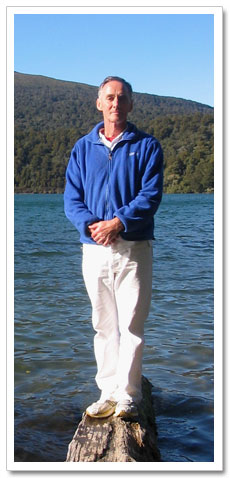
For Sri Chinmoy's male students one of the great things about our path though is the reduction of our contemporary overabundance down to one magnificent multipurpose garment - our set of whites! My favourite whites hang poised in my cupboard like a knight's armour, waiting to be donned for some new adventure. In this one resplendent outfit, I can honestly and sincerely claim to have:
- Met and shook hands with the former President of Sri Lanka
- Swum the turgid cauldron of the Wanganui River in flood
- Attended meditation functions on four continents
- Washed mountains of malodorous dishes at our vegetarian cafe in Auckland
- Skydived in them
- Visited the United Nations and hobnobbed with great men
- Lifted lambs into pens during
I flung them in my locker.
A week went by, I couldn't sleep
I even phoned my mother
"My boy" she said "just trust your whites,
They're sturdy like no other."I listened to her sage advice
My doubts I had to squash
I took them to the laundromat
Committed to 'The Wash'.I watched the minutes ticking by
My heart was all aflutter
First wash, then rinse, then spin, Oh God.
My knees had turned to butter.I wrung my hands, I looked on high
"Oh Lord, I may erred!"
The wash attendant hung her head
For clearly she concurred.At last the fateful moment came
I lifted up the lid
Oh yippee yippee yippee yay!
I chortled like a kid.My whites were spotless, gleaming white
As pure as winter snow
"Oh Lord!" I cried, "a miracle!"
My face was all aglow.So brothers dear, revere your whites
My words you mustn't mock
And should you yearn for extra grace
Just wear them round the clock.And when 'tis time to leave this world
And no one can arouse ya
Ensure your mortal frame is clad
In-yes-your laundered trousa.Yes, when the soul has fled the cage
Winged upward to the light
Make sure you're scrubbed up, buffed and clean
Angelic all in white.And when the good Lord finds the time
To have a tête-à-tête
Be sure you're free of curry stains
For God's sake don't forget!– Jogyata.

Minor Accomplishments
Looking back over our lives, it's remarkable how many silly inconsequentials linger in our memory.
I recall that at school I distinguished myself by having the highest non-attendence rate for three consecutive years, forging my mothers handwriting in a series of imaginative medical excuses for the sympathetic school principal, who came to think of me as a sickly child. At University I recall having the highest unpaid library fine for overdue books ever accrued in the entire history of the university; and later in life, working in the country, I have fond memories of mastering the art of rolling a cigarette while riding a galloping horse. Try it! It's not easy!
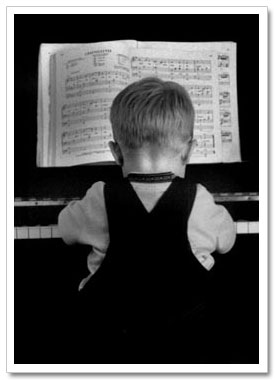
I clearly remember, too, the occasion when, as a reluctant fourteen-year-old I was struggling to master the piano under the tutelage of an unpleasant and disapproving teacher. One afternoon, during a lesson, a large earthquake rocked the town and sent my teacher cowering under a kitchen table. I played on, more terrified of her than concerned about the earthquake, while crockery smashed and furniture crashed all around us. A new relationship of grudging admiration was borne in that moment. This small triumph deserves a poem...
Mrs. Jewel and the Earthquake
 When I was just a little lad
my Poppa said to me,
"It's time to make your old man proud,
a pianist you shall be."
He sent me off to music school
with tutor Mrs. Jewel.
The name was inappropriate,
in fact she was plain crewel.
Just one wrong note, she'd shout my name
and strike me with a cane.
My little digits went all blue
and caused a lot of pain.
I mastered preludes, rattled off
arpeggios and scales,
while Mrs. Jewel lashed and yelled,
"In my school no-one fails!"
But one day kind fate intervened;
we had a largish 'quake.
The house began to rock and pitch,
the earth began to shake.
A flight of ducks fell off the wall,
a fishbowl - it was shattered.
A pot plant crashed, a painting flew,
my tutor's nerves were battered.
She sprang up from the piano stool,
she lurched towards the door.
She staggered vainly round the room
then tumbled to the floor.
"O Lord !" she cried, "my hour has come."
She gave an awful wail.
Her eyes took on a ghastly hue,
her features went all pale.
And though all round, destruction reigned,
the scene I did ignore,
including Mrs Jewel, pale
and cowering on the floor.
For I, more terrified of she
than of this odd dilemma,
I played straight through the episode,
ignored the seismic tremor.
I dashed off triplets, semibreves,
it was my finest hour,
while Mrs Jewel upon the floor
could only wail and cower.
Each note was true, my fingers flew
across the tinkling keys.
I played and played and couldn't stop,
my father's hopes to please.
At last the 'quake it passed us by,
my tutor left the floor.
A new respect was in her eyes,
she staggered through the door.
"You'll never make the stage, my boy
Your father may be shattered,
but a brave young man you'll one day make."
I really felt quite flattered.
"While musically you mightn't be
the maestro we had thought,
the qualities you've just displayed
they can't be sold or bought."
With that she clasped me in her arms,
you wouldn't have believed.
She swept me from the piano stool,
a giant hug bequeathed.
And from that day the Big Quake came
to stop her reign of terror,
she made the simple heartfelt plea:
"From now on call me Sarah."
My old Dad quietly took the news
I wouldn't be a star.
He said, "I've still got faith in you,
I think you'll go quite far."
"I think a lawyer you could be,
this time you mustn't fail.
Let's see if you can make it there..."
but that's another tale.
My Favourite Heroines
This article was originally written for Inspiration-Letters – a theme that was to have been entitled 'Women Who Have Changed Our World'. But that all changed and so my article has found its way here...
It's a pleasure for me to offer a few appreciative thoughts on the many women who have changed our world. It gives me, too, an opportunity to write about my maths teacher, Mr. Pennington, an amateur historian who filled my teenage school years with harrowing tales of ruthless, scheming women who maneuvered, murdered, swindled or charmed their way to power. Although avoiding becoming a misogynist – I had three great sisters and a wonderful mother – I did develop a fascination with scurrilous, successful people, specialising in Mr. Pennington’s own area of expertise which was ancient China.
Academically, Mr. Pennington valued loyalty and perseverance over mere intelligence and so surrounded himself with an admiring society of under-achieving boys like myself who in later life would march to the beat of a very, very different drum – merely by attending all of his classes we were given a generous pass mark even though they left us mathematically dysfunctional for life. But I know a few things about evil, world changing Chinese women that, if disclosed, would give you many a sleepless night.
One of my favourites was the Empress Wu Lei, a 10th century character of considerable ambition and zero scruples, and Mr. Pennington really brought her to life in our Tuesday afternoon trigonometry sessions – a hateful subject even he despised. You could hear a pin drop at these times, so absorbed were we in his riveting tales of Oriental intrigue, mayhem and venality. The blackboard carried a mind-numbing smokescreen of incomprehensible maths equations and Mr. Pennington, secure in our loyalty and the blackboard’s illusion of bona fide study, pressed on.
Wu Lei was an enterprising creature of ‘unsurpassed loveliness’ but in equal parts guileful, murderous and cruel. She successfully dispatched seven husbands and concealed their deaths by ‘suicide’, poisoning, a beheading, one trampled beneath the galloping hooves of horses, one by unspeakable torture and two by relatively pleasant drownings – with elaborate subterfuge and persuasive charm. Here Mr. P. provided graphic details. The eighth suitor, perhaps in lucid moments contemplating the fate of his predecessors, must surely have felt at least a twinge of apprehension as the nuptial day arrived and his bride of ‘unsurpassed loveliness’ led him away. Or been possessed himself of unsurpassed stupidity. A wisp of poetry gleaned from Trigonometry 1 still echoes, words that Wu Lei’s last husband might himself have written:
I have travelled down this road
Felt desire’s siren cry
But want no more
The sorrow-sweet of love.
I have seen the beauty in your eyes
Imagined too the promises and lies
But want no more of bitter joys and sighs.
I’ve turned away from love.
Indeed, I should think so! The Empress’s further years of intrigue and unbridled cupidity even saw her dispatch her own son – "Her own son!" Mr P. reiterated, and in the mesmerized silence that followed we would reflect on this monstrous violation of motherhood , suddenly grateful that our own mothers had shown no such dark inclinations. Years later the unseen hand of karma intervened and Wu Lei mysteriously fell off the battlements of the city wall one dark night and was found only the following day, very dead and now clearly surpassed in loveliness by others. And here Mr. P. smiled, clearly pleased by life’s rough justice, and chuckled, rubbed his hands together in satisfaction. “Just desserts I’d say, my boys, just desserts.” To which we would all nod in silent assent.
Spellbound by this grand denouement, we felt ourselves almost there, hearing the shriek from high up on the battlements and seeing the scheming dowager-empress falling, falling, trailing a comet’s tail of pale silk as she tumbled to her death like a rag doll, almond-eyed and surpassingly lovely on that long ago Oriental night. And had we been able to see it, perhaps the seven souls of successive murdered husbands and a small army of others deposed, hovering and now avenged, there to escort her to some Oriental underworld of Retribution. The Emperor, relieved and reprieved, had good reason never to remarry.
Mr. P.’s mathematics classes with their riveting accounts of larger than life heroes and heroines were the only real sunlight in the wasteland years of secondary school and Mr. P. himself, a co-conspirator in our secret war against academia and ‘the system’ was a quiet ally. The school principal too was generally liked but this mild mannered scholar was clearly unsuited for the trench warfare of a seedy third rate boy’s school and eventually retreated, battle scarred and weary, to the principalship of a gentler country school. His replacement was definitely a world changer – and yes, a woman – and under Mrs. Matthews tough regime (or “Herr General” as we called her) rebellion flourished.
Small cells of resistance formed and we would often endure days of interrogation after someone redesigned the paintwork on her car, conducted unsupervised and dangerous chemistry experiments with obvious pyroclastic ambitions, hoisted aloft a rough skull and crossbones pennant to replace the proud flying New Zealand flag or deflated a teacher’s tires. Our underground artists sketched unflattering portraits of a tyrannical, jodpurs and jack-booted despot armed with AK47 and whips in our school toilet cubicles.
My apostasy was evident only in trifles – an unrivalled absentee record, flicking ink from my pen onto my French teacher’s white shirt back as he chalked up French declensions on the blackboard, or releasing ‘stink bombs’, foul smelling crushed black seeds from a neighbourhood tree that made the classroom virtually uninhabitable. I nearly lost my coveted role in our secret society of dissidents when one day, facing caning for some infraction, I doffed my school cap to the male teacher’s passing wife. This craven but inspired act of self-preservation won me a reprieve but caused even my best chum to hiss at me “fawning sycophant” and after consulting a dictionary to learn what sycophant meant I felt wounded for days.
In order to redeem myself I was obliged to carve the initials of the school bully in foot high letters onto my wooden desk top with a penknife, no mean feat, and we all giggled hysterically outside in the corridor while the protesting boy, presumed guilty, got ‘six of the best’ across his derriere from Herr General’s beefy deputy. This triumph won me much kudos and I was swiftly reinstated – my earlier act of ‘fawning sycophancy’ was now firmly behind me.
Once, in a thrilling daylight raid into Principal Matthew’s own private office, a large live garden worm was placed in her lunchbox sandwich – the stuff of legends and expulsions! Our sentinels were strategically placed to report on her response, a single great heart stopping bellow, the thud of a heavy object driven against a wall, then a menacing silence. Days of interrogation followed, assembly hall denunciations, and from Mrs. Matthew’s office the occasional sounds of a rolled newspaper colliding with a suspect’s cranium. But our clannish troupe maintained an impenetrable silence.
Principal Matthew’s swift punishments and her thirst for vengeance included the use of a wide ranging vocabulary rich in colourful and inventive phrases, canings (usually carried out by the large silent deputy while you dutifully bent over, though wads of paper concealed beneath one’s trousers nullified this threat) or belting the reprobate’s head with the rolled up newspaper. Ear twisting was also quite popular, and sustained until a long drawn out ‘AAAAAH!’ signified penitence.
Collaborative parent-teacher ‘think tanks’ failed to quell the insurgency. The repressive Mrs. Matthews inspired us to organize our rabble of headstrong school boys into a coherent body of revolutionaries – and many of us, our skills honed during these five years of insubordination and counterstrike, went on to work as environmental campaigners, political activists, lobbyists and explorers.
Believing that resistance and debate and the occasional healthy insurrection or two are character forming and preferable to timidity and mindless acquiescence, Mr. P. permitted a small smile as our misadventures unfolded. At heart he was one of us and we recognised in him a senior member of our society, the ‘nous autres’, those who would never belong to or want that utopian promised land of financial success, family, comfort, the quotidian that schooling and society so ardently and mindlessly promoted. Stranded on the reefs of professional responsibility and joyless adulthood he was obliged to conceal his acerbic intelligence behind thick rimmed glasses, a rumpled suit and a mild manner – yet he was complicit in our pranks, wistful that he could no longer adventure with us.
‘Mr. Pennington’ in the presence of other teachers, ‘Bill’ among ourselves – a huge liberty we felt entirely comfortable with – and ‘Mr. P.’ in the classroom or during those intimate, oratorical moods, he accepted these informalities as the tribute they were, our recognition of a comrade. And because we liked him his occasional reproving tut-tut or finger wagging carried the authority of ‘six of the best’.
Come to think of it though, there’s been a whole galaxy of women world-changers and our history books are jammed with their deeds and misdeeds – all those suffragettes, psychopaths, paleontologists and pugilists, survivors of famous shipwrecks, heads of state, con artists, stars of stage and screen, great beauties, priestesses, poets, witches, aviators, media moguls, even an admiral or two of great fleets; and voodoo queens, Olympians, female vampires, saints and sports personalities, jailbirds, astronauts and literary giants, monarchs, tyrants and deceivers, heroines of near and distant battlefields.
It’s useful also to remind ourselves of the impact that every life, every man and woman, has in the infinitely complex causal chain of history. We think of Cleopatra, Helen of Troy, Joan of Arc, Pocahontas, Florence Nightingale for example, but what of those who nurtured them, brought them into this world? Or their mothers, and theirs also? Who should get the credit? It’s messy and complex like the ripples of countless tiny pebbles tossed into a huge pond, each insignificant event, action, heartbeat, life extending irreversibly and forever out into future time and compounding the giant matrix of change and possibility, shaping a world of infinite potentiality. The great achievers are simply the waves tossed up from the boundless ocean of Time and Life which created them and apart from which they have no existence.
Extraordinary, too, that the forces sweeping through our hearts and minds – waves of consciousness; pure imaginings; the intangibles of thought and feeling; the abstract polarities of love, hate, desire, aversion, compassion, cruelty – are only spectres that have no existence save in the dreaming mind.
Turned loose from the confines and dark vaults of the human brain they incarnate in the world around us and are there unleashed as the wars between countries, the tyrannies of despots, the dreams of conquerors; or our nobilities now manifest as the compassion of peacemakers or the philanthropy of the clement, their ships filled not with soldiers but Good Samaritans, impelled now by inner winds of charity.
Yes, we are each a microcosm of the world and its author. The universe sleeps and dreams inside us, stirs into being through us. Tat twam asi – I am this, I am that (you too!) – the sadness of the bereft, the innocence of the child, the malice of the vengeful, the devoutness of the bhakta, the bitterness of the damned, the renunciate’s calm poise, the loneliness of those estranged from God, the multifariousness of all experience. We are all world shapers.
So I’m grateful to the autocratic, iron reign of Mrs Matthews for it bred in us a little character, a willingness to dispute, and comradeship at arms – all healthy life skills. And grateful to Wu Lei, a girl with tons of personality who could still ignite our maths class ten centuries after her demise – even though she was a little unreliable in her affections. Charming, unscrupulous Chinese women and boys with garden worms can topple governments, change our world.
– Jogyata.
Sumangali Morhall's Poems

Love
LoveNature
SavernakeGardenia
The Fifth Season
Petal Pilgrim
Silver
Birds
His Art
Mouse
Salutations
To GodTo Friends
To Silence
To Light
To Happiness
To Strength
To Beauty
To Poise
To Sleep
To the City
To England
Annwyl Gymru - Dear Wales
To Auspiciousness: 1
To Auspiciousness: 2
Rhyming Plays
Krishna's Supreme LoveMusic and Religion
Satyavama's Perfect Husband
The Pilgrimage to Santiago
People and Places
Lucky ThingsDeparting Queens
Allotments
The Piper
Llantwit Major
The Guide Dog and Her Man
Hotchpotch
The Small and Big I AmThe Sun's Parade
Is This The Day?
My Golden World Restored
Lost and Found
Of Phoenix Tails and Marigold Trees
My Mainly Transient Guests
He Does Not Shun Me
How Are You?
An Ordinary Day
Release
Our Merry Terpsichore
Miniatures
The Short RunAnger's Anodyne
The Riddle of Time
Café
All
- ‹ previous
- 96 of 125
- next ›

Except where explicitly stated otherwise, the contents of this site are licensed under a Creative Commons Attribution-NonCommercial-NoDerivs 3.0 Unported License. read more »
SriChinmoyCentre.org is a Vasudeva Server project.