
Ashrita's Blog and the Celebrity Duck
I am enjoying reading Ashrita's Blog
Ashrita finds time to break numerous world records, and seems to have a lot of fun in the process.
This post will make you smile:
The Ways Of Love
Writing about the tattoos adorning a long dead girl or the life of a cranky uncle may invite the charge of being 'unspiritual' – but spirituality permeates every part of God's lovely world just like the all-pervasive invisibility of air and the elusive intangibility of consciousness, the living stuff of all being. And love – one of the most powerful forces in our universe – although hidden away in the troubled lives of my characters, I saw it there, a tiny furtive thing promising one day to bloom. And it delights me to recall its brief flowering.
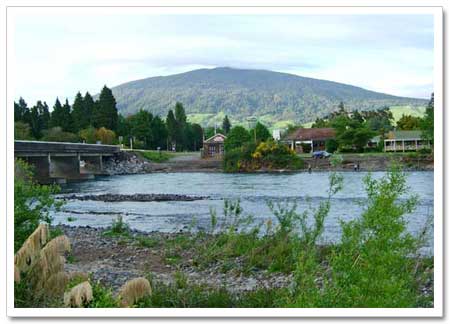 Uncle Dan stopped for gas in Turangi in the winter of 1974, a ten-minute coffee'n pie pick-me-up en route to another intended life, but instead got to talking to a local, sat yarning around a cheap formica cafe table while light snow drifted, heard of a good job, housing included, decided to stay and see. The settlement was surrounded by volcanoes, Pihunga, Kuharua, Kakaramea, all clad higher up in the olive green of virgin forest – tangled, logged over slash, broken logs, regenerating vines and scrub blanketed the lower slopes, then a clear line of demarcation, a sudden wall of tall dark trees where the chainsaws had fallen silent, the remnant canopy reminding of what had once been a glorious abundance. To the east the long mystic spine of the Kaimanawa mountains, alpine ridge tops with their steep scree slides blazing gold when the sun shone.
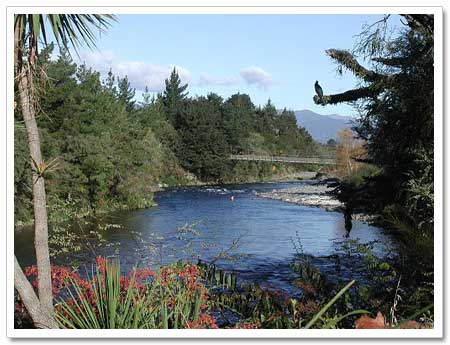
That day mist hung in a flat long plimsoll line over the world, everything over 1,000 metres lost in a cloying white soup. In a drizzle of slow falling snowflakes Dan drove to the accommodation first, seeing the place where he would spend the next thirty years, die in too, the empty yellow house sitting on one metre piles close to the Tongariro river, a dog kennel and chain out back, dog long gone. A pool of fire blackened stones, fish bones where someone had cooked a trout. Dan liked what he felt here, decided to stay, take the job whatever. Turangi was an electricity town, boomed during the ten years that it took the hydro schemes and spillways to grow, re-jigging landscapes, diverting mountain catchments into twenty miles of concrete flows that ran across a volcanic plateau, bored straight through a mountain range then plunged down into turbines, a man lost for every mile of drilling.
The workers left, the town withered, those remaining too poor to leave – a handful of tourism operators, loggers, trout fishermen, misfits with reason to lay low, Park officials, ski field workers, Maori families that loved the land. He quickly came to love the place too, an affinity too deep for words, the clear green river that sang all night, flowing in long runs down rapids of grey smooth stones or quiet in deep calm pools, soothing, cradling his sleep, touching his heart deeper than words ever could. In April on a still cold night, first snows, you could hear the wild red stags bellow up on Kuharua, a sound that thrilled him, the great beasts high up in the alpine mists and black forest growling and roaring through the night – the primal spirit of wild places and the pathos of a vanishing world.
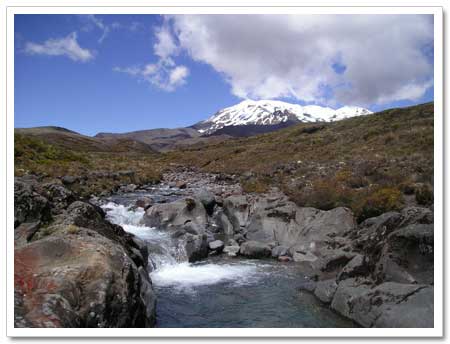 Dan befriended a few of the locals, characters in whom he recognised a part of himself, refugees from the urban grind with it's idiot ambitions. Sometimes with his neighbour they'd go up into the mountains before daybreak, sneak across old man Campbell's farm, a shortcut, heart thumping in his chest from exertion, excitement – up through the great podocarps and undercanopy of ferns and dense vines towards the sounds spilling out in the darkness, the stags' guttural moans and rage, the white tines slashing at foliage, shredding an old totara stump, the ancient ritual of procreation. Once the farmer saw them climbing his fences before daybreak, let loose with a double barrel shotgun. Later Dan read about his slow death pinned under a tractor, serve the old geezer right, he thought, remembering buckshot scorching over their heads on that illicit foray, curses ringing in their ears as they fled into the National Park's black wall of trees.
A rich lode of colourful expletives ran through Dan's vocabulary like veins of quartz across an exposed rock face, his opinions shot through with the zig-zag lightning white of his profane, unbridled tongue. But could be a sweet and sentimental old goat at times, as in his unwavering dotage on grandchildren, especially the obese and waspish Dolly whose hormonal disarray caused explosive mood swings that he found endearing, touched his heart. The house shuddered when Dolly visited, floorboards thundering under her elephantine weight, sherry glasses trembling and clinking in the wall cabinet where the grandfather's Waterford crystal blazed. Even the caged, irrepressible yellow songbirds fell silent, as though sensing an impending quake.
Dolly wore a succession of bewildered t-shirts, her favourite emblazoned with 'does anybody know the plot?'. Beneath, an iconic bemused face with interrogative hands upraised. But no one dared suggest an answer. Her own bewilderment at life's inscrutable ways encouraged her to take refuge in a comatose twilight of television and protracted sleep, almost hibernation, waiting for the long winter of her discontent to pass. Which it did not, though her occasional visits to the grandfather helped, and the sherry poured by the grandfather's own trembling hands from the ceremonial Waterford decanter softened her, a sweet marinade that loosened the knot of her heart into an almost tiny smile. Between these two palliatives a distant hope glimmered.
In her mid-teens tattoos began to flower, at first a secret and discreet butterfly concealed on one shoulder then a barbed wire scroll around an ankle. The grandfather loved dark secrets and chuckled, winked his complicity. As rebellion increased, so too the dark pigmented images multiplied, blossomed and sprang on her flesh – a lurid crouching jaguar, a wrap-around Polynesian motif on one entire thigh, the faces of defiant mentors – Che Guevara, Bob Dylan, Jimi Hendrix – on arms and shoulders. Then finally, an all-out declaration of war, a scaly green and red dragon uncoiling up her back, fanged and bloody jaws breathing her own apostate fire, one taloned claw coiled around her pale throat.
 Her mother visibly shuddered when Dolly flaunted her defiance, once even peeling off a garment at the beach – tiny in-laws, gleeful and shrieking, rushed over to inspect the maquillage of tattooed insects and symbols. The reptilian artwork glared, hateful thigh dark blue with war paint and pigment, an embossed Che Guevara on her arm conniving in the daughter's own revolution. Now in the mother a far-off and sleeping dragon of her own anger stirred – she imagined her writhing offspring manacled to a bed, herself scrubbing off the tapestry of snarls and fangs and tangled wire with an excoriating acid while the daughter howled and wept, an expulsion of demons. Though finally chose silence, sensing hopelessness.
Dolly acquired a car, painted it one afternoon in all the colours of her rage and freedom, reckless daubs of the garish and grotesque, scumbles of red, green, black, yellow, the vehicle transformed into a demented spotted bug that proved an ironic and irresistible magnet to every passing police car. Then drove off one day never to be seen by the mother again.
The grandfather fumbled along, though missed his brooding kin – years slip by, made coherent as his own life plot only by the rivers calm refrain, water become time, time itself as water, each month a bead on the turquoise thread, the balm of flowing green a leitmotif that brought order and continuity to the cyclic blur of seasons, snows, his own emotions, randomness, pointlessness, lovelessness, and not a word from the evanescent Dolly who alone had won his crotchety love. He recalled her huge form, the painted claw on her neck as she swivelled in farewell, the diminutive ruined car with it’s defiant daubs of paint beetling away down a gravel road out of his life forever.
Until one Autumn afternoon, an eternity later, a phone call from a faraway place, fat lady dead, Dolly Carlyle, are you next of kin? What, what, what, oh Jesus he said stupidly. A moment of frozen disbelief, this can’t be happening, then a pain in his heart like a hot needle, something hidden carefully away by masks, habit, cantankerousness, resolve, dissolving into hot tears, floodgates of his walled-up secret heart breaking open. How did you ever find me, he thought to ask, a stupid question out of the wet mask. The tattoos, the voice said, the heart on her right arm, her name on top, yours below, Uncle Dan and phone number etched into the flesh. You must have been really special to her.
Dan took Dolly's odds and ends stacked in boxes in his house and burnt them by the edge of the river, a private ceremony of valediction, final parting of ways. The ashes flew away in the wind, the charred lumps of her things to be borne away by the next high water. The fire-blackened stones would remain and remind for years, but the river won’t mind, thought Dan, for no one loves the river more than I do.
– Jogyata.

The Nature of the Supreme
Spiritual progress is always tested in the proving ground of everyday life and our maturing is always examined there.
To be peaceful during a deep meditation is one thing, but how peaceful will you be when someone is rude to you? To be filled with loving kindness on a friend’s birthday is fine, but can you still see the divinity in someone who has just stolen your car?
One of the truly illumining things we can observe in the company of spiritual masters is how they respond to the everyday challenges and problems of life. The passing hours in their company are our schoolroom and each situation with the teacher illustrates an important lesson – how to be happy, or detached, or what is the right conduct or response in a certain situation.
In my own years with Sri Chinmoy, many of the most significant and enduring lessons have been taught in this way. Just as we learn how to be a great tennis player or dancer or writer by observing the best of these in action, so too we learn what enlightenment means by spending time studying the actions and reactions of those who are enlightened. Examples of this with my teacher are countless.
I remember, in one very random example, in a six-day race in New York how one of the competitors endlessly complained about everyone and everything, finding fault everywhere. A foot blister had worsened and become infected and as he found his number two race position slipping back to number five, then sixth, his mood worsened and he demanded stronger and stronger painkillers, then prescription medicines to mask the pain and keep going in the race. At a certain point, when the race officials feared serious injury could result and refused his request for further pain suppressants our competitor became extremely bitter and complaining.
Sri Chinmoy was consulted and simply said, "The nature of the scorpion is to sting, the nature of the Supreme is to be compassionate." It was a simple thing to say but it put everything into a perspective that carried the calming and soothing feeling that deep truth always brings. Our competitor was caught by the force of his own nature but God’s nature is to be compassionate – and our challenge as spiritual seekers is to respond in this same way. Compassion does not mean excessive leniency or indulgence or weakness – instead it endows us with a sympathetic identification and kindness, and empowers us also with detachment and an understanding of the right thing to do. Compassion lifts us up above ‘right’ and ‘wrong’, ‘good’ and ‘bad’ to the awareness that everything is just God’s game, and He is enjoying His own unfolding in every human being.
So you play your part, and others play theirs, and everything will work out just fine.
– Jogyata.
All Credit to God
Spiritual Masters who have truly realised God are very rare souls and most human beings will almost certainly never encounter one.
 And if they did, how many would recognise in this encounter a being genuinely immersed in God. For the lives of God-realised souls are characterised by humility and simplicity, not the overt trappings of pomp, power and status that characterise most other forms of human celebrity. There is an illustrative story of an ascetic in search of the Buddha – he travelled far and wide, at last coming to stay for a night in a house where the Buddha was also staying. “Have you seen the Buddha?” he asked, but unaware of what the Buddha would look like, he continued next day on his way, still searching. In the same way you could pass an enlightened master in the street, but without some training of your own, you would in all probability be unaware of who had just passed you by.
In late 1989 Sri Chinmoy was in New Zealand for a few days and one afternoon following a pipe organ performance at the Auckland Town Hall, at his request we took him to a local gym. In a bright yellow dhoti after his concert he was an unusual figure, a small unassuming Indian man in his early sixties with two or three attendants. Well known for his feats of strength and his advocacy of meditation as a key to transcendence in all areas of accomplishment, in no time he had a small group of weightlifters and bodybuilders around him, keen to ask questions and determine for themselves the authenticity of stories about his achievements.
Sri Chinmoy was asked about his lifts and the size of weights involved and he replied with simple candor. As though to dispel any doubts about these claims, he then went to two or three sets of apparatus while his audience closely watched and lifted first a 900 pound stack on the standing calf-raise - even lifting one foot off the platform at the height of the lift - then a very heavy overhead one-arm press. His audience were clearly surprised and impressed and several tried to emulate these feats. His credibility now established to everyone’s satisfaction, Sri Chinmoy then began an impromptu informative talk about the relationship between strength and power, body and spirit, and ended by saying “I can do nothing, I am nothing without the grace of God, my Beloved Supreme.”
It was thrilling and moving to see this simple situation being used to bring a new understanding to the people there. With an absolute confidence and an absolute humility he disowned anything of personal accomplishment and credited his achievement entirely to God, inspiring each person there to understand their own unlimited potential when finite matter is harnessed to the infinite possibilities of spirit.
In their lives, spiritual masters teach others in every little thing they say and do, spreading the light of God and the message of the infinite into the everyday and finite stuff of human life.
– Jogyata.
The Sky is a Storybook

photo by Sharani
I drowsily slid into the driver's seat of my car for the morning commute to work. Would my thoughts ricochet back to yesterday's day off of work project or just settle into the long commute as a waking up coffee equivalent?
I knew a book on tape of Tolkien's short stories could entertain me during the next half hour but declined the notion. As I said, my brain was already brimming with stimuli from the prior day. Rather than listening to a new tale, the memory of the fairies from "Smith of Wooten Major" could beguile me once again if need be.
Driving due east, the morning sun was still low in the winter sky - itself also only just risen although seemingly less drowsy than me with its bright glare. Sunglasses donned, my attention soon folded into the horizon before me. The clouds in the sky directly ahead formed such a riveting combination of shapes and styles that I felt as if I was driving into the page of a storybook. The book lay open in invitation framed by the trees on each side of the road.
I think there ought to be a special dictionary for clouds because their variety is stunning and scientific labels like cumulous or cirrus hardly paint the picture in words. The closest I could get to the multi-faceted clouds up ahead was to say it was like a comet trail punctuated by sheep jumping over a fence. Add in several other flourishes of white "paint" in the sky and I decided this was definitely God's abstract art hanging in the sky gallery.
Of course as I drove the horizon ahead changed and the cloud formations shifted slightly. The storybook hue persisted however and I pinched myself to be sure I was driving to work instead of into a fairy tale world.
When I spilled out of the car in the parking lot at work, I marvelled at how I had read a story after all during my commute. The sky was a storybook and the clouds were the starring cast. At my feet on the pavement lay a tiny pinecone beckoning like a jewel dropped from Nature's bountiful storehouse of beauty. I picked it up and looked around to find what tree it played hooky from. Tucked in my pocket, I offered a silent thank you for such an enchanting morning all before my workday had even begun.
Now at work, I exclaim aha! The large tall Spruce tree directly outside my office window is full of tiny pinecones. Question answered. And cloud story remembered until the next time God paints and reads aloud on the canvas of the sky.
A Swimming Pool Meditation
To be living on this earth when a great master lives, breathes, moves amongst us – what an incalculable blessing. We read about the highest of these, the Avatars, but usually their physical absence numbers long centuries, even longer millennia, though their legacy is eternal.
 What did they look like? How would we have felt in their company, how did they live, what really happened in the life of Christ, the Buddha, Sri Krishna, the other God-souls who walked this earth so long ago? We don't know. Yet even in our modern world the envoys of God, the realised masters, are still here among us, though few and far between and hard to find. Everyday I try to feel gratitude for my own discovery of a true spiritual master, a living teacher to help me in my personal spiritual quest. How is it that such an insignificant person was granted such a peerless and generous gift?
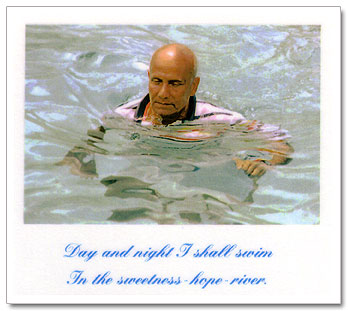
In 1984 – the date is written on the back of a rare photo I have from this time – I was in New York for Sri Chinmoy's 52nd birthday. One very hot and humid afternoon someone told me that our guru was going to bathe in a pool in the back garden of a nearby home – would I like to come? Yes, I would. We arrived as Sri Chinmoy was lowering himself into a small circular pool about four metres across, dressed in shorts and a collared summer shirt, his feet bare. He moved to the centre of the water, only his neck and head visible and then began to meditate. About fifteen of his disciples stood silently around the circular perimeter – we were about to be given a wonderful meditation experience.
All the sounds of the local streets began to fade, the buzz of cicadas fell silent, cars, people, life's unfolding all receding away. We were standing in a circle of utmost silence as though an invisible curtain had fallen, shielding us from all distraction. Nature itself seemed to be conspiring in this stillness, attentive to some inner reality. A force had come down into this urban garden and we were rooted to the earth, senses suspended – with enormous deliberation and intensity Sri Chinmoy was slowly turning in the pool, fixing on each of us a powerful concentration as though penetrating to some essence of our nature. Eyes barely open, only his head above the water, rotating ever so slowly, he was summoning from a higher, unknown world a spiritual energy so strong that we were transfixed, breathless.
Ten long minutes passed, many exquisite and slow rotations, the searchlight of our Guru's ministrations resting momentarily on each of us. Sometimes his eyes were looking up into some other world then down again at the disciples in the still garden, bringing to our physical plane the bounty of a loftier beyond.
Then without any word or gesture Sri Chinmoy moved to the edge of the pool, climbed slowly out and left. I remember this experience well because the intensity of such rare moments teaches us things that never fade – a glimpse into a matrix of consciousness that unifies and sustains all existence, an experience both to aspire to in our own meditation and against which other inner experiences could be measured. These, too, go to the very heart of the Guru-disciple relationship where the bridge between earth and heaven, matter and spirit is crossed – and our very understanding of what it means to be human is forever changed.
– Jogyata.
A Divine Phone Call
The concern of a spiritual Master for their disciples demonstrates an unwavering love and an undying solicitude that itself can be cause for great wonder. I recall Sri Chinmoy demonstrating this some years ago, on one of our Christmas trips to Asia, when in the early hours of the morning he began calling up his disciples in the hotel and singing their names over the telephone – a spontaneous and lovely blessing for the soul.
It was a lovely, gratuitous minute or two, to be woken from sleep – not the sleep only of body and senses but the unawakened state of the soul's long centuries in samsara – and to feel oneself summoned from both states of unmindfulness by the voice of the master was the sweetest thing. Given the quite large number of disciples, there was no certainty that Guru would call you, yet hope ran high nonetheless.
(Guru is a Sanskrit word meaning 'the one who illumines' – although my own Guru, Sri Chinmoy, always tells us that the One who illumines and the only real Guru is God, we refer to Sri Chinmoy as 'Guru'. Among the many wonderful teachers I have met, he is the one who has accepted responsibility for my illumining and I am certainly the one who needs illumining – posthaste!)
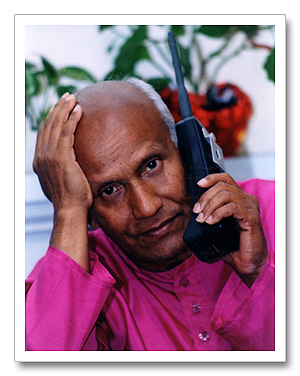 But one night I learnt that, working alphabetically through the name list of those on our trip, Sri Chinmoy had reached the J's – glancing at the same list I saw that I was one of very few 'J' candidates and concluded that my chances of a late night call were very high indeed.
My sources told me that Guru had not always been very pleased at some of the responses he had so far received – unaware that it was the Master himself who was calling, some unfortunates had probably been grumpy at the early morning call and had not exactly been in their most receptive frame of mind. On the 'J' night I prepared myself with a longer than normal evening meditation, inwardly rehearsed what I would say if the phone rang and, finally satisfied that I was in my very best consciousness drifted off into a hopeful, even expectant sleep. I was ready!
At 1:30 am the phone rang – I shot bolt upright in bed, paused briefly to summon my best consciousness, then picked up the phone on the third ring. "Good morning!" I intoned in my most divine voice, "this is Jogyata speaking."
Alas, it was a call from New Zealand! Slightly annoyed by this worldly intrusion I eventually replaced the phone and again went back to sleep. At 3:00am the phone rang again and expecting a follow-up call from New Zealand I took the phone from the side table and was about to mildly rebuke my inconsiderate caller when I paused, just in case, and switched over to a more polite "Good morning this is Jogyata speaking", adding inanely, "how may I help you?"
It was Sri Chinmoy in person! He sang my name to me, a lovely ascending meditative chant and I sat there on the bed, eyes closed, absorbing something quite indescribable, this freely given benediction, marvelling at my sublime good fortune. It was a wonderful and joyful experience, one of those golden moments when the soul is bathed in light – inside me a tiny doorway had been opened and I could feel my soul's delight, a remembering of Self and my eternal existence rekindled by this awakening grace. Then a last quiet incantation, a click and Guru was gone.
I was sure I would easily remember the clear notes and simple melody in the morning and sang the song a few times over to capture it – but in the morning when I again awoke the exact melody was gone.
Two weeks later, now in the 'S's, Sri Chinmoy called my wife Subarata – wisely she afterwards sang the song of her name into a tape recorder while the melody was clear in her mind and even today we can sing her song with fidelity to detail. But the song of Jogyata has now been lost in the mists of time.
- ‹ previous
- 110 of 125
- next ›

Except where explicitly stated otherwise, the contents of this site are licensed under a Creative Commons Attribution-NonCommercial-NoDerivs 3.0 Unported License. read more »
SriChinmoyCentre.org is a Vasudeva Server project.