
New Year Odyssey
Last day of 2006...
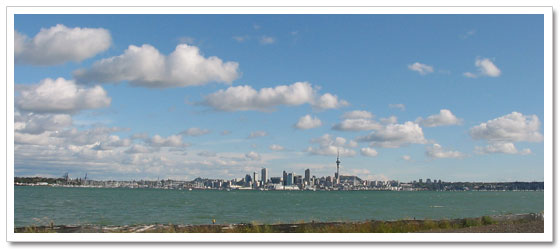
Nine boys from our Auckland Sri Chinmoy Centre are spending a few days away over New Year, an unhurried ramble by car, looping 700 miles around the northern part of New Zealand. No maps, no plans, the winds of impulse and whimsy filling our sails. I love landscapes, opt to sit in a back seat exempt from chatter, watch instead the ever new beauty of life unravelling all around. We head north early, over the arched spine of the Harbour Bridge and out through multiplying suburbs, industrial estates, a green field dotted with white cricketers, someone running up to bowl.
Then slowly for a time through motorway construction, yellow clay scraped bare, black irrigation piping coiled like sleeping anacondas, a tired all night crew flagging us down. Out at last into country, a hawk scrambling up from a roadside mat of fur and bone, calm fields of contoured grasses, yellow bleached under the harsh burning of summer. Squat grey pylons march away across farmlands, raptor shapes, skeletal hanging arms dragging cables across valleys, on down to the coast, the shoreline's musket blaze of scarlet blossoming pohutukawa, coruscations of light through fast-tracking trees, glimpses of shimmering grey-blue sea, the pencil lines of pale islands at furthermost rim of earth. Gumbooted fishermen, redolent of cod and gasoline, fix roadside signs – oysters, scallops, fresh fish, crays, this mornings catch.
 North we go, a caravanserai at the waning of the old year, travelling a sweet-flowing road that curves like a ribbon through soft hills on into another year of promises and hopes and surprises. Contours of hills free flowing too, the smooth nape of earth, overlapping ridgelines folding into step-back silhouettes against pale sky. Skylines merging, blending like folded arms.
Now at a junction we turn down a dusty gravel road towards the sea, stones pinging off the metal underbellies of the cars. A wide tidal flat, beyond calm sea; swimming and playing for an age in the clear waters. Two hundred metres from shore thousands of black seabirds slash and scavenge, dense-packed over a sea boiling with harried silver fish, shoals herded by the lightning blur of kingfish – in depths of sunlit jade the dark lurking of dolphins. The sea churns in a frenzy of living and dying, the unabating raids of gape-jawed predators tearing through the panicked, huddled shoals.
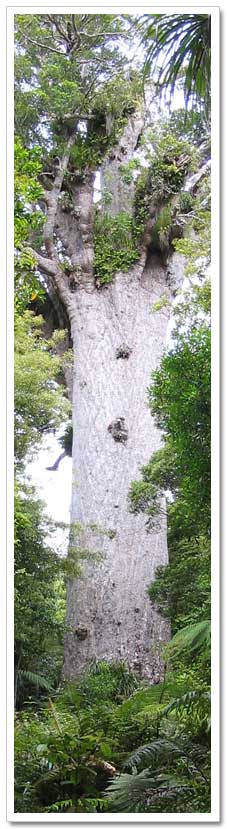
At Dargaville, two hours north, a lunch break in a café then on to Waipoua Forest, home of the largest kauri remnants, a range of folded mountains where kiwis still thrive. Here a glimpse into a beautiful past. The great tree monarchs seem more of stone than sap and wood, the dark scales of bark with their smooth hammer-like indentations the armour of some prehistoric thing. Two thousand years old. Bashful snaps of tree-hugging, Tarzan poses, swinging from vines trailing down from the wide spreading crowns where nests of hanging ferns bunch and thrive.
A cellphone rings, a voice asks where are you? Danny lost out there on a country road in a big wide valley dotted with Lilliputian cottages and hay barns, crouched over a map spread across the hot car bonnet. Coursing like hares down country lanes till we find him. There he is, lounging beneath the shade of an acorn bough, all around poplars and the grandeur of old kapok trees, drizzle of white fluff like snow banks lining the roads. In an empty nearby paddock an old homestead with rusted roof, open doorways and gaping windows like empty eye sockets, poignant shell of a dead generation, imagining autumn winds howling through. And as always never far away, the jumbled skyline of forested mountains with their variegated greens and deep shadowed valleys while above the wind brushed skeins of summer cirrus.
Evening is creeping in. We drive up another gravel road to our lodgings for the night, Okarito Lodge, bunk beds and a communal kitchen on the side of a mountain, either this or camping in a lumpy paddock somewhere down the line. Andy our bearded host stands on a hillock looking at his vege garden and I ask him about the local hills. Mistake. He's off and half an hour later he's still hard-talking, of Maori legends, opossum populations, pig hunts, the family genealogy, tractors, his early years truck-driving in Queensland, his most memorable fishing expeditions, daughter doing well at Uni, organic gardening, neighbours good and bad, his private arsenal of firearms – an old snipers .303, some illicit stuff that draws a conspiratorial wink, several shotguns in varying gauges, a short barrelled scattergun for night prowlers. Yeah, he says, you wouldn't believe about that...
Anecdotes too about each of the derelict car wrecks up in the back paddock, wheels gone, hoods up, dissolving into rust and long grass and rain – I can tell you a story about them, he warns, does that, on and on. I'd like to say, they're an awful eyesore Andy, get them to a wrecker but Andy won't pay heed to an upstart city slicker. Then reminiscing about a long-ago cattle muster still seared into memory like a branding iron, herding a half-wild mob out of the steep bluff country and dark forest and the new shepherd's dogs pushing too hard, fifty head of cattle over a cliff in the dark.
My local knowledge is now encyclopedic – a book maybe? Andy barely notices when I thank him and walk away, he still tugging at sentences, eyes self-absorbed and immersed in the long unfurling of his life.
 A late awful dinner of baked beans and hard potatoes, lashings of redemptive pasta almost cooked. That night, mind still reeling from Andy's expletives and blowtorch life, I dream of riding at the rear of 400 bush cattle, straggling down late under blazing stars, a fern-lined ridge track, dark banks of glow worms, mud a foot deep, trail jammed with steaming, bawling cows but stop before reliving their awful plunge.
Then to wake around 3am, seized by hunger. Pitch black night. Stumbling around, careful not to wake the other's heavy breathing, bemused by the unfamiliar bunkhouse, hands sliding across the walls, searching for things that might give a clue to lights, doors, windows. Morepork are calling from the invisible folds of hills, rain is thrumming on the sheets of fibrolite roofing, curtains of grey sliding over the dark land. First dawn of the New Year. Across the tops of plum trees, cloud blanketed valleys far away materialize out of night, the slow contours of dark hills against a paling grey sky.
We sit in plastic chairs on the wooden verandah decking to meditate. Sri Chinmoy's photo in my much-travelled portable shrine is there before me on the balustrade, a reminder of what for me is ultimately and only real and true, and then, too, of what is not real and not true in the endless verisimilitude of life. Then to sing one song while incoming dawn extinguishes stars, light flowing above the orchards, magpies caroling over in the paddocks and pines. The first day of the New Year, but I make no promises – though hopes still linger. Especially the one that I never forget why I am really here, another that I never break the golden cord that ties me to my teacher. And, though less importantly, the hope to sometimes enjoy (at least a little) playing leading man in the awkward drama-dream of my own life – yes, to be happy!
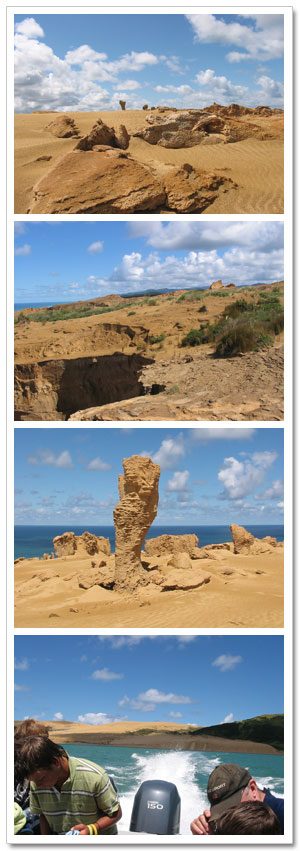
Breakfast – another attempt at last night's failed potatoes – a forest run then a cold-water shower. The electricity has gone out during the night when a reveler drove into a power pole. Mid-morning we cross the Hokianga harbour by boat, the receding crest of our wake a white road across a beryl green sea, waves slap-banging on the aluminium hull. Across the wide harbour sun-flooded golden dunes shine wave after wave, banking up 800 ft to a high smooth skyline – far above, cloud wisps hang like condors riding thermals, hovering high up in the blue. Ashore, steep golden sand hills plunge into the sea and we slide down them endlessly on curled boards, the velocity carrying us 30 metres out into the clear tide. Screams of other children skimming out into the harbour's lazy calm.
I trudge up to the far skyline, a half hour slog, up to a place of beauty and isolation and vistas, feet bare in the warm yellow sand. From a high outpost you look north along 70 miles of shoreline, the deep blue ocean a vast tablecloth rumpled with white borders where slow rollers break. Past here, the winds have scoured the plateau back to bony outcrops, ironpans, strange shapes of sculpted harsh sandstone. Here too, raw and deep ravines, cavernous wounds gouged out of the headlands by something inexplicable, sink holes where you would never be found nor find your way out of if caught, blocks of misshapen sandstone, deformed and malign. An eerie place of troubled landscape, den of spirits.
From far up on the skyline I see our Maori boatman returning, a faraway silver dot inching across an emerald meadow, a meteorites white tail across the falling green tide. At last the bow crunching onto the sand. Good natured and with a raft of local jokes, our pilot looks unwell; the last hours of the old year saw much unbridled revelry and the first hours of the new year are exacting their toll.
Patvakan's car is having problems and in the village of Opononi, we switch from four to three vehicles, abandoning the old Honda in a gravel yard. The kind local dairy owner points to the back of her section for safe keeping – tomorrow we'll be back through.
And here we split up, myself with two friends one-way, the others turning at a road fork to the north. Four hours down the eastern side of the island we go, through small rural villages where Maori families grow corn and potatoes, trap eels in the creeks, then coastal holiday towns filled with shoppers, jandaled strollers, nut-brown, neat rows of boats in marinas. At last home, glad to be back in my own place.
Wandering the nooks and crannies and beautiful places of earth is fun, though only offers a brief reprieve from the serious stuff of attaining that other and more fulfilling freedom at the end of all striving. The Greek poet Cavafy reminds us of this: "No ship exists to take you from yourself." And this from Sri Chinmoy's vast anthology of writings and gold nuggets on freedom:
Earth -freedom:
Disastrous madness.
Heaven-freedom:
Harmonious oneness.
God-freedom:
Prosperous surrender.
But it's nice now and then to break out and roam to a far horizon...
– Jogyata.

Arizona Style New Year's 2007

The winter holidays found me in the Arizona desert this year savoring a chili pepper chipolte flavor for Christmas and New Year's. Holiday yard decorations were a hit with the hummingbirds offering this adult a step back into the spirit of wonder more commonly associated with children and the holidays.
My mother had put a large Agave stalk in a pot in the front yard of their house and wrapped red and gold ribbon around the stalk and hung shiny red and gold ball ornaments on the branches. There were some blossoms on the branch as well and it sat right outside the view from the windows by their kitchen table.

To my total delight, hummingbirds were quite entranced with the shiny bright red colours on the Agave and kept coming all day long to drink from the blossoms. I guess hummingbirds like the colour red and this holiday yard decoration turned into a hummingbird feeder. I could hardly drag myself away what with trying to catch good photos of the hummingbird and other birds in the yard.
We went to a recreation of the American West - a street that was supposed to be like the times of the cowboys in the American West in the 1880's. It was called "Rawhide" and as I looked at the covered wagons and such I wondered if the U.S. is one of the only places with this flavor of history. Maybe also some places in South America and Australia/New Zealand? I mention the latter as I remember reading Shardul's (a student of Sri Chinmoy living in New Zealand) tales of herding cattle in the Australian Outback.

I actually have relatives who left behind written accounts of their own travels by covered wagon as they migrated across the country back at that time. This pioneer spirit is something I "brand" as a very formative aspect of what the American character comprises.
But the New Year is a time to look forward and I'm here writing about America's past. When I think of the poems and essays by Sri Chinmoy that I have read, one theme which appears again and again is the power of newness and fresh beginnings. I'm glad it is a new year and hope to learn soon Sri Chinmoy's New Year's Message for 2007. Since every day even begins anew, I close with a quote from the book My Morning Begins by Sri Chinmoy:
My morning begins And I closely listen To the singing heartbeat Of my life. -Sri Chinmoy
The Call of Turkey
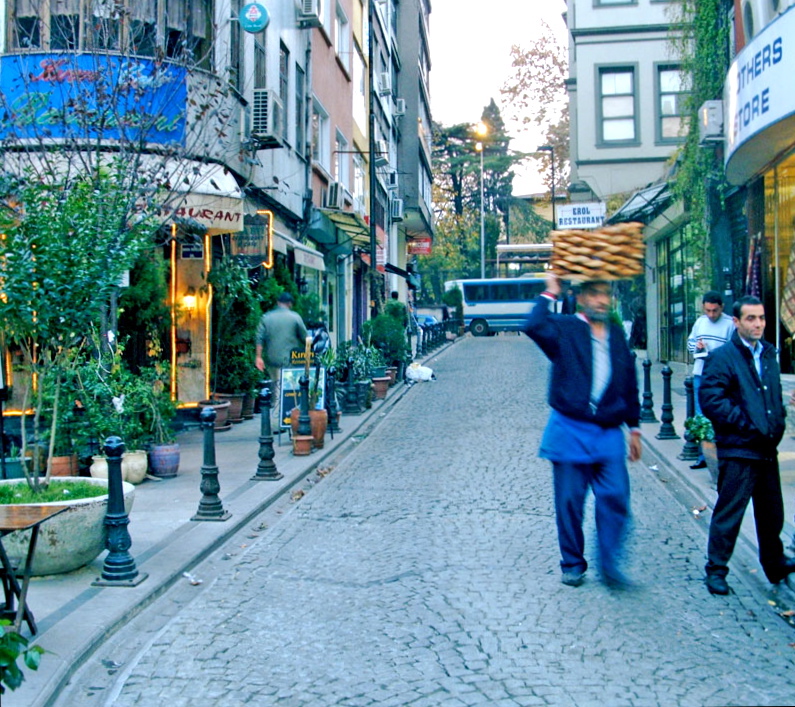
photo by Sharani
We sat down on a bench in the middle of a pedestrian street of shops. Rather exhausted from our whirlwind day of sightseeing in Istanbul, we fought the sleepy lure of the fast approaching dusk. We hadn’t even found the Grand Bazaar yet and knew that the journey back to our hotel on the Asian side was still a ferry ride away
Once the ferry boat deposited us across the Bosphorus, a function in our hotel meeting room punctuated by plays and other performances awaited. We were several hundred together on a chartered group tour that would eventually touch foot in several countries – a journey mostly spiritual in nature comprising Indian spiritual teacher Sri Chinmoy and his students gathered from many corners of the globe.
As we sat catching a second wind, the call to Salaah (Muslim prayer) began to echo through the street amplified by the loudspeaker on the street pole directly nearby. Since my travelling companion was the one with a microphone feature on the video portion of her digital camera, I urged her to hit the video record button to capture a memory of the muezzin’s melodic call.
We first thought of this manner of capturing audio outside a Buddhist temple in Kamakura, Japan. We had just visited the Ofuna temple to the Goddess Kannon and ventured up the steps of an adjoining building to find the source of the chanting and drums that we could hear from outside. After the chanting monks motioned for us to sit in the back during their service, I felt as if my soul was soaring on the wings of the chants the monks sang accompanied by the drone of the drum. Before we departed, we sat outside the temple on a bench, like we were doing now here in Istanbul. As the sound of the chanting continued to the outdoors through the open window above us, she hit the record button on the camera – but for sound not pictures.
Just as the muezzin calls the faithful to bow in prayer, Turkey itself calls the world to receive its rich heritage and culture. In my first visit to this country, I experienced:
- The call of the coast
- The call of cuisine
- The call of civilization
- The call of church/temple/mosque
- The call of the crossroads/carpet
In Turkey for 19 days, I spent 2 ½ days in Istanbul and the remainder on the coast of the Mediterranean in Belek and Antalya.
First Port of Call: The Call of the Coast
Upon arrival by airplane to the European section of Istanbul, we embarked instantly on the predominant mode of Istanbul transportation. Divided by the Bosphorus Strait, Istanbul straddles both Europe and Asia. We had heard that it would take a taxi an hour long ride to reach our hotel on the Asian side by driving through the reputedly congested streets of the city and over the bridge. Thus, we went straight to a ferry stop near the airport and travelled by boat with our luggage and disembarked about a mile from our hotel. In the course of a few short days, we rode ferries several times.
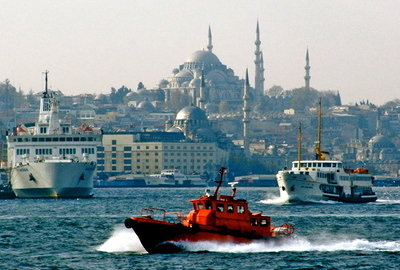
photo by Sharani
Invariably, every boat we saw load up and unload was teeming with passengers. Boats were everywhere in the waters as well. I live on the ocean and have visited numerous other destinations with sea ports. Never in my life did I see as many boats and ships as along the coast of Istanbul. In his book Crescent & Star : Turkey Between Two Worlds former New York Times journalist Stephen Kinzer states,
"Ferries cross it and shuttle among its villages a thousand times a day. They and the hundreds of skiffs from which fishermen ply their trade are reminders that a great city depends on this artery for its daily life. It is also the world’s busiest commercial waterway. About one hundred fifty vessels … pass through it each day."
This volume of water traffic adds up to 45,000 ships a year. Photos I took from the ferry as it approached the European side of Istanbul with the imposing skyline of the Blue Mosque and Hagia Sophia include numerous boats of all shapes and sizes.
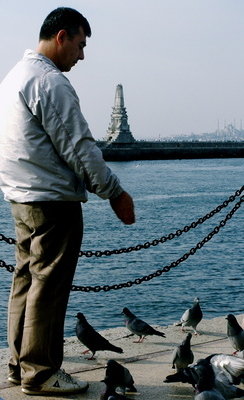
photo by Sharani
A ferry ride in Istanbul included its share of pigeons along the dock being fed bread by a man waiting to travel. Seagulls followed the boat and one time I even saw a dolphin fin crest the wave while looking out the window. Every trip featured the opportunity to buy tea in a small glass cup and some kind of bread that I didn’t recognize as being familiar.
Second Port of Call: The Call of the Cuisine
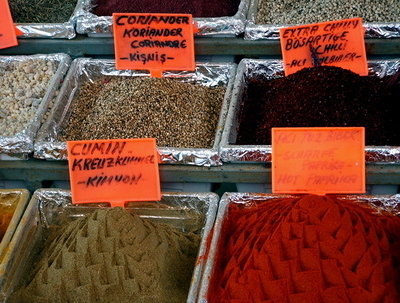
While I cannot accurately describe the bread for sale on the ferry for you, I did sample a cornucopia of culinary delights while in Turkey. I must admit I was startled to eat some of the best food I have ever tasted while I was in Turkey. The fare seemed to be a blending of the Mediterranean diet with a dash of Middle Eastern and Greek cooking. The buffet at our hotel in Belek was extraordinary. Every morning for breakfast one could break off a chunk of fresh honey from the large honeycomb. Or you could spread some rose petal jam on an infinite variety of breads and pastries – both sweet and savory.
For lunch and dinner you could choose from wonderful soft white cheeses, feta, olives, yogurt and marinated vegetable salads (lots of eggplant, tomato and red and yellow peppers). I usually ate figs and apricots every day. The citrus fruit was picked from trees right on the hotel property and one day the hotel staff motioned to my roommate that she could take one of the lemons just picked and in a carton under the tree. She found that it was the most fragrant lemon she had ever smelled. My version of Turkish cuisine is vegetarian (no meat or fish) and I can only imagine that a country situated on four seas – the Mediterranean, the Sea of Marmara, the Black Sea and the Aegean must also have extraordinarily fresh seafood as well.
Spices Photo by Sharani
It was only after coming home and pondering that this food matched my experience of French cuisine or bested it that I tried to find out more about the call of Turkish cuisine. It is in fact considered one of the world’s great cuisines – standing head to head with Chinese and French. It appears that two factors influenced its development into a world class status. On the one hand is geography itself. The Anatolia region of Turkey has been referred to as one of the world’s breadbaskets. The climates represented in different sections of the country are ideal for growing wheat, citrus, olives and other crops. Turkey is one of the few countries in the world that grows enough food to feed its own people with extra left for export to other nations. Situated for world trade with the East, the West and Africa, Turkey was also a key part of the Silk Road trade route, including the Spice Road, controlled by the Sultan during the Ottoman Empire.
Topkapi Palace Photo by Sharani
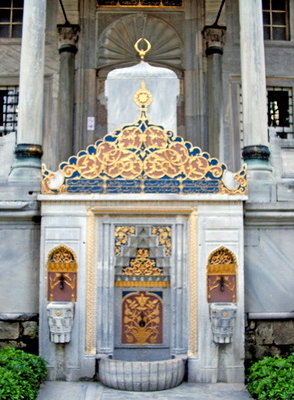
The other factor in the greatness of Turkish cuisine is this culture of the Islamic Ottoman Empire. The importance of culinary excellence can be witnessed in the history of cuisine in the Topkapi Palace in Istanbul – residence of the Sultan, the royal family, the harem and thousands upon thousands of residents. Clifford A. Wright, award-winning cookbook author and culinary historian, describes
"It was prescribed in Islam that one of a ruler’s charitable duties was to feed his people. Because of this responsibility elaborate organizations were set up to fulfill the requirements of feeding people. Large kitchens were built in the palaces and public feasts became important. A public feast was a privilege and a duty of the ruler. In Ottoman society the kitchen had a central importance because it was a social institution. The kitchen, on one hand, was central to the ruling classes who had to feed their huge retinues, numbering thousands of people. On the other hand, the kitchen symbolized the bonds of people with the ruler."
By the 1500’s, the Topkapi Palace had ten kitchens and over a thousand cooks. The cuisine that developed was exquisite in its scope and guests at a public feast at the palace would be regaled with a 300 course meal. An afternoon I spent touring the Topkapi Palace resounded in splendor on all levels. We included it in our sightseeing because the guidebooks recommend it but we ended up staying far longer than we imagined because of its magnificence.
Echoes of this grand legacy continue today and the breaking of bread and the supremacy of the kitchen still reigns supreme. Participants in the Turkish portion of the World Harmony Run (a 70+ nation hand-to-hand relay of a flaming torch for harmony originated by Sri Chinmoy) shared that the generosity of Turkish hospitality – especially the food – was unmatched by any other country they visited in Europe.
Third Port of Call: The Call of Civilization
My perspective is that of an American hailing from a nation yet in veritable infancy compared to the grand sweep of history found wherever you cast your glance in Turkey. Eventful markers on Turkey’s historical timeline are measured in thousands of years rather than the American yardstick of hundreds. Touring ancient Roman and Greek ruins such as Perge, Side and Aspendos found me pinching myself for reassurance that I hadn’t gone backwards through a time machine.
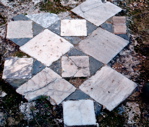
Perge Photo by Sharani
In Perge, located on the Mediterranean coast, relatively intact ruins showed the Roman baths with sections for cold, warm and hot water. In several places, patterned mosaic tile adorned the rocks in a design that could have been mistaken for a current-day tiled home interior. The remains of the road through the center of town had ruts in the rock showing the path of the chariots along the street. One carved rock “sign” in the agora had the symbols which would have denoted a butcher. Other rocks had Greek letters or carved reliefs.
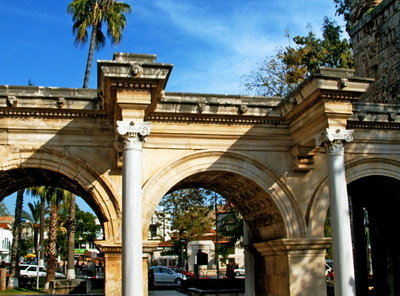
Hadrian's Gate Photo by Sharani
In the center of town in Antalya surrounded by modern buildings and palm trees, you can visit Hadrian’s Gate. This three arched gate was added to the walls that encircled the city when Emperor Hadrian came to visit in 130 A.D. Old and new commingle with a McDonalds restaurant built adjacent to one part of the city wall just a short walk past Hadrian’s Gate.
Fully prepared for the heady gust of history when I visited destinations such as Paris, China and Japan; the magnitude of cultural and historical heritage to be found in Turkey swept me off my feet with surprise. My schoolbook memories of the world’s great ancient civilizations have admittedly faded but I remember that they certainly didn’t focus on Turkey in our world history lessons. Once returned home, I learned that Greek, Roman, Byzantine and Ottoman Empire currents of world history converge impressively in this country on the cusp of two continents.
It was home to two of the seven ancient wonders of the world – the Temple of Artemis in Ephesus and the King Mausolous' Tomb in Halicarnassus (present-day Bodrum). Turkey vies with Egypt and the Fertile Crescent with evidence pointing to it as a cradle of ancient civilization.
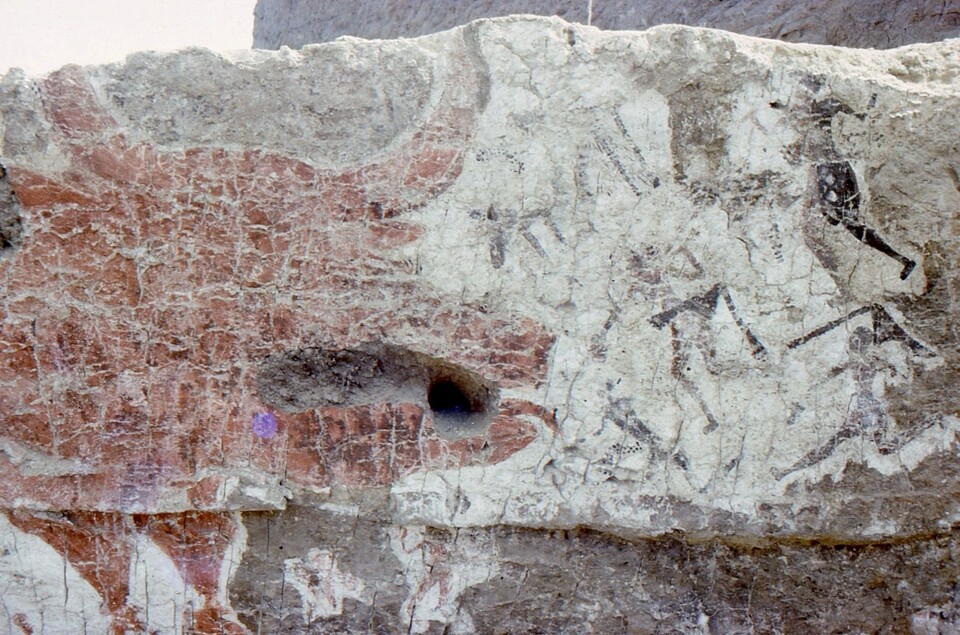
In Central Turkey, a Neolithic settlement was discovered in the 1960’s. It dates from 6,200 B.C. and is said to be the oldest example in the world of a landscape painting on the walls of a Catalhoyuk house. The site is also the largest and most complex of its kind ever found by archaeologists.
Excavation on the western coast of Turkey identifies Canakkale as the ancient city of Troy where the Trojan War took place. Marc Antony and Cleopatra lived in in Tarsus, Turkey in the 1st century BC. Julius Caesar uttered his famous words, “Veni, Vidi, Vici” in 47 B.C. while in Anatolia. Alexander the Great and Greek rule was followed by the Byzantine Roman Empire and Constantinople (present-day Instanbul) was the capital of the Eastern Roman Empire which lasted for a thousand years. Nomadic peoples from Central Asia began to gain control of parts of Anatolia and the first Christian Crusade was an attempt to stop them from capturing Constantinople. Then a wave of successive invasions and battles eventually led to the Ottoman Empire by 1413 under the Sultan Mehmed. Constantinople, renamed Istanbul, became the capital of the Ottoman empire in 1453. This vast Islamic Empire lasted for 600 years. When about to be completely dismantled after World War I, it became the nation of its present size under the leadership of Ataturk.
Since I have always been fascinated by history, if I didn’t restrain myself I could go on and on. Such is the nature of Turkey’s historical legacy. And I haven’t even begun to extol the extraordinary achievements of the Islamic Ottoman Empire. In case others are not equally captivated by the history of various civilizations centered in Turkey, I will try to restrain my urge to turn this impression of Turkey into one big history lecture. Suffice it to say that Turkey offered endless possibilities to taste first-hand the remnants of these ancient worlds known mostly to the rest of the world only by reading of it in books.
Fourth Port of Call: The Call of Church/Temple/Mosque
Along with an impressive history of ancient civilizations, Turkey is also home to a diverse spiritual and religious history. I’m once again awe-struck when considering some of the ancient temples among the ruins scattered throughout Turkey. Sacred Destination Travel Guide describes ruins in Aphrodisias that progressed through various spiritual identites.
“The site of Aphrodisias has been sacred since as early as 5,800 BC, when Neolithic farmers came here to worship the Mother Goddess of fertility and crops. In Greek times, the site was dedicated to Aphrodite, the goddess of love and fertility. The site was named Aphrodisias during the 2nd century BC and the great Temple of Aphrodite was built in the 1st century AD. The cult of Aphrodite at Aphrodisias was distinctive, reflecting the goddess' ancient origins and commonalities with other Anatolian deities (such as Artemis of Ephesus) while also bringing in familiar Greco-Roman motifs that made her universal.”
Or you can imagine what the Oracle might have decreed through a high priestess at the Temple of Apollo in Didyma? This temple gained importance during the reign of Alexander the Great. Udertaking to build the largest temple in the Greek world, Didyma’s Apollo Temple would probably have become one of the seven wonders instead of the Temple of Artemis if it had been completed. Today only three of the original 122 Ionic columns remain standing. Brace yourself when I add that each column is 6 feet in diameter and 60 feet (6 stories) high. Second only to the Oracle at Delphi, the Temple of Apollo involved ceremonies in which special rites by the priestess preceded the telling of the future by the Oracle.
Turkey also played a pivotal role in the early beginnings of Christianity. Some believe that Mount Ararat in Anatolia is where Noah’s Ark landed. St. Paul was born in Tarsus, Turkey and most of his missionary work and writings were done in Anatolia. St. Peter came to Antioch (present-day Antakya) after Christ’s death and began preaching secretly in a cave. This church inside a cave is called St. Peter’s Grotto and is a modern-day place of pilgrimage for Christians. On a mountain near Ephesus, one finds the House of the Virgin, recognized as a shrine by the Vatican.
St. John brought her here to escape Roman persecution and it is believed this is where her last years were spent. St. John also died in Ephesus at a later date and his grave is also a religious shrine. St. Nicholas (the precursor to the Christian traditions centered around Santa Claus) was also born in Turkey.
With the exceptional modern distinction of being a Muslim country (98% of Turkish citizens are Muslim) that is secular and not governed by fundamentalist Islam, Turkey is also a country of rich Islamic heritage. Especially noteworthy is the shrine and tomb for Rumi, the Sufi mystic and poet who founded the Whirling Dervishes. Located in Konya, it is a site of pilgrimage and a holy city of Islam.
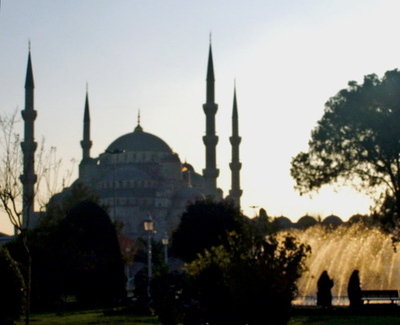
Photo by Sharani Blue Mosque
One finds the most famous mosque in Turkey in the heart of Istanbul – the Blue Mosque. Built in the early 1600’s to rival the nearby Hagia Sophia (originally a Christian church), the mosque receives its name from the tens of thousands of blue tiles with floral and abstract Iznik patterns. The Blue Mosque has six minarets and Mecca had to add one more to its mosque after this occurrence because previously no other mosque but Mecca had as many.
Also very sacred to Islam, the Topkapi Palace contains numerous sacred relics and objects associated with the prophet Muhammad, the founder of Islam.
Fifth Port of Call: The Call of the Carpet/Crossroads
The word crossroads is often used in relation to Turkey. As I read books and studied about the country once I returned home, it alternately mystified and eluded me. My perception is that the country is enigmatic and houses contradictions as easily as its history has encompassed diverse legacies that position it as neither Eastern or Western, but an amalgam of both. Even when in Istanbul, each side seemed to remind me respectively of Europe or Asian countries that I had previously visited. How could one city mirror both so distinctly – and on the respective corresponding side no less?
Turkey was a central part of the Silk Road trade route that linked China to Rome. The sweep of its various empires incorporated diverse cultural influences and Turkey’s Ministry of Foreign Affairs calls its relation to the Mediterranean “the oldest hub of global commerce and exchange.”
It is the only predominantly Muslim nation in the region (sharing borders on the northeast with countries such as Syria, Iraq and Iran) that switched from an Arabic script alphabet to a Latin one, among numerous other more European secular practices instituted by Kemal Ataturk when the modern nation of Turkey was in its infancy in the 1920’s.
It seems that it has adopted the daunting challenge to explore the potential for at least imagining a world that finds the bridge between continents, cultures, religions and heritages. While it has grappled with obstacles and weaknesses (what country hasn’t?), it calls to the world to envision a meeting place where the best that all have to offer can weave an heirloom carpet that demonstrates the sum is greater than the individual threads.
Five times a day devout Muslims heed the call to prayer. In five ways – the call of the coast, the call of cuisine, the call of civilization, the call of church/temple/mosque and the call of the crossroads – Turkey calls to the world’s heart. My first trip to Turkey called to my heart and its cultural and historical riches shimmer with magic. You do not have to retreat into fantasy to find a magic carpet ride of wonder. It resides for real in Turkey. Heed its call and follow the wonder.
References
Books: Eboch, Chris. Turkey. Farmington Hills, MI : Lucent/Gale Publications, 2003.
Kinzer, Stephen. Crescent & Star : Turkey Between Two Worlds. New York : Farrar, Straus and Giroux, 2001.
Pamuk, Orhan. Istanbul : Memories and the City. New York : Knopf, 2005.
Roden, Claudia. Arabesque : A Taste of Morocco, Turkey, and Lebanon. New York : Knopf, 2006.
Articles:
Willoughby, John. Rhapsody in Blue. Gourmet magazine Feb. 2007.
Websites Consulted:
For Cuisine:
Cookbook Author and Culinary Historian Clifford A. Wright's Site
For History, Religious Heritage, Cuisine:
All About Turkey with Tour Guide Burak Sansal
For Cuisine:
For Religious Heritage:
Sacred Destinations Travel Guide "an ecumenical online catalogue of more than 1,200 sacred sites, holy places, pilgrimage destinations, historical religious sites, places of worship, sacred art and religious architecture in 53 countries (and counting) around the world."
More Photos from my trip to Turkey in my Turkish Delight album.
The Magic of Mornings and the Joy of Running
Unleash the weapons! Slay the dragons! For the treasure that lies beyond is definitely worth it!
From the very moment the monotonous drone of the alarm clock suddenly invades the last scene of my dream and I slowly awake, here forth lies the mighty battle. A battle against my monkey-mind and my lethargy-body to rise at the break of dawn, fuel my soul with my morning meditation and embrace the rising sun with the one thing that brings joy and vigour to every part of my being – running!
I won’t deny that mornings can undoubtedly be a struggle at times and the mere suggestion of getting up any earlier than necessary can seem out of the question. But as the old saying goes, “every treasure is guarded by dragons”, in my opinion these early morning dragons are guarding the most luminous, rewarding and utterly magical treasures ever!
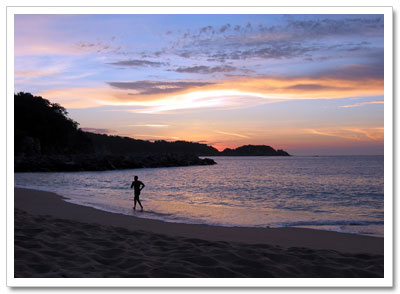
...tranquility and stillness of the world in the early morning...
It is the tranquility and stillness of the world in the early morning that creates the ideal conditions for the most peaceful and fruitful meditations. It is the beauty and energy of the rising sun that radiates new-life-enthusiasm to those who dare to open their eyes. It is the fresh, invigorating prana of the beach and bush on an early morning escape out of the city that gives me a bursting joy and an exuberant gratitude to be alive. Finally, there is something about knowing that the majority of the world is still sleeping while we are out soaking up every bit of positive energy from the world before anyone else even blinks an eyelid.
I often meet with friends, encouraging one another and sharing inspiration for early morning jogs. We head out around 6:30, bounding down the deserted streets, along the waterfront or exploring parks and hidden nooks of Auckland. When I arrive home I feel so eager for the day ahead, full of vitality and with my mind and body surging with positive, illumining energy. My favourite are the “wild west” escapes we make, out of the city. Only thirty minutes drive and we encounter miles of black sand, rugged and untouched coastline with beaches stretching as far as the eye can see. Bush trails, sand dunes and waterfalls a plenty. In the Sri Chinmoy Centre we love these soul-stirring escapades so much it has become a weekly occurrence and any bold soul is welcome to join us on our Sunday morning outings. A meditative stroll through beautiful native bush or soaring through forest trails, wading across streams and ending up at the far end of a deserted beach. With thunderous waves rolling in beside us and not another human in sight, I get the feeling that these mystically beautiful settings are known only to a very lucky few.
After being out in nature some of us are often lured towards the refreshing and uplifting idea of a swim - ocean, stream or waterfall, middle of winter or peak of summer. There is nothing better than a revitalising swim making us feel alive and tingling all over. Times spent amidst such vistas of nature are permanently woven into my consciousness, nourishing every cell. I realise gold nuggets like these are present everywhere in life. It is only a matter of opening my eyes to them and noticing the endless beauty, joy and light that is ceaselessly on offer in this world.
I love the treasures that my mornings can bring. It seems the tougher it is to get out of bed, whether it be tiredness from a late night or the patter of rain outside, the greater the unending rewards are when I conquer these trivia niggles and stand up for what I know gives me so much joy and nourishes my body, mind, heart and soul.
Back to: My Articles and Stories.
Meditation Nights at the Sri Chinmoy Centre
Our Centre meditation nights are a highlight in my week, when I always have my best meditations and my aspiration seems to multiply.
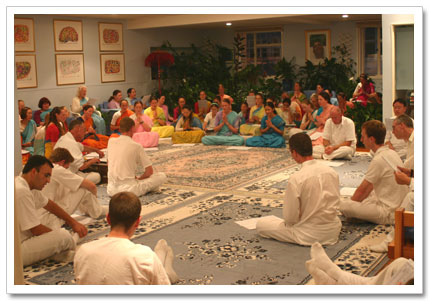
Members singing at the Sri Chinmoy Centre in Auckland...
My spiritual family – seventy other members of the Sri Chinmoy Centre in Auckland also join me in our meditation room, which is abundantly decorated with flowers, spiritual books, photos and Sri Chinmoy’s beautiful bird paintings. The incense is wafting through and the room is pin-drop silent. A few of us are reading on cushions while we wait for more to arrive. The singing starts in the next room led by melodies on the harmonium.
As meditation night approaches we all know how sacred a night like this is where the collective aspiration of many people meditating together can attract a lot of grace and can provide the ideal conditions for a great deal of spiritual progress.
Tonight I am reading some questions that people have asked Sri Chinmoy on various topics. I put my book down and head into the next room where the harmonium is being played and songs are being sung. Sri Chinmoy has written thousands of songs both in English and in Bengali. He writes them with so much feeling right from the soul that they have profound depth, embodying the infinite, the eternal, and many secrets of the way forward for spiritual seekers. It is often said that the infinite cannot be expressed in the language of the finite. That there are no words to describe what it is like to experience pure divinity. I think music, the language of the soul, must come closest to capturing it's true essence. Sometimes with the most beautiful, hauntingly soulful songs, without even understanding the literal meaning of the Bengali words, tears can well up in my eyes and I feel deeply moved.
Now with the days events gently erased from our thoughts and the resonance of music inside our hearts, we silently fill the meditation room with intensity and aspiration to go beyond our previous and unveil a little more of our true divinity. We sit in complete silence for some time until the restlessness of the body gives in to the enveloping stillness of the whole room. Soon I am so overwhelmed by how still it feels, with seventy individuals feeling like one, that I sometimes overlook my own breathing and have to remind myself to take a breath. Soaking up the stillness, my whole being seems to go into economy mode, leaving all my energy free to be directed towards meditation.
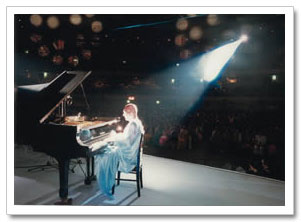
Sri Chinmoy performs on the grand piano...
Music begins to sound from the speakers. Tonight it is Sri Chinmoy’s piano music playing. My mind initially follows the composer’s movements as this mighty composition travels from the thunderous depths of the keyboard up to the delicate twinkling of the high notes, like little droplets. Evolving into a fullness-medley of sounds, this very unconventional piano playing has the listener sure that Sri Chinmoy must have more than the usual two hands at the time of his performance to possibly create such a masterpiece! The high notes, the low, the thunderous booms and the rolling scales all mix together simultaneously in a miraculously harmonious sound. It is reaching crescendo point and I feel my mind give way to it's overwhelming depth and power, helplessly left silent in the wake of the storm. Too much for my mind to grasp, this music leads me directly into my spiritual heart and into meditation. I get a feeling that only the soul can fully comprehend this language. Every note that is played I feel that it is I who is being played. My heart reverberates and my whole being is entirely claimed by this creation of sound. Down into the depths of the thunderous rumble and up with the delightful tinkling, wherever the music dances, I too, go. No longer is it a combination of notes but one delightful existence. No longer is it music but a reality of it’s own. Heavenly, powerful, captivating and enchanting are the only words that come close to describing such an experience. And just when I think it can’t get any better, emerging from the very depths of the sound… a glimpse of silence.
For some time I sit assimilating the experience I have just lived which will surely be a permanent part of me forever, in some form or another. Possible only in the conditions that our centre meditation nights offer, where collective aspiration and a lot of grace are present, I am filled with gratitude for these opportunities and regard meditation nights as the single most important thing in my life now.
Back to: My Articles and Stories.
A Great Way To Start The Day
Running… out onto the fog-laden street. My cold limbs reluctantly awake.
I pass school children waiting at the bus stop, and cross the road lying dormant before the rush of day. Another jogger with his dog run past, we exchange eye contact as we run on our separate ways. A bus full of school children laughing and playing, heaves up the road breathing a smoky sigh. A cute little girl is looking out at me. I wave. She smiles.
I run on, faster now. A feeling of gratitude spontaneously fills me, for my life, for simplicity. For this joy I get from running. I increase my pace. Rhythm and momentum have taken over. My legs on automatic pilot stretch out and fly back. Little effort is needed bar my lungs, tested by the cold. An electric current is tormenting through me. Faster I must run to release this energy. Where does it come from? I am flying now. Over the busy bridge I bound, weaving between early morning work goers. Some smile. Some deep in thought. All with their own incentives to be out this chill-bitten morning. My imagination kicks in and I find myself carving down the slopes of the Swiss Alps. It is now snow-dusted trees that I slalom my way through. Or maybe I am running along Muriwhai Beach, into the endless vastness as far as I can see. The waves rolling in beside me… until I reach the green relief of the mid-city park.
Into the park I bound. Past other runners. We smile a knowing smile. All sharing a common secret – nothing tops a good run! Down the steps into the forest. My feet instinctively avoid all danger. Lucky ‘cause there is no time for careful consideration. Rocks, tree roots and mud puddles abundantly tempt fate… not today!
Back onto the street among city life again. It is busier now as the day launches forward. I notice less. My concentration turned inwards. Dynamic energy flowing forth. Again a feeling of gratitude suddenly engulfs me. For my limbs carrying me fast and injury free. For this fantastic feeling I have. Even for the motivation to be out here on this cold morning, away from my warm bed, which nearly won the lethargy battle this morning! Thank God it didn’t! Now I feel on top of the world!
~ Today will be a great day! ~
Karangahape Road
A stroll along an urban road...
The Auckland Sri Chinmoy Centre is hosed in a long building straddling two roads, 65 long paces from the front entrance in bustling Karangahape Road to the rear entrance in a small side street, a favourite locale for film crews shooting commercials and scenes for TV soaps and dramas. Everyone calls Karangahape Road 'K' Road'. Its a melting pot of cultures – Asian, Polynesian, Indian, Caucasian – and for three nights of each week when it's nightclubs are open all night, it teeters on the roughhouse and seedy. But it's an interesting place – I walked around the other day with my spectators cap on, wrote a few notes to describe it to you...
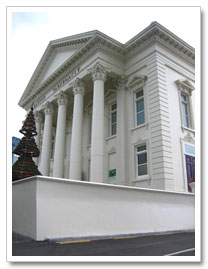 You might start at the east end of the road by the Baptist Tabernacle Church with its fluted Byzantine columns, a huge monolith towering over a sludge of irredeemably ugly office blocks. On the courtyard in front of the church a nativity scene gone astray, Joseph's son a bald shop doll swaddled in grey wrappings and lying in the arms of a very unmaternal Mary. Around them three larger than life mannequin shepherds crowd beneath an anachronistic striped umbrella, looking not wise but apprehensive, gazing not at the infant Jesus but out at the street chaos of another age. There is a pathos though that still makes it work – their innocence and vulnerability, and the sense of hopelessness that what they represent could even dent the hard indifference of this banal world. An unholy wind of grime and street flotsam tugging at turbans and robes.
Past a coffee shop, a bank, then at my local deli I buy two Christmas cards. "What do you want from Santa?" I ask the familiar face at the counter. Flowers she replies. "I'll wish for a big bunch of flowers." Her brother had lived in America and sent her flowers every Christmas, promised he would every year of his life. "When they stopped coming one year I knew he had died even though no one ever told me. I just knew."
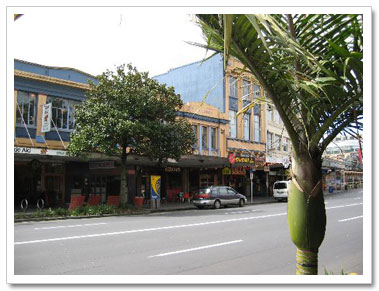
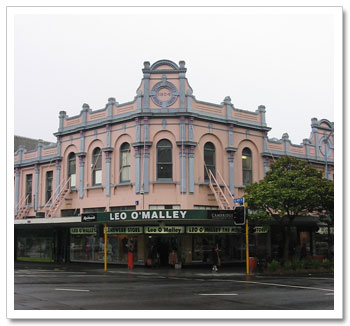 K' Road is a short road only half a mile long, but all of life is here. You pass a ragtag mix of gift shops, pre-loved clothing boutiques, sushi bars, not one but three tattoo parlours, a men's smart clothing store – a last besieged outpost of conservatism with it's rack suits and starched shirts – then coffee shops, Turkish kebab restaurants and dollar stores where you could buy a coil of rope, a hammer, a pair of plastic jandals, a picture frame and a mirror for only five dollars. You don't need any of this stuff but at these wildly low prices shopping is compulsory and you know you can find some use for this bric-à-brac later.
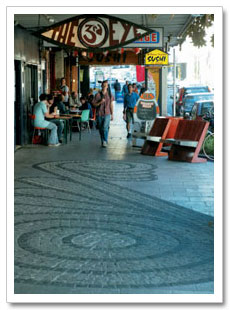
Outside the Third Eye gift store a rumpled man sits on the pavement and sells Nepalese silver, grey faced, a hard life of survival. Inside young people crowd around Buddhas and Bodhisattvas, Indian deities in jade, black teak, brass and stone; around saris, lapis lazuli jewellery and tables of bright clothing shipped from the Orient.
Strains of music – next door is the K' Road ballroom and couples moving to the excitement of the tango, the men in black, women in colourful satin, high-stepping, bright cheeked, elated by the electric passions and beauty of the dance.
Adjacent in a new bookshop you pause and browse for a while, sifting through a selection of New Zealand poets. Some very cute stuff. A stanza from Denis Glover's The Magpies captures your attention:
When Tom and Elizabeth took the farm
The bracken made their bed,
And Quardle oodle ardle wardle doodle
The magpies said.
 The staff wear floppy Santa caps, draped tinsel and goofy reindeer antlers – one has wings, more large beetle than angel. Balloons, give-aways, Santa is coming at three. I recognise a person from my meditation class trolling through a Lonely Planet Guide to Italy and I ask her, are you going to Europe? When even strangers move away our own peregrine-heart longings stir, the unlived lives twitch, then you catch yourself. You weren't so happy in those wandering days, idiot lost, taking refuge in perpetual motion, riven with dreams, existential pangs.
A man hovers near the bookshop door, hopeful of compassion, a cup of dull coins, gravel voiced – "Got any loose change bro?" Next door in the Asian food court the sounds of the tango are drowned in the babble of a hundred diners crouched over noodles, curries, Thai dishes. Caramelised brown ducks hang in rows, windows steamed up, stink of food. Outside, you nearly bump into an intellectually handicapped man, a simpleton's vacant grin and florid cheeks, leading a blind man by the arm protectively, himself so helpless in the hard maze of life. They stop to listen to a girl playing a guitar, a Bic Runga song, "Precious, precious thing, you are the thought that makes me sing", clap their pleasure, the blind man banging his cane tap, tap, tap on the paving stones for encores. She sings sweetly, eyes closed, a private inner audience – and I remember Amit this morning after meditation singing me a Hindi song. I had asked him, what does it mean? "If you chant ten million slokas you'll obtain one dhyan. If you do ten million dhyans you'll get one samadhi. But if you sing one song soulfully to God, He will be even more pleased." My guru, Sri Chinmoy, would agree. God loves the tender heart of a singer.
 At the far end of the road you sit in a café and order a drink, watch the unfolding of the morning. Peering through the clear tea glass that reflects a prismatic world, you see shadowy two-dimensional figures sliding around the side of the glass, veering away into an elliptical world of illusion. And the illusion now of everything accelerating into fast forward, the flow of humanity speeded up, la fourmiliere humaine, the human ant-hill, stick-figures scurrying in quick-time, frenetic, robotic tiny steps. A bus stops, disgorges dozens of human ants, abruptly leaves. Through this looking-glass days pass in moments, shops emptying into night, clouds in bas-relief swollen from reflected city light, yellow against bruised purple of night, fast scudding. And dawn again, suddenly it's flood of light, everything filling up with frenetic ants, clouds racing away to horizons of dawns and dusks, generations passing like seabirds across oceans. And imagining all this here without you, no 'I' left, peering into the void at shadows, the illusions of illusion itself.
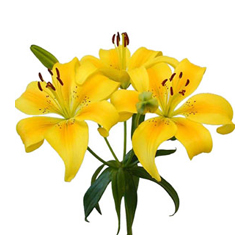 Putting aside the glass, returning now to real time, meandering again back to recomposed faces, past dancers of the tango moving to the rhythm of unheard music; past sick, beautiful, happy, unhappy; buskers and their songs and pleas; the boutiques and dollar stores; past the bakery and the importunings of the poor; the pre-loved clothing shops and coffee bars, billboards of rock bands, tattoo parlours, graffiti'd walls; and now into a K' Road arcade florist, bright multi-coloured blooms stacked high and jostling in yellow buckets. I select a big bunch of white and yellow lilies that will last as long as any flowers do and ask the florist to deliver them to my acquaintance in the deli on the first day after Christmas. She promises to – an anonymous card will simply say "Merry Christmas from a Kiwi brother".
– Jogyata.
- ‹ previous
- 113 of 125
- next ›

Except where explicitly stated otherwise, the contents of this site are licensed under a Creative Commons Attribution-NonCommercial-NoDerivs 3.0 Unported License. read more »
SriChinmoyCentre.org is a Vasudeva Server project.