
Sri Chinmoy's Book About Angels
Have you ever seen an angel or felt its presence? Do you feel that you have a guardian angel? I do believe in them but cannot say that I have in-depth awareness of their presence in my life.

When I want to ponder the role of angels in my life, there is a book about angels which greatly increases my appreciation and understanding of them. This perennial favorite title of mine by Sri Chinmoy is called Angels. I own it as an audiobook read by the author as well as a small gift book published by the Jharna-Kala Card Company. Its unique and perceptive commentary on the subject of angels remains unsurpassed in my opinion.
Passages from the Book
The touch of an angel is my
passport to my heart's freedom-joy.
My guardian angel is my most
admirable and adorable medium
of God-communication.
When my meditation is
extremely deep, I clearly see that
my guardian angel chariots my
heart from paradise to paradise.
My guardian angel repeatedly
tells me that I do not have to
remain a prisoner of my fate.
When God swiftly wants to
offer me His blessingful Hand,
he always employs an angel.
Weekend Away
You stand there, three hours from home, high up on the pass over the ranges, a gravel rest-a-while overlooking big vistas of hills and the far away blues of sea and sky. A slow wind passes almost imperceptibly through the surrounding forest, moving through the dark trunks of trees like an unseen hand trailing softly across the undercanopy of ferns, gently caressing as it passes. This is not a wind moving through a forest but the forest itself sighing. It is living, breathing, whispering and every part of it is eloquent with the softest chittering of leaves, the rustling fronds of ferns and the obsequies of tiny nodding flowers. You huddle in your thin coat, climb back into your car and amble down the switchbacks and steep turns of the mountain road towards familiar things, now into the village of Miranda, a cluster of cottages where rough and lonely farmhands shuffle cards at kitchen tables and dream of the Saturday night dance.
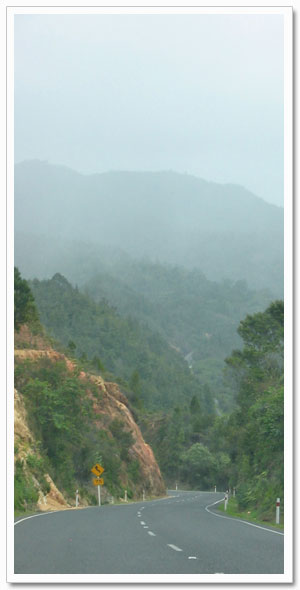 You stand there, three hours from home, high up on the pass over the ranges, a gravel rest-a-while overlooking big vistas of hills and the far away blues of sea and sky. A slow wind passes almost imperceptibly through the surrounding forest, moving through the dark trunks of trees like an unseen hand trailing softly across the undercanopy of ferns, gently caressing as it passes. This is not a wind moving through a forest but the forest itself sighing. It is living, breathing, whispering and every part of it is eloquent with the softest chittering of leaves, the rustling fronds of ferns and the obsequies of tiny nodding flowers. You huddle in your thin coat, climb back into your car and amble down the switchbacks and steep turns of the mountain road towards familiar things, now into the village of
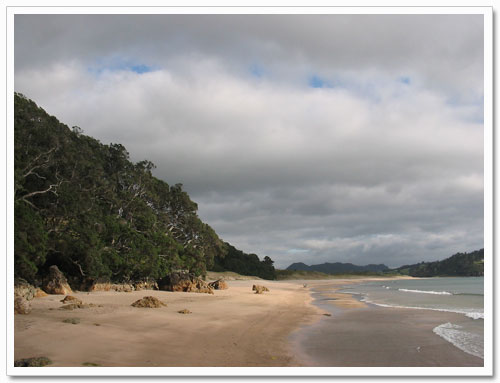
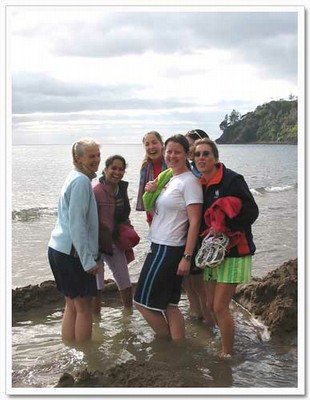
 A small group of us, members of the Auckland Sri Chinmoy Centre, were away on an adventurous sojourn, a sunny weekend in a tiny village on the east coast of the Coromandel Peninsula. Here lots of small unpopulated golden beaches, clear, cool turquoise seas, spectacular limestone arches and sea caves inviting exploration. Once you've forced yourself, grimacing and yelping, into the cold ocean – a few tourists stare in disbelief – you can swim around headlands of green sea and wade ashore into cool dark grottos tunneled by an eternity of waves. Inside, the absolute silence of a yogi's cave, eerily silent. You could meditation here through a cycle of tides if the weather behaved – but it might not, and that would be the end of you, your mahasamadhi.
Just the drive over here is a joy. You meander across rich brown furrowed fields and market gardens of the Bombay Hills, the food basket of Auckland, then south into green pasturelands. Cows, knee deep in yellow buttercups and spring verdure, graze and dream, eyes dopey with contentment – everywhere meadows bursting upwards, the jubilation of spring. The local council has scattered the seeds of wildflowers all along the highway, exploding from the spring loam as a sea of nodding heads and multi-colored fragrant blooms, peonies, poppies, violets, marigolds, salvation jane, gratuitously splendid. Other flowers too, faded garlands draped on occasional white crosses marking sad places where motorists have erred and died.
Crossing now the flat dairy farmlands of the Hauraki Plains – far away the clear, strange Lord of the Rings silhouettes of the Coromandel Ranges loom with their volcanic spires and high truncated tablelands. We cross the Thames River, a single carriageway across six hundred metres of brown water, mangroves either side. Captain James Cook, dauntless adventurer, first sailed up here in 1769, inching under half-sail up a wide blue uncharted river, the bowsman calling the depth. Then it was a wilderness of virgin forest bubbling with daylong birdsong, mystery – and occasional encounters with the Maori people who lived on the river. These staring in disbelief at the great white sails, only later comprehending that the old world of Europe and a new age of land wars, white colonization and exploitation had finally reached this secluded last outpost. Everything was about to change.
 The Maori people often welcomed visitors with a haka, a fierce martial challenge – the intention of visitors was gauged by their response. Unaware of these protocols, early white arrivals often misunderstood the haka as an act of aggression and blazed away with their muskets and ship's cannon. So the enmity began.
Across to Coromandel now – Budhsamudra has put on an Elgar piece, a dramatic cello concerto. Lounging contentedly in the passenger seat while mountains slide by, climbing now up and up through narrow cuttings of red rock, hairpin bends, mist sitting over the hills, scarred landscapes recovering from the wholesale massacre of the once regal rainforests. Then down the other side of the range to the eastern Coromandel, a first glimpse of sparkling sea.
In the lowland valleys huge pillars of limestone rear up out of the earth, columns of weathered grey rock like defiant fists – or perhaps more a farewell valediction since so much of beauty has been lost here. On distant mountain escarpments great blocks have broken free, disintegrating as they tumbled down and forming slopes of giant shattered talus.
Alone in a meadow three towering columns of granite, all leaning east as though in flight, catch your eye – they resemble fleeing invaders lurching back to the sea after some mythological battle, now frozen mute and turned to stone by some fatal curse. I name them 'the three warriors' and my companions nod in silent assent. Elgar adds atmosphere – stranded for all eternity in an open plain, the proud forsaken warriors tower over the landscapes, cast arcane shadows of chill. Around them wind and light play in the long empty fields of tall silken grasses, a beautiful liquid flowing, sparkle and glisten in the moving waters of the Tairua River. It's a gorgeous place, your heart sings and you look and look and feast on all the beauty.
At a local gas station I make friends with Reg, short for Reginald, who serves petrol and pick-me-ups to travel jaded motorists. He's just married for the third time – "third time lucky, eh?" he winks – and tells me about a whirlwind romance "I told her straight up I'd bad teeth, hair frightened of the comb it was coming out so fast, behind on the mortgage and short on charm – but she just looks at me quietly and says, 'you'll do Reginald' – what a woman, eh?" and nudges me conspiratorially.
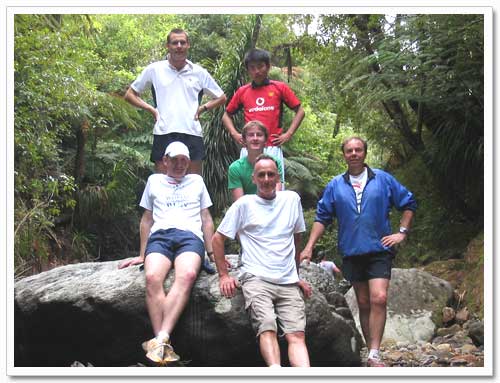
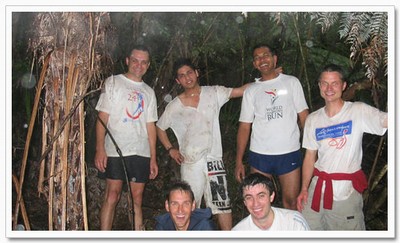
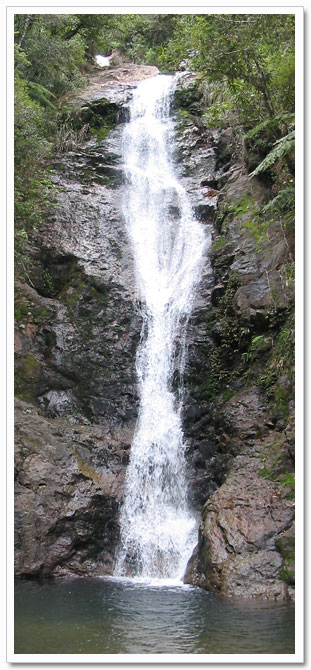
We arrive mid-morning and talk turns to food. I prepare my traditional, even notorious, oatmeal gruel – a madly healthy concoction whose secret ingredients are shrouded in the mystery of a fraudulent Scottish ancestry. The butt of incessant jokes, half a bowl of the gruel is left over and someone jokes about using it for building mortar. I pounce and tickle in retribution. Gruel-powered we run or walk for an hour up into the nearby mountains, a leafy forested trail that takes us at last to a two tiered waterfall, river plummeting down seventy-five metres into a deep, super-cold pool – into which of course we goad each other, plunging, shrieking the banshee wail of madmen into the rocky depths.
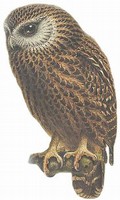 More post-lunch games, then an evening of singing and a long, long meditation, so easy in the newness of a new place and the rural silence. I wake at 3am, summoned by an owl calling – Ruru the message bringer; stars blaze, the seas cadences are clear sibilant hisses of water on sandy shores. Sitting on a porch deckchair, watching the night unfolding, you feel closer to something eternal, perhaps a tiny intimation of the sat-chit-ananda of the old scriptures. Alone in a universe of stars, cradled by a blatant eternity, your human 'I', the cloaks and personas, are falling away in this in-between world, the Self unmasked, selves dissolving, the thin veil that separates life from eternal Life, being from Being parting – might I please have even a tiny glimpse of the existence-consciousness-bliss spoken of by the sages?
 Returning next day, we pass the three warriors – from this side a white cross can be seen, painted by a zealot on the middle granite column. Yes, the symbolism is appropriate, the three crosses of Calgary, a further dimension to tug the mind. Crucifixion too of landscapes betrayed by greed, the remnant rainforests driven back into gullies and unmerchantable steep hillsides, understorey chewed out by cattle and doomed; and the cancerous man-forests, pines, creeping down to the road edge – birdless, sterile and a scene of utter devastation once logged, testimony to the white man's utter insensitivity towards Earth or the living spirit of landscape.
Aloof in their altitude and inviolable grandeur the ramparts of the distant mountains blaze gold in the evening sun – the three warriors also catch the sun and glow with the same light. Were they stranded there by daylight, a raiding party from some barbaric underworld lost in a sudden dawn, or defectors from the mountain fortresses seeking refuge on the coast? They seem linked by sunlight to the faraway mountains but we cannot decide and the granite features will not soften or speak as we pass.
 Local things of the human world catch your eye – roadside signs offer honey; fresh farm eggs, very cheap; firewood from storm sundered macrocarpas; pottery; and jewelry crafted by the rough brown hands of local artisans, malacite and jade hewn from the local hills and creeks.
The sun falls and the sky turns to apricot – evening lends itself to contemplation. I am remembering someone's comments about 'divine amnesia' – forgetful we are of our true selves. And Sri Chinmoy saying 'unconscious realisation of God you already have – now you have to realise God consciously'. Are moments such as these, sinking back into a car seat on an unhurried journey somewhere, thoughts dissolving into a mellow evening sky, are such moments close to this understanding that we are forgetful God's, our true selves and divine nature smothered in the assumption of an all-absorbing humanness. I have seen this rediscovery, an epiphany, in the dying of people I know, something extraordinary left after the humanness has gone, in my father's withdrawal into a last and utterly surprising nobility, the death mask a Bodhisattva's face, in my mother's strange dying smile, and others known and lost, consciousness draining out of the eyes but something left, the last impression of a Self after the selves have gone, a final imprint or signature of the soul's splendor.
Wondering to myself, is this all just a dreaming, nothing really out there that is not a play of consciousness, an imagining – that pale quarter moon over the graying hills, is it really there without me? Am I witnessing only the play of my mind, as real and as unreal as a movie – will it end like that, a flack-flacker of transparent film? I don't know – best to leave such conundrums to God.
Back into the convoy of cars at last, the motorway into Auckland clogged with weekenders returning to urban lives and the quotidian stream. A child, nose flattened against a window, makes a gargoyle's face from a passing car – I poke out my tongue, waggle my ears, eyes bulge. The mother sees me and laughs – another bored child materialises and now two excited faces are peering, pointing, creating masks of putty flesh as they pass. I make a face at Budhsamudra and we all laugh – we will be back in our usual beds by midnight.
– Jogyata.

The Gypsies of Fall
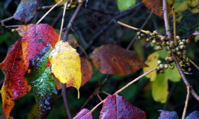
Like a permanent sunset that even the colours of rain cannot muddy, the fall foliage is awash in red, yellow, orange and pink...
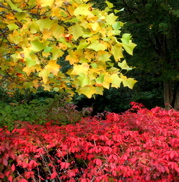
Fall's glory inspired me to write the following poem on the subject as I enjoy a visual feast of colour from every tree top.
The Gypsies of Fall
A caravan barters in rubies and gold
saffron sings while emeralds sleep
weaving an amber carpet
placed at God's Feet
leaving the silk road of summer
in measured retreat
-poem by Sharani
Related links:
More poems I've written.
Of Tempests and Lost Fishermen
I love storms and tempests. Weather...! – enchanting you with it's lashings of character and wild, intemperate ways, not just climate with it's bland and predictable days of unremitting sunshine. People grumble about Auckland and it's mood swings – sweeping winds keener than grief; great columns of cumulus banked up and towering out there on the sea's horizons; here a random rainbow; over there to the West blue skies and the promise of imminent summer. Mornings you step out in a thin shirt, bare-armed, whistling a cheery tune, then a winter blast sweeps you away and you rush back inside, muttering in retreat, rummaging through your stuff for a whole new wardrobe.
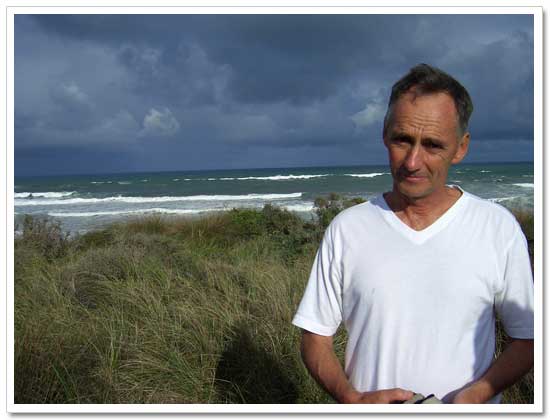
Veterans of Auckland's riotous, all-seasons-in-a-day onslaughts wear a simultaneous assortment of summer light/winter warm/plus rain cheaters, peeling off or multiplying whichever, depending on the vagaries of the day. Shardul and I once vied and went all winter long in shorts – who would seek sanctuary in long trousers first? - but a high price was paid with chillblains, red noses, knees aching in the furnace of cold. This week in our city has been superb – hailstones as large as duck eggs thundering on our roof, winds howling in every crack and crevice, a pea soup fog blanketing the nearby ranges, then the long lovely nights of unrelenting rain.
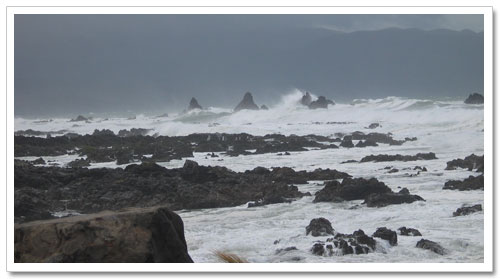
I ventured one morning, a foolish insomniac, out to the West Coast, a 45-minute pre-dawn drive through mist and foreboding gusts of wind, the car rocking under each assault. The sea was a cauldron of white caps, sand almost shredding flesh from bones in the blast, a maelstrom of whirling, buffeting, fearful wildness, an exultant, elemental dance of nature. A little poem is called for . . .
The oceans are uprising
malign dreams of a new dominion
massing leagues of pitiless green
summoning the armies of the sea,
rebellion! breaking free of coral reef and shore
– the old constraints –
borders breached, swept asunder.
Listen to the drumming of the surf
the sea's hexameter beating
a dark night invasion . . .
The rain was howling off the sea, razored and burning my hands, waves gleaming like swords and savaging the dunes, not a living thing to be seen. White foam was piling up on the high tide mark, white and yellow suds scudding up into the dunes, wind-borne –
oceans are rising
rebellious
battering headlands, invading sleep,
cadavers tossed ashore like dolls
broken in your vengeful savagery
Yes a litter of dead things, starfish, broken crabs, a small hammerhead shark, a flounder or two flung up, banks of bladderwrack and kelp torn from the seabed, the flotsam of fishing gear – buoys and ropes and a Wellington boot.
Destruction and fear
Lord of the dawn
are thy unholy empire.
Bind me you would
in your siren's hair –
lashing kelp, roiling sand –
drag me down to your
green, green deep.
Awaken things of earth
and flee
the hour of reckoning comes
malign, a dark avenger
wind-driven,
howling horizontal off the sea . . .
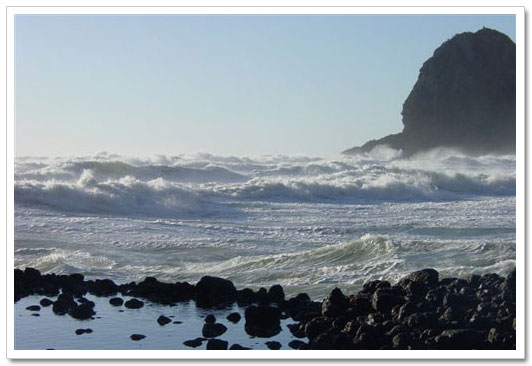
Huge ocean rollers, shock troops of the sea, were pounding a nearby promontory, spectacular explosions of foam and green cataracts sluicing off the rocks – but you avoid venturing too close, fishermen get swept away here every month. Sometimes their grieving widows stand on the shore and weep, clutching their children and sobbing at the sea.
You grin, a frozen rictus mask
while tides rage, lay siege.
Everything shrinks in the desolation.
The gulls are battened down
on the rugby field,
a full mile inland
and every dog is whining at it's door.
On weekend evenings the families of the drowned fishermen sometimes stand on the headlands jutting out into the tides where their fathers and husbands were lost. Many are Maori people who believe the souls of those swept away will linger there, a stone's throw away in the ocean. They call out to the sea, to the souls there.
Trussed up in long ropey tentacles of brown kelp, the husbands drifted ashore here on night tides, pale, sightless, still clad in their thigh-length waders, a full week after tumbling off those treacherous rocks into the boiling sea. Under the balm of a now calm evening sky, the families summon their trapped spirits, mop each others eyes and huddle together for comfort.
Time is no healer and words are useless in their void of grief, but the sea and the sky soothe them for a while and help them to endure.
– Jogyata.
Sunrise
With the inspiration to greet the sunrise over the water on the morning of my birthday, I was quite delighted to find the weather fully cooperated.
This tradition of greeting my birthday's beginning with a sunrise meditation found me delighted to encounter Sri Chinmoy's series of daily prayers called My God-Hunger-Cry included a prayer about the sunrise written on my birthday.
My God-Hunger-Cry prayer for October 3, 2006
No surprise, no surprise, no surprise!
God comes to me at each sunrise.
-Sri Chinmoy
Last year, thick fog over the water prevented a sunrise over the marsh although I meditated and took photos in a less foggy area. This year my east-facing destination over a marsh featured a clear sky - just dew and mist shimmering above the water. Synchronizing oneself with the morning sunrise imparts a feeling of healing and contentment. After watching the sunrise, the day can unfold while carrying the beauty of the dawn inside your heart. With Sri Chinmoy's glorious poem, the sunrise can also symbolize the eternally present beckoning of God's sweetest love for His creation.
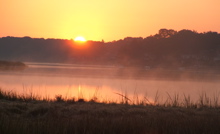
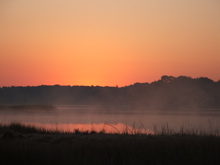
Photos by Sharani taken at sunrise on my birthday at Osemequin Marsh in Rhode Island.
An African Safari
I have just returned from eleven days in South Africa, in Johannesburg. I've been here before but my knowledge of this continent is very small – impressions from a raft of Hemingway novels and Joseph Conrad's Heart of Darkness still linger.
I greatly admired Hemingway, who wrote of safaris and wars and bullfights, until I actually attended a bullfight in Mexico – the courage and death of nine bulls scalded my heart and Hemingway and I parted company. Behind me, two burrito wielding Mexican women snatched savage mouthfuls of lunch and bayed for more – Olé, Olé, Olé! Whose blood did they crave, bull or matador – or mine for my unmasculine dispassion and failure to excite.
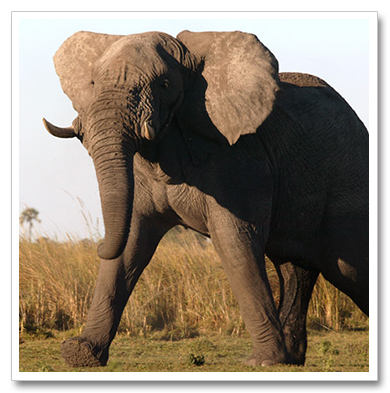 Day one and my host-friends Abhijatri and Balarka take me out to a game reserve three hours south of the sprawling city – the high veldt stretches away on all sides, savannah plains, the innumerable, jumbled outcrops of kopjes, and far off the lovely purple silhouettes of mountains. Scanning the orange rocks for leopards through a scarred set of 12x binoculars. We play a game called 'spot the...', competing for points for unusual animals seen, with the winner (the one accruing most points) earning a free lunch at some roadside haven out of the heat. Here not just buffalo but wildebeest, antelope, warthog, gnu roam – a 'spot the...' spotter's paradise! This continent has offered up the first traces of man's predecessors, the earliest known cradle of our evolution.
Inside the reserve a huge old elephant, one tusk broken off, dozes under an acacia tree. We pull over and click away, but photos are absurd in this 360-degree panorama and I toss my cheap toy into the back seat. The elephant wanders towards us – a waterhole lies on the other side of our car and Abhijatri, our driver, is taking stunt photos through the binocular lens. Now the elephant is almost directly in front of our car, a large behemoth clearly unhappy with our presence, waving his ears, snorting loudly and showing all the signs of a likely charge. Alarm bells are ringing loudly – my eyes are round as teacups. Oblivious, his own eyes riveted to his camera, Abhijatri is blithely unaware of the sudden and dangerous turn of events. We call out, almost in unison – Abhijatri, Abhijatri, Abhijatri! and our last shout alerts him. He pales, fumbles to start the car while we watch anxiously. Reversing respectfully away, and just in time. Has any disciple gone to meet the Grim Reaper after being gored by a 3-ton elephant, impaled like a rag doll on those fearsome ivories? A glorious and very original exit from this world but after this experience I'd prefer a nice quick heart failure out on the frisbee field or a leisurely and dignified (and painless please) exit in a disciples old folk's home or maybe a nice high speed train wreck.
We safari survivors have an intense week of workshops – how lovely the people we meet with their open hearts and goodwill. Here most people believe in God, laugh in surprise at my own surprise at this. I try to run each day in the nearby parklands – but such tiredness, wheezing along like an infirm and pallid geriatric, then I remember the city is 1800 metres up from sea level. Not dying from some insidious illness after all.
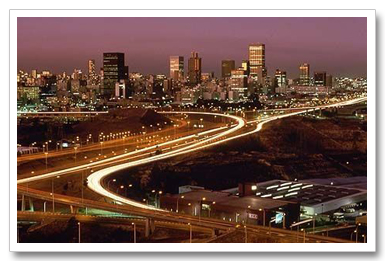 Downtown Johannesburg at night – not a good place to be, even in a car. Empty streets, a sense of menace and sudden danger, a bad movie scene. The brothers are wonderful – up at 5am every morning, disciplined and hard working trailblazers out in this frontier. An intense eleven days, then home via Asia. Abhijatri had slipped $80 into my carry-on at J'Burg airport, a gracious little au revoir – donning the unfamiliar mantle of shopper, in Singapore I wandered the spiritless, good-times gauntlet of Changi airport, the boutiques of relentless handbags, jewelry, gadgets, cigarettes and liquor, in search of a cheap item of clothing to replace my travel weary, fake Ralph Lauren shirt. A large indelible curry stain from my 'Asian Veg' plane meal glowed a disreputable yellow against the white cotton.
Upstairs, a transit hotel offers 3-hour rooms for twenty local dollars and I succumb, only falling asleep on my token bunk after a frustrating 2 ½ hours of twitching, jetlagged wakefulness. Wandering, a prayer room and adjoining meditation room loom – unadorned in careful deference to neutrality, instead they fail to inspire or touch the heart. Even here, the bland, unfailingly insipid music of airports and hotels gnaws away. If I could be God for one day, my first task after running a 1:59:00 marathon and restoring my hair would be to erase all muzac from the planet – a mere wave of my sparkly wand – and substitute it with my favourite Sri Chinmoy piano and pipe organ improvisations. (okay, then I'd stop all world wars). I buy unwanted chocolates, a token gift, but fail to replace the shirt, a tramp doomed to curry stains for the final 11-hour haul over the Pacific and home.
Circadian rhythms still trapped in an African time zone, frazzled from 35 hours of travel, I drive out to Auckland's west coast to roam the empty beaches, a little balm for body and spirit. A calm dawn, white caps curling and breaking far out, the sky swallowing it's last stars.
Chaos of stars, godwits' flight
against the sea at the end of night
the murmur of tide in the half dawn light...
yes, I like it like this.
Fears, fantasies, wistful thoughts
a burst of sky...
words unsaid, tears unshed
but I like it like this.
– Jogyata.
Seagull Frolic
Recently while walking on the beach, I closely observed some seagulls with the intention of taking a photograph of one.
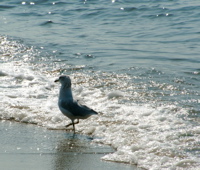 One seagull in particular caught my attention as it walked along the water's edge. I had my camera lens on zoom and was concentrating on the gull in order to capture its portrait.
Often when I am on a picture taking expedition, I transition into a hyper-aware and concentrated perpective. The everyday mood of the world dissolves and a kind of sixth sense springs to the surface.
I'm not even certain what precipitates the shift but it is completely tangible and suddenly like in a Star Trek moment I'm transported to some other mode. As I observed the seagull, that shift unfolded inside me and I found myself tuned into a seagull who was emanating a completely playful vibration amidst the waves.
The reason I choose the word playful to describe the seagull is because after about the third time in a row of repeating the pattern of walking towards the water as a wave receded only to position itself for a dash of spray as the waves came back to the shore I suddenly realized it was playing race the waves.
As a child growing up in the Midwest of America, I rarely travelled to the ocean but trips to the Great Lakes were commonplace. The Great Lakes are tremendous bodies of fresh water complete with sand dunes on the shore and waters powerful enough to sink large ships. Along the shores of Lake Michigan and Lake Huron is where I played race the waves - a frolic along the water's edge guaranteed to evoke squeals of delight from young and old alike.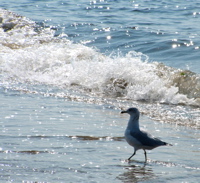
On this walk along the ocean's edge near my current coastal habitat, I learned something new about marine ecology and avian behavior. Gulls like to play in the water and offered me an instant mood-booster with the element of surprise in this discovery.
So the next time that someone characterizes seagulls as one of the duller species to observe just tell them that seagulls are anything but dull. Who knows? Maybe if you invite them they'll even play hide and seek.
Photos by Sharani
- ‹ previous
- 120 of 125
- next ›

Except where explicitly stated otherwise, the contents of this site are licensed under a Creative Commons Attribution-NonCommercial-NoDerivs 3.0 Unported License. read more »
SriChinmoyCentre.org is a Vasudeva Server project.