
Running for Peace
It's mid-day in Auckland on a summer Thursday. The Domain grandstand, a popular landmark for local runners, has been transformed by a bright array of helium balloons. The Auckland Girls Grammar School band are belting out a succession of festive songs and a large body of lunchtime runners are warming up, out to do justice to a new mile circuit of the park.
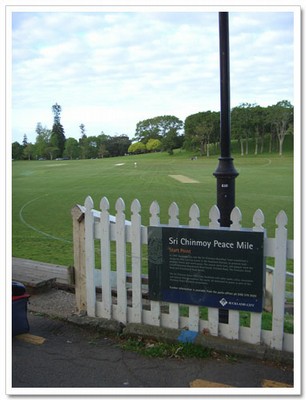
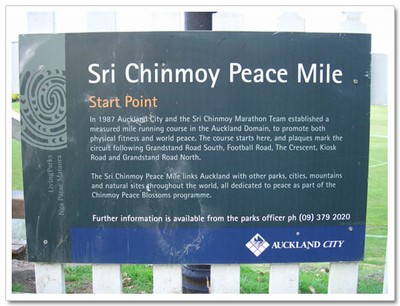 The occasion is the inauguration of New Zealand's first Peace Mile, an accurately measured one mile loop of the Domain which links Auckland with a network of over fifty Peace Mile cities worldwide, and focuses on the Olympic theme of athletics and world harmony.
The person after whom the Peace Mile is named has also arrived.
Smiling and composed despite an exhausting flight from New York, Sri Chinmoy mixes unobtrusively with local runners. He is the inspiration behind history’s longest running event, the recent 43,000k Peace Run, a relay spanning six continents and involving hundreds of thousands of athletes in eighty countries.
The director of the Peace Meditations at the United Nations in New York, Sri Chinmoy is also an internationally respected spiritual leader who has dedicated his life to world harmony. His international marathon team organises over 500 races each year worldwide and provides essential support to several major outside events.
Today Sri Chinmoy does not speak but rather, standing in a semi-circle of attentive runners, offers several minutes of silent meditation for the Peace Mile inauguration. It's an unusual moment and the silence is unexpectedly powerful.
Some well-known faces are present. Auckland's mayor, in high heels, confesses she has left her running shoes behind to avoid having to run! However Parks and Recreation director Barry Bonner, an enthusiastic supporter and architect of the Peace Mile concept, has left his suit at the office and is lining up for the inaugural one mile race. Richard Tout, NZ's record holder of 24 hours, 100 miles and 100k, is also there along with ultrarunner Sandy Barwick.
The Park Director now offers some reflections on the need to find inner peace, acknowledges Sri Chinmoy's unique contribution to athletics and world peace, and unveils the sign. There is generous applause and then silence as everyone reads the gold and green placard. Try to be a runner reads the quotation at the bottom, and try all the time to surpass and go beyond all that is bothering you and standing in your way. Be a real runner so that ignorance, limitations and imperfections will all drop far behind you in the race.
Olympic canoeist Ian Ferguson starts the one and three mile races around the newly established loop, amid cheers from a large contingent of schoolchildren. New Zealand's first Sri Chinmoy Peace Mile is now fact.
Sri Chinmoy is unique among spiritual leaders in his belief that sport, particularly running, is an important 'personal growth' discipline, cultivating qualities which are important to the spiritual life he advocates.
 Running form two important disciplines practiced by his students – on the one hand developing physical wellbeing, strength and dynamism; and on the other, inner peace and poise, mental strength and inner capacities. A decathlon and sprint champion in his own youth, Sri Chinmoy then turned to weightlifting to help him overcome a chronic knee injury.
Inspired by their teacher's personal example, many of Sri Chinmoy's students have applied his philosophy of self-transcendence to their own field of endeavour – many have swum the English Channel, some hold national and international running records; one, Ashrita Furman, holds over 100 current Guinness world records, itself a record for the most held by any person!
Sri Chinmoy offered the following comments on competitive sport:
"Our aim is not to become the world's best athlete. Our aim is to keep the body fit, to develop dynamism and to give the vital innocent joy. Our aim should not be to surpass others but to constantly surpass our own previous achievements. We cannot properly evaluate our own capacity unless we have some standard of comparison. Therefore, we compete not for the sake of defeating others but in order to bring forward our own capacity. Our best capacity comes forward only when there are other people around us. They inspire us to bring forward our utmost capacity, and we inspire them to bring forward theirs. This is why we have competitive sports. Our goal should be our own progress, and progress itself is the most illuminating experience."
On the benefits of meditation for runners:
"Through meditation we can develop intense will power, and this will power can help us do extremely well in our outer running. Meditation is stillness, calmness, quietness, while the running consciousness is all dynamism. The outer life, the outer movement, can be successful only when it comes from the inner poise. If there is no poise, then there can be no successful outer movement. Poise is an unseen power, and this unseen power is always ready to come to the aid of the outer runner."
Sri Chinmoy's own running serves as a reminder that he is not just another armchair philosopher. A veteran of 21 marathons and also some ultra-marathons, Sri Chinmoy still participated in his students' races and followed an astonishing daily schedule of weight-training and workouts that leaves little time for rest, right up until his passing in 2007. At the Domain Sri Chinmoy jogs slowly around the new Peace Mile on his injured knee, a humble figure in a green tracksuit whose inspiration and talents have touched so many lives. One is reminded of his words to the first of his students to complete a marathon: "Now you see what is true for all human beings – we are all truly unlimited if only we dare to try and have faith . . . our goal is always to go beyond, beyond, beyond. There are no limits to our capacity because we each have the infinite Divine within us."
This article was originally written for a New Zealand running magazine following Sri Chinmoy's second visit to New Zealand in 1989.
An Advocate of Peace
This article was written in 1990 following Sri Chinmoy's second visit to New Zealand in 1989.
At a time when religious differences continue to create division and turmoil in areas of the world, it is refreshing to reflect upon the efforts of a recent New Zealand visitor who has done much to promote greater unity and global awareness among the world's religions.
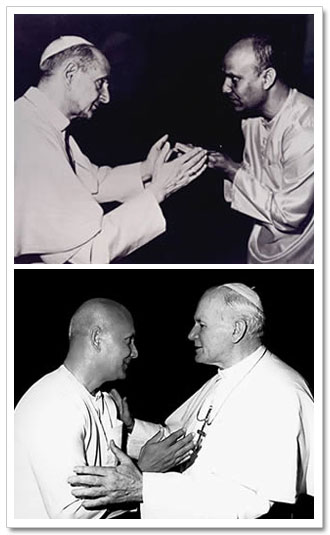 He is a man who on three separate occasions met Pope Paul VI at the Vatican and had a special friendship with the Pontiff; a composer of devotional music whose meetings with Pope John Paul II inspired eleven songs using words spoken by the Holy Father; an author of over 1000 spiritual books and plays, including a life of Christ entitled The Son, which ran for two years in London and was hailed by Christians of all faiths as a masterpiece; and an athlete who sponsors inter-faith tennis tournaments for religious leaders to encourage unity and oneness among religions.
That man is Sri Chinmoy, director of the non-denominational Peace Meditations at the United Nations in New York.
The humble and quietly spoken Sri Chinmoy resists any attempts at religious classification – ‘my religion is love of God’ – and identifies rather with the universal truths which he believes most religions embody. He once commented: "I have the deepest admiration and adoration for the Christ. Although I was born in India and brought upon the teachings of Krishna, the Buddha and other spiritual Masters, when I studied the Bible I found that the teachings of the Christ and the teachings of our Indian Masters are the same. This is because God is Truth, God is Love, and Truth and Love are universal."
Now 75, Sri Chinmoy spent his first 33 years in India before moving to New York in 1964. At the invitation of diplomats and staff members, he was invited to conduct twice-weekly meditations for world peace at the United Nations, a role he has continued to fill ever since. So successful were these programmes that in 1984 Sri Chinmoy was invited to inaugurate weekly peace meditations at the United States Congress in Washington in the same spirit and format.
UN Secretary-General Javier Pérez de Cuéllar said: "In your meditation you see beyond the superficial distinctions of race, sex, language or religion, as the Charter encourages us to do. You concentrate on the truths and ideals which unite all mankind: the longing for peace, the need for compassion, the search for tolerance and understanding among men and women of all nations... In recalling the fundamental goals which inspire our work, you are helping to reaffirm our commitment to the organisation and it's purposes."
In his first and memorable meeting with Sri Chinmoy in 1972, Pope Paul VI commented: "This meeting of ours has been most essential. The Hindu life and the Christian life shall go together. Your message and my message are the same. When we both leave this world, you and I, we will meet together."
At their last meeting, in 1976, Sri Chinmoy presented Pope Paul VI with a book he had written about him, Compassion-Father, Champion-Brother, Perfection-Friend.
Sri Chinmoy is regarded as the most prolific composer of devotional music today, with over 19,000 compositions to his credit. These has been performed at over 700 free concerts of harmony-inspiring music in major concert venues world-wide.
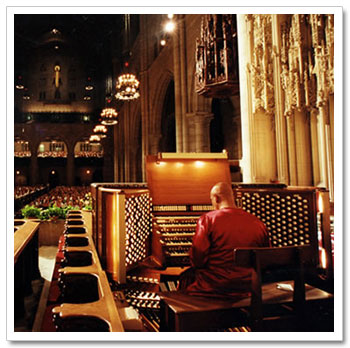 His favourite instrument is the pipe-organ, and many Aucklanders will remember Sri Chinmoy's astonishing and moving performance in the Auckland Town Hall last November. He has performed in many major cathedrals around the world and this year performed on the Vatican organ, a special honour which acknowledges the respect in which he is held in the international community and which recognises both his musicianship and his accord with religious leaders.
After hearing a performance of Sri Chinmoy's music, the late John Balka, director of the office of sacred music at St Mary's Cathedral in San Francisco, remarked: "Sri Chinmoy has understood that the essence of music has the power to move the soul in ways that words alone cannot. Combining his highly developed spirituality and his well-honed physique into one brilliant and expressive energy, he projects the considerably unique power of music through performance that is perfect in it’s freedom from reservation and constriction. This is how he teaches with his music; that is how he moves thousands at a time, through the super conscious, into that perfectly serene light of God's Peace... This is art of the highest order."
In 1987 the Auckland City Council acknowledged his major contribution to world peace by establishing a recreational Sri Chinmoy Peace Mile in the Auckland Domain. During its November dedication a poem by Sri Chinmoy was offered for reflection:
My Lord, I do not want the peace
That tells me I need nothing more.
No, I want the peace that creates in me
Constant hunger to receive You
In every way
And distribute You
In every widening heart.
– Sri Chinmoy.
– Jogyata.

Why I Didn't Become A Quantum Physicist
 Somebody plonked a book on quantum physics (!!) onto my chair after a class the other night and said "have a look – seems very much like the ideas proposed in meditation." Now quantum physics and any possibility of my ever considering the subject vanished out of my life a very long time ago, way back when my high school maths teacher quietly confided to me, a sixteen year old confronting an even then murky future, that where mathematics/calculus/geometry/anything using the logical realm of the brain was concerned I showed zero aptitude. In that one watershed moment any hope of humanity discovering Jogyata the trailblazing nuclear physicist perished. So I might have been forgiven for tossing the book scornfully into a neglected corner of my room, but on an impulse I flipped through a few pages before sleep – and was hooked! Here an alternative description of our familiar world of consciousness/unity/soul/meditation and quite startlingly so, two different modalities converging at the same conclusion.
Consider some of this:
For several hundred years, science has taught us that all physical phenomena is made of matter – matter was seen as the ground of all being. Elementary particles make atoms, atoms make molecules, molecules make cells including neurons, neurons make the brain, the brain produces consciousness – the 'theory of upward causation'. But in modern quantum physics, a new paradigm has emerged, a science based on the primacy of consciousness. Consciousness is not a brain epiphenomena but the ground of all being out of which all material possibilities, including the brain emerge and are embedded. This parallels the teachings and insights of the spiritual figures down through the ages, a perennial philosophy asserting that all being is grounded in a limitless, transcendent and unifying consciousness. This is the unified field theory or super stream theory of quantum physics.
Quantum objects ('quantum' means 'a discreet quantity') have been found to influence one another nonlocally ie. without signals through space, and without taking a finite time, thus being interconnected in a domain that transcends space and time. At a human level this is proven true experimentally – two meditators in different parts of the world, for example, simultaneously experiencing the same data. (We call this telepathy!)
Amazingly, in quantum physics the quantum field, which is the ground of all being, is only waves of possibility, and our observation brings about actuality from this potentiality. An example from Amit Goswami's book, Physics of the Soul:
We have all seen what are called Gestalt pictures in which the same lines represent two superimposed pictures. I am glancing now at a picture called 'My wife and my mother-in-law'. When I perceive one or the other I am not doing anything to the picture but just recognising and choosing among the possibilities that are already present. If you are seeing the mother-in-law, in order to see the wife you don't do anything to the picture, all you do is change your perspective of looking. The possibilities of both wife and the mother-in-law are within your consciousness; all you do is recognise one possibility or the other. The process of conscious collapse or actualisation is like this.'Suppose we release an electron in a room. In a matter of moments, the electron wave spreads all over the room. And now suppose we set up a grid of electron detectors, called Geiger counters, in the room. Do all the counters go ticking? No. Only one of the Geiger counters ticks. Conclusion? Before observation the electron does spread all over space, but only as a wave of possibility. An observation brings about the collapse of the possibility wave into an actual event.'
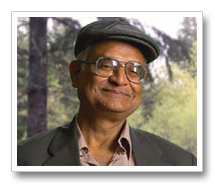 'Suppose we release an electron in a room. In a matter of moments, the electron wave spreads all over the room. And now suppose we set up a grid of electron detectors, called Geiger counters, in the room. Do all the counters go ticking? No. Only one of the Geiger counters ticks. Conclusion? Before observation the electron does spread all over space, but only as a wave of possibility. An observation brings about the collapse of the possibility wave into an actual event.'
So the new sciences of molecular biology and quantum physics are very interesting because they point squarely at the great truths enunciated down through thousands of years by mystics, God-realised masters, the sages and illuminati who have directly seen into the heart of everything. Science and spirituality are merging together at last. The universe is a symphony, an ocean of consciousness and we are one, unified in a universal consciousness that percolates up through our body, our senses. We exist as ripples in this ocean of existence, which is intelligent, self-aware, non-material being, waves of possibility out of which everything – plants, people, planets – emerge. And experiencing our oneness with all of life might be called enlightenment. Clearly, meditation leads to this understanding, the unbounded awareness when the senses and the mind settle down and we expand our consciousness.
"The universe is a symphony," my author writes, "and we are a part of its music." Echos here of Sri Chinmoy commenting on music: "It carries us into the Universal Consciousness and makes us feel that we are in tune with the highest, with the deepest, with the farthest [...] This self-expansion is not egocentric; it is something divine, something supreme, something universal [...] With it the 'I' goes away. In soulful sound there is no I. It is all 'we' [...] The soulful sound is of eternity and for eternity and immortality."
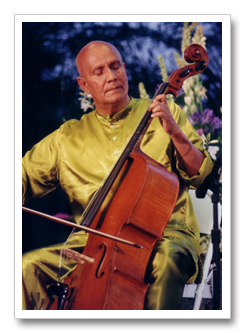 In The Source of Music Sri Chinmoy also adds:
"The Universal Consciousness is constantly being played by the Supreme Himself and is constantly growing into the supreme music. God the Creator is the Supreme Musician and God the Creation is the supreme music. The musician and his music can never be separated. Through music, God is offering the message of unity in multiplicity and also the message of multiplicity in unity. His dream is called the cosmic reality, the universal reality. God created sound in order to know outwardly what He is inwardly. Inwardly He knows what He is but if He does not outwardly manifest His inner divinity then the world cannot accept Him, cannot realise Him, so He created sound just for the sake of His own manifestation."
How lucky we are to have a living Masters in our midst, one who sees beyond science, matter, time, space into the absolute Reality and Truth of existence – who lives there in that final knowing – and has undertaken the responsibility of leading each of us to that same realisation, the great and liberating understanding that alone will satisfy our souls.
If I ever run into my high school maths teacher again (he'll be a really old man by now so I could visit my vengeful fantasies on him with impunity) I'll bend the frames on his glasses, stomp on his toes, call him all kinds of unflattering names in retribution for those remarks of his years ago that turned me away from being a brilliant scientist into an unemployable lay-about destined to die in poverty, genius untapped. Oooh, if I could find him I'd tweak his nose so hard – but hang on, since we're all one, ripples in the unifying and underlying matrix of consciousness, if I pull his ear that means I'm actually pulling my... oh darn!
– Jogyata.
Related links from the writings of Sri Chinmoy
Behala
Es ist jetzt 11 Jahre her, dass ich meinen Leben neue Impulse gegeben habe. Damals hatte ich begonnen zu meditieren - einen spirituellen Weg zu gehen und mich der Führung eines spirituellen Meisters anzuvertrauen.
Wenn ich auf mein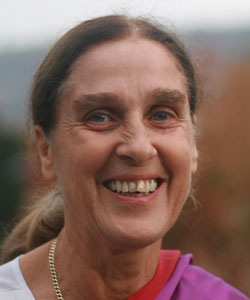 Leben zurückblicke, und das ist immerhin schon mehr als ein halbes Jahrhundert, dann sehe ich, wie sich meine Suche nach Gott und dem Sinn des Lebens wie ein roter Faden durch all die Jahre hindurchgezogen hat.
Ich hatte unzählige Bücher gelesen, vieles ausprobiert und so oft habe ich gedacht, gefunden zu haben was ich suche. Aber schon nach kurzer Zeit hat sich wieder eine Leere breitgemacht die meine Suche von neuem vorantrieb.
Als ich aber vor 11 Jahren mit der Meditation begann, fühlte ich Ruhe in mir, mein Leben wurde bewusster und erfüllter. Nicht dass die Meditation eine neue Richtung von allem Gehabten wäre, nein, sie schließt alles mit ein aber sie führt in die Tiefe meines Herzens. Dort erfühle ich die Stille des Seins, das lebendige Schweigen das Licht meiner Seele.
Mir wurde klar, wenn ich einen Weg in die unbekannten Tiefen meines Bewusstseins gehen will, brauche ich einen Meister, der mich führen kann - jemand, der diesen Weg kennt, der diesen Weg selbst schon gegangen ist, der innerlich und spürbar seine Hilfe anbietet, wie ein Vater der mich an der Hand nimmt und mir Sicherheit gibt.
Welche Rolle spielt der Meister in meinem Leben, das sehr stark an Intensität gewonnen hat?
Er inspiriert durch seine beispiellosen Aktivitäten:
Er ist das lebendige Beispiel von selbstloser Liebe, unermüdlicher Kreativität und inspirierender Aktivität, die das bisher Bestehende immer transzendiert. Denn Er schöpft aus der Quelle des Unendlichen, des Göttlichen, die Er auch mir erschließen will.
Endlich habe ich verstanden, dass es das Annehmen und Loslassen von Problemen und schwierigen Situationen ist, das Fortschritt in sich birgt und nicht der bewusste Kampf gegen die Gegebenheiten des Lebens. Je mehr Vertrauen ich in das Göttliche entwickeln kann umso leichter ist das Leben zu meistern.
Da auch mein Mann und meine vier Kinder diesen spirituellen Weg gewählt haben, herrscht in unserer Familie ein Gefühl des Einsseins und der Verbundenheit.
Behala
Halloween Festivities

This year I found myself on duty at work during the evening of Halloween when children dress up in costume and go trick-or-treating. We joined in the festivities at work by dressing up in costume and handing out candy to visitors to the library.
While the redeeming value of masquerading in costume and overdosing on sugar could be easily debated for the likes of one trying to haunt abodes of peace and light rather than ghosts and goblins, I readily admit I had good bit of fun at work last night.
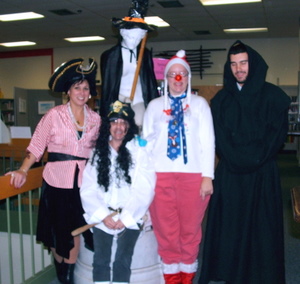
Here the night shift is posing in front of the resident statue at the library, affectionately nicknamed Buffy. One of my co-workers usually dresses up the statue in some kind of seasonal attire so it only seemed fitting that Buffy join in the group photo.
Still recovering from a bump to my noggin, I found great distraction from my aches and pains by being a holiday elf - all accessories found at the local dollar store where - yes everything costs $1.00. My red plastic nose had a blinking light inside it that kept up its Rudolph imitation the whole evening.
When I actually had a serious reference question to answer, one of my co-workers dressed as a pirate found herself in fits of laughter just looking at me doing regular work with a flashing light on my head.
Since we had very few customers, the timing was perfect to also revel in celebrating two recent October staffer birthdays behind the scenes. I think we could build a Great Wall replica out of all the candy leftovers brought in to work today. As we chew on Skittles and chocolate bars, we can also chew on Rabbi Marc Gellman's interesting and somewhat humorous article on the relationship between Halloween, spirituality and organized religion.
Another spiritual purpose of Halloween that goes way beyond candy and candy, is the way Halloween opens us up to the possibility of the undead. I have a Ph.D. in Philosophy and so union rules prevent me from believing in things you can only kill with garlic and a silver bullet...there is more in Heaven and Earth that is dreamed of in our philosophy. Halloween puts us, particularly children, face to face with spooks. This is a good thing because if spooks are real, then we have the holiday to keep them away, and if spooks are not real, then, hey, the candy and the party were good. Part of the original Celtic observance of Samhain was the lighting of bonfires all through the night to scare away the spirits of the dead. Yes I know, this is all just bogus superstition, but perhaps, just perhaps…quick! Look behind you!! Wow that was close. -Rabbi Marc Gellman
Ashrita's Egg Balancing Act
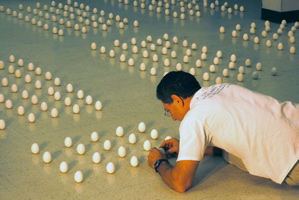
He broke the record of 420 eggs in 7 hrs. 33 minutes and finished at 700 eggs in a little over 12 hours.
Ashrita set a Guinness World Record on October 29, 2006 for simultaneously balancing 700 eggs. He achieved his latest record here at the Rhode Island School of Design (RISD) in the Metcalf Lecture Hall above the Design Store.
He was inspired to do it at RISD because he sees it as a type of performance art. The current record is 420 eggs.
From the Press Release:
Over the last 25 years, Ashrita, the holder of the most Guinness records, has set or beaten a total of 119 records in numerous categories. Ashrita's records usually involve a physical challenge such as somersaulting the greatest distance (12 miles) or doing the most abdominal crunches in one hour (9,628) but in the case of the egg record, concentration will be the key. Ashrita expects the record attempt to take anywhere from 5 to 7 hours. Needless to say everyone in the room will be walking on eggshells until the record is broken!
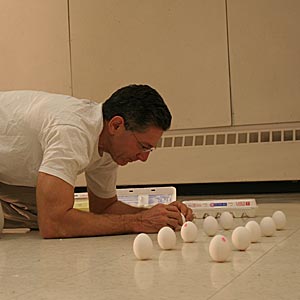
Top Right Photo by Sharani - Lower Left Photo by Salil
Related Links
Ashrita's Previous Record Earlier This Month
My Online Photo Album with Pictures from the Event
I will write more as the day progresses. Live from Providence, it's Sharani's blog!
Ashrita was on the 6 pm news with 3 lead-ins to the story and a finishing shot of a close-up announcing to stay tuned at 11 pm to hear if he breaks the record.
He was on the 11 pm news again and on a different channel on the early morning news the day after. The media television coverage was eggscellent with all kinds of egg related puns in the reporting of the story.
Congratulations Ashrita!
Puppy Power Revisited
I have been enjoying Sumangali's trilogy of dog stories very much – lovely prose and a very beautiful poem, showing us again the wonderful talents of a writer and such affection for her canine and other friends. May I share a few short memories of my own.
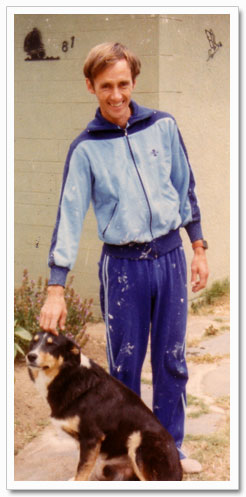
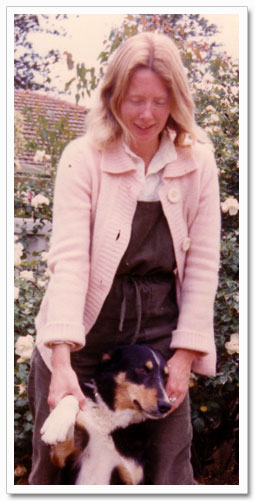
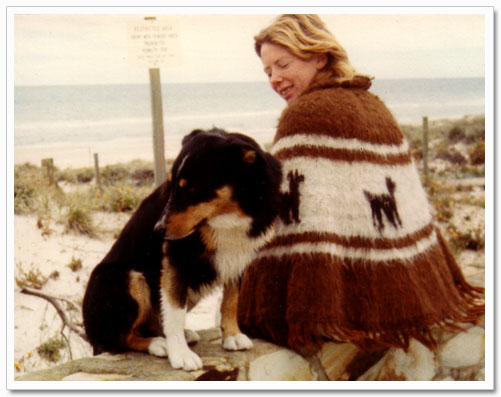
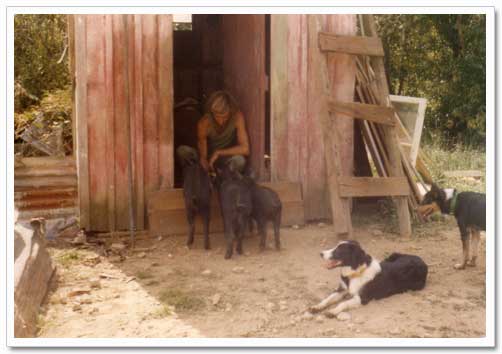 Many years ago, before my soul became tired of a wastrel's life and pointed me to our path, an acquaintance of mine took pity on two border collie pups he spied in a dog pound for unwanted strays and took them home (the fate of such strays is sadly very grim). My friend's compassion dried up after one week of ownership (chewed shoes, fur over all of his clothes, malodorous carpets, the odd bone wedged under his bed etc) and I was implored to take them 'while he had a break' (a euphemism, as it turned out, for 'flee the country never to be seen again'.) Reluctantly – though in hindsight happily – I agreed. The two pups grew into two wonderful creatures that I loved. Lifelong vegetarians, they were full of mischief and fun, possessed of such intelligence and intuition that I was endlessly surprised, and unfailingly loyal as friends.
My grown up collie friends had a bizarre fondness for all kinds of fruit and took apples, strawberries, peaches and pears at whim from market places, stalls, any random back gardens they came across – and with absolute impunity, for what sane person would accuse a dog of stealing their grapes or strawberries?
"Your honour, the defendant's dog jumped over my fence, ate several bunches of grapes then ran off with a pear in it's mouth – then had the gall to return the very next day and finish off my strawberries. The nerve!"
"Madam, I am a patient and God-fearing man but all that is about to change! Are you asking me to believe that a grape-loving dog performed a supernatural jump over your garden fence, lunched off your vines, chose a pear for dessert then trotted off? And did this fruitarian canine enquire, perchance, whether you use organic or inorganic sprays on your strawberries when it reappeared the following morning for breakfast? CASE DISMISSED!"
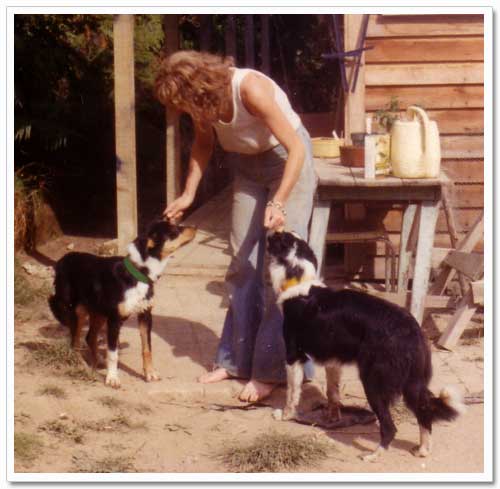 In backcountry New Zealand where I spent long months away from my own two-legged kind, my border collie companions and I enjoyed our life together very much – later this little family expanded and I had lambs, wild pigs that had lost their mother (and proved equally delightful and loyal as they grew up), the odd goat, a mercurial and sometimes temperamental fawn plus a few very unendearing chooks that generally disapproved, with much cluck-clucking, of all these animal comings and goings. Oh, and also my bemused but patient horse.
Subarata turned up from Ireland around this time. She adored animals and they her. Sometimes up on a ridge at work, I would see her far off on a farm track, Pied-Piperish with a stream of dogs, pigs and a lamb or two strung out behind her. Our winter cottage back in the mountains was like a scene from Babe on those cold nights – dogs stretched out by the log fire, a lamb or two on a hay cot, the three pigs on the porch outside, squealing at the injustice of this, prim and disapproving hens perched on the yard fence, the horse meandering in the yard – snorting to gain our attention and hopeful of a late night snack from the ever doting Subarata, usually an apple or piece of pie.
Our remote place was surrounded by the Matemateaonga Ranges, a mostly trackless and vast wilderness of native forest. Here many animals roamed and I had numerous occasions in which to be amazed by the sixth sense possessed by these wild creatures – they have an awareness of their environment which far surpasses that of urban man.
 In untouched nature, it seems that life is intricately interconnected, symbiotic, the forest a whole living entity – thus what happens in one small part, the footfall of a man, can quickly be felt elsewhere. Animals instantly detect a change in what you might call the 'forest consciousness' through both obvious means – bird calls of alarm/a sudden silence in the rhythm of the forest/through highly developed and acute senses – but also through subtle means, a shift of consciousness across the forest as the 'ripple' or energy shift created by the intrusion of something unnatural, especially man, is registered. The forest has it's own language which is read at subtle levels by all parts of the eco system. Interestingly we humans too have this capacity but it is dormant, probably atrophied by now, emerging again only through protracted periods of solitariness in nature.
If you practice sitting very quietly in a wild forest (not exotic plantations) and listening, tuning in carefully, you can begin to sense the feeling of the whole environment, the pauses where everything is suddenly alert to some change, and detect local things – an animal moving up a nearby ridge, a shift in energy or a 'ripple' in the matrix of silence.
Wild animals too are very conscious of 'intention'. After a period of fear and mistrust the wild deer and pigs in the hills around our small home stopped running away when they saw us, and would watch carefully then resume feeding when we walked slowly past. We would avoid looking at them and be as relaxed and peaceful as possible – but when the occasional visitor came they would instantly melt away into the forest.
Once I stumbled across a large grass nest in the forest made by a boar to shelter it from the snow – mistaking the size of the unseen animal beneath I put my hand under the dried grasses and ferns and felt a large leg. The nest erupted and an enormous black and tan boar stood there, glaring at me, literally two metres away – I was helpless as these are lightning fast and can beat a galloping horse in speed. Sensing I was not a threat it quickly turned and wandered away – as did I!
 As a child I had an Australian terrier for company – this little dog had a 'small man' inferiority complex and would often rush at much larger animals, at passing cars and even the nearby train – teeth bared, whipping itself up into a fury at this invasion of it’s territory our little friend would stand inches away from the huge wheels of the passing engines, snapping away in a frenzy of indignation.
Our vegetarian collies were very placid and gentle, especially Scruffles, the female collie. In the mountains I remember her finding a tiny hare and bringing it back to us in her mouth, ever so delicately and protectively, for care. Raised as a pup with so many other species from God’s creation, the unbiased Scruffles would play with the lambs and pigs each day, an activity that most self respecting canines would certainly frown upon.
Both had a wildly adventurous life, even riding in helicopters when I had two summers as an outfit guide on six day white water rafting expeditions. Scruffles loved riding the rivers, her paws over the front of the inflatables and braced as we charged down the big rolling rapids while a more circumspect Scobie, preferring to stay dry, would sit up on the lashed down food barrels, a difficult balancing feat, bracing himself against the pitch and roll and downward plunging.
The bond between man and animals can become very strong, even to such a point that their karma can become intertwined. Sri Chinmoy once commented on the death of a student's dog in this light – the reason was extraordinary and deeply moving. When Scruffles died, racing at full speed along a back country road in glorious style, flowing and free, such a sight, then under the wheels of a sudden car, we were heartbroken. We mourned the death of our longtime companion for ages.
Footnote
Where are they now, these lovely souls that shared their lives with us for a while and then were gone? What a compelling case for animal-to-man reincarnation they make, for where else can creatures of such sentience, intelligence and development go but onwards into our troubled human kingdom with it's further, if bittersweet, possibilities?
If through some divine dispensation I might have some small say in all this, a boon for my many years of dogless austerity, I would choose for them a pleasant interlude in some heavenly canine loka (vegetarian of course, the accent on strawberries and grapes) then a gentle transition to the human realm, perhaps even somewhere around here, a brother and sister in some happy rural family, lots of pets and farmyard pals, doting parents of course. Perhaps our paths might even cross – two children flying along some forest trail, happy and free, running wild towards me through the trees, and stopping momentarily to say, a little shyly to this stranger – 'haven't we met you somewhere before...?'
– Jogyata.
Related Links
- Inspirational Dogs – by Sumangali Morhall
- Dog: Faithfulness – from 'Animal Kingdom' by Sri Chinmoy
- ‹ previous
- 119 of 125
- next ›

Except where explicitly stated otherwise, the contents of this site are licensed under a Creative Commons Attribution-NonCommercial-NoDerivs 3.0 Unported License. read more »
SriChinmoyCentre.org is a Vasudeva Server project.