
Don't Do This. (Just Don’t.)
Or, more accurately: A Moronic Moment From My Youth
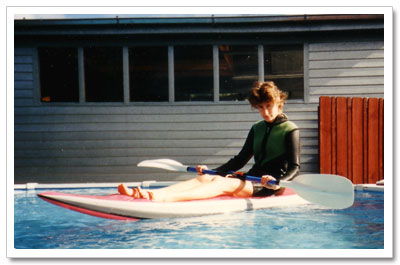
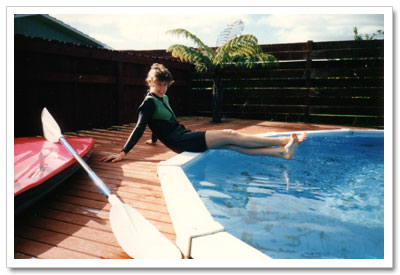
I had recently come into possession of a brand spanking new shiny bright pink wave ski. I had had occasional goes on the odd wave ski that had come my way in the past and having rowed my Grandad’s wooden dinghy around the bay of Whangamata for over six years, and being (if I may say so myself) pretty deft at it, I was a relatively experienced rower. I had also procured a wave ski book from the library and had practiced some snazzy moves and manoeuvres in a friend’s pool. Since my recent asset accrual I had keenly gone out every day that summer past the breakers, cruising in on the waves, flipping every now and then to test, sharpen and speed up my skills at spinning back out on top again. Yep – I thought I was fairly much the bees knees as far as wave skiing went.
Cyclone Bola was a Big Momma of a hurricane that struck the North Island of New Zealand in March 1988. Whangamata – the holiday resort on the east coast of the idyllic golden-sanded Coromandel Peninsula to which both sets of my grandparents had retired – was badly hit by the tropical mega-storm. The sea was churning and wild – waves tore at the sand dunes with gnarly talons and creatures from the depths were driven forth. The beach was littered with seaweeds and zonal shellfish that had been lashed off the rocks and mercilessly dumped – pounded by the mindless breakers. The whole calm, idyllic seaside was transformed into a chaotic battlefield of the elements.
For two days I had been stuck indoors with the holidays drawing to a close. When the rain abated, I dashed out to the beach and the whole scene was revealed. The violent gales took my breath away as the enormous vista stormed and boiled around me. It was exhilarating standing on the dunes with the roaring wind and a whole fresh world before me. I loved it – the moody clouds, the freshly washed beach – and the waves!! They were enormous! Eyes widened with glee, I rushed back and grabbed my wave ski – I only paused briefly, wondering about the wisdom of my venture – then hauled it down to the beach and into the sea.
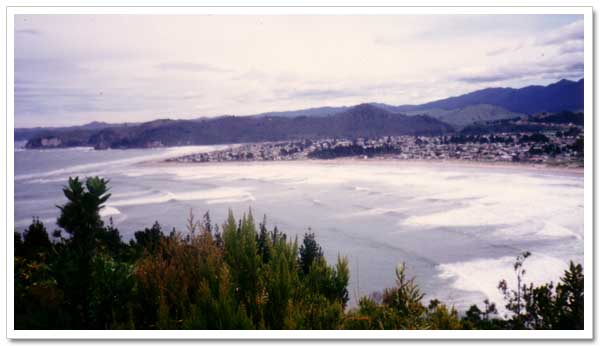
The main shore of Whangamata Bay in calm conditions, viewed from Moana Point
The waves were coming in fast and strong, but in a brief gap I quickly pushed out onto the turbulent water of a backwashing wave – felt the familiar thrill of starting out to face the elements. Then "BOOMPH!" – the first wave hit with a strength that surprised me. Then they all came at me in quick succession but I managed to make a slow headway, heading for the point past the breakers where I could whiz around and ride in. The waves were big and the sea was wild so I was rapidly coming to the conclusion that maybe I would ride only once, then call it a day. There was the briefest lull in the waves and I grabbed the respite to quickly shoot out a bit and was going to turn and come in when a really huge wave reared up before me really fast. Instantly the options flashed before me – they were: (a) try to turn and ride it, however with not enough time to get fully around I would probably be caught broadside, and not only be flipped, but dumped and maybe face injury; (b) stay where I was and risk being flipped over lengthwise in the curl at the top, and maybe face injury, or; (c) row fast (really really fast), get over it and catch the next one. As (c) was the only safe-ish one I rode over it – for one panicky moment I was vertical near the top, but leaned forward and managed to get over just as the curl was forming. The wind sent the spray back, stinging, onto my hands and face. To my horror there was another, at least to my eyes, tsunami-sized roller behind it. And behind that as well. I faced a long succession of these waves and it took all of my strength and skill in the cross-currents just to face them straight on. I was getting quite freaked out at this point. It was at the top of one of these titan waves that I started to face my folly. At the pinnacle of an extremely big one I looked out upon a vista of an untamed and angry ocean. In fact the vast ocean itself was a succession of huge breakers and the only point past the breakers for which I was seeking was on a beach on the coast of South America, some thousands of miles away. I tried a few frantic efforts to turn around and nearly came to grief several times and just about lost my paddle.
Just as I thought that at least things couldn’t get worse, they got worse. The outgoing tide had drifted me near the offshore islands and waves from cross-currents started buffeting the wave ski, and it became very unstable – sometimes the waves would cross each other out (where there was a wave and a trough occurring together) and I would find myself in an enormous node of calm water, facing an even more enormous peak of water where the waves had doubled themselves! It was a freaky situation and if I had had any time that wasn’t action and battling, swerving, turning, propelling forward, stopping, etc, (i.e. time to think), I would have panicked. And badly.
Very soon the islands loomed before me and I was being swept between the first two – and the waves changed again – very choppy and uncertain as I was over the reef and the rocks (relatively near the surface) made unexpected eddies to complicate things. I was beginning to tire badly but had to keep going for all I was worth. I was trying for the small beach on the first island. (Ironically at low spring tides it is shallow enough to walk from the beach of Whangamata to the beach of this island and I had splashed gaily across to the island many times. Now – in the same spot – I was fighting for my life in mountainous seas.) However there was no chance – the tide had a mind of its own and there was a swell trying to shove me roughly onto the jagged rocks of the island.
During my struggles to avoid the rocks I was swept between and past the first two islands. (I was afraid of capsizing at that point as my morbid mind conjured up a scene where earlier that month, on a fishing expedition, we had been plagued by a 14 foot long grey nurse shark at approximately this position and I didn’t fancy being shark bait. I calmed myself somewhat by thinking that no self-respecting shark would be anywhere near the surface in these conditions.) When I was out in the open sea – and a hostile one at that – it was upsetting to have all of my efforts and plans thwarted and to see the back of all that was familiar to me: the beach, the islands, etc – and to be swept away completely against my will. I was powerless to say the least, in an extremely dangerous situation, and despair started to set in. Stuck in a holding pattern of keeping upright, I knew my energy was nearing an end. I had been fighting for a couple of hours now at least, was hungry, afraid and COLD! My hands and feet were numb and painful, and up till now my wetsuit had kept me warm, even when the waves had broken over me and a couple of times the wave ski and I had completely submerged. Now I was aware that my body temperature had dropped and I was shivering. It also began to rain. I had been sustained by the thought that as soon as it was noticed I was missing, my grandparents would raise the alarm, when with finality it hit me that I would not be missed at all! Not until bed time at least. With both sets of grandparents settled at Whangamata, each would naturally assume that I was with the other.
All thoughts of rescue were smashed to smithereens and I privately also thought that no self-respecting life saver would venture out into conditions such as these anyway. I cried and the tears were hot on my frozen face. Rage born of hopelessness boiled up in me and I re-doubled my efforts for a while. But to absolutely no avail! The islands got no closer. When I was completely exhausted – I had gone past hunger and was weak and shaking with effort, I had to subside and just sit there amongst the turbulence, passively observing. I was mortified at my situation. It was starting to get dark, and on the crest of waves I could see the lights come on in the houses of Whangamata. I could even discern the window of Pop’s house where there was warmth and the safety that I had so easily, naively and foolishly dispensed with. I thought of my most beloved grandparents and grieved thinking of how they would blame themselves; of my parents and their grief; and of my own callous stupidity that had allowed this to happen – that had needlessly jeopardized the happiness of many, for I had come to the conclusion that I would undoubtedly die. I was on a small exposed wave ski on the open sea in hostile conditions – nobody knew I was there and there was no way of getting back. Trust me – the outlook was bleak. There was nothing I could do. I had read enough Readers’ Digest condensed books to know that drowning was an okay way to die, although I didn’t really fancy it myself, now that I faced my doom. I just thought I had better stay on the wave ski as long as possible, then when it sank or I fell off it, to tread water as long as possible. I was wearing a lifejacket, which would help, so I could be okay until tomorrow, if I wasn’t so cold. Actually I was starting to get warm deep inside and my focus was starting to blur – I recognized the onset of hypothermia. I wasn’t really aware of my limbs right then.
It began to get quite dark. To assuage my feeling of upset-ness I prayed. Mainly I prayed for God to minimize the grief of those left behind and I also commended my soul to Him for His Keeping. If I was going to meet God, I wanted to be at my best so I prayed for peace and forgiveness and to be surrendered to the conditions over which I had no control. To my relief, a tangible Peace stole into me, and then grew and grew. I felt it inside my entire being. It comforted and warmed me and I stopped fighting the elements. So I sat there, holding my paddle, in extreme peace, happy that my passing was being made easy, and thanked God for all of the good things I had known and which seemed so much more precious now. As I sat and waited to die, what struck me was that I didn’t. I became aware that the wave ski stayed in the troughs, and the waves that swung up into the air – threatening to curl over me – flattened out as they came near. Without doing anything except sit there, it seemed I was completely safe. It was quite dark when I heard the sea making another noise – a dull booming – and a shape darker than the night hove into view. It was the first island. To my surprise the wave ski and I were being swept back between the first two islands and towards the main shore. The tide had obviously turned and was taking me back with it! As I drew near the shore I calmly and with little effort placed one end of the paddle in the water, turned the wave ski and a large breaker caught it up and smoothly glided me all the way (and it was quite far!) into shore, capsizing on a rogue cross-wave that I didn’t see in the dark in (thankfully) chest-deep water. I managed to drag the wave ski up the beach only a little way and had to leave it as far as strength and trembling limbs would allow me to. (As it happened, the tide pushed it up a bit further and it was there, partially covered in sand, the following day when I retrieved it.)
I had been gone for about seven hours and – true to my reckoning at sea – was right in that each set of grandparents had thought that I was with the other. At the same time that I was out on the sea, three other lives were lost off the coast of Whangamata, just near to me. By Divine Grace it was not my turn to go. I believe God saved me for something else and in turn I am grateful to Him.
Precisely because God loves me infinitely more Than I love myself, God cannot afford to be As careless with my life As I am. – Sri Chinmoy from his book titled ‘Love’.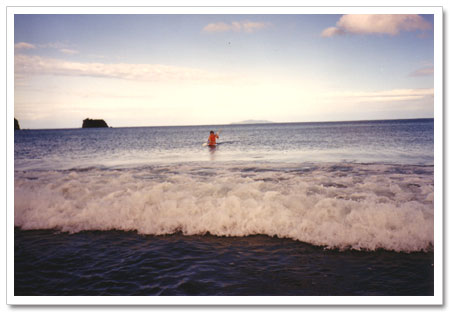
Ideal conditions for wave skiing!
Epilogue
After my experience in the maelstrom during Cyclone Bola my nerve was broken as far as wave skiing went and I no longer sought my thrills on the waves. Instead I only went out when the sea was as flat as a millpond!
Return to: The Homepage of Toshala Elliott
The Random Dog
It wasn’t following proper etiquette. The dog had given a short, happy bark and was standing there wagging his tail, ready for a pat. He was not strictly following the doggy code of behaviour that every dog is instinctively born with (which I knew well because up until I was 14½ years old my family had handled many dogs) and a slight variance could offend and earn a small nip. There were rules and he wasn’t following them. We had not formally met - I had sized up this confident middle-sized dog and was willing to bet that I had never seen him before in my life - and he was being way too casual. So I ignored him. So he barked again, “I’m here!” I was surprised because dogs do not usually make a social gaffe like this – their keen sense of smell remembers better than their sight, and he was treating me very familiarly. I was in a tricky position. The dog had obviously made a mistake and if I bestowed the pat, the shock of understanding could result in a horrified yip or even a bite. On the other hand, I didn’t want to hurt his feelings so I looked at him, smiled and said, “Hello little doggy!” He was really happy and wagged so hard his whole body wiggled. He moved closer to more easily facilitate a patting. However I did not, for I did not know him, and he yapped again.
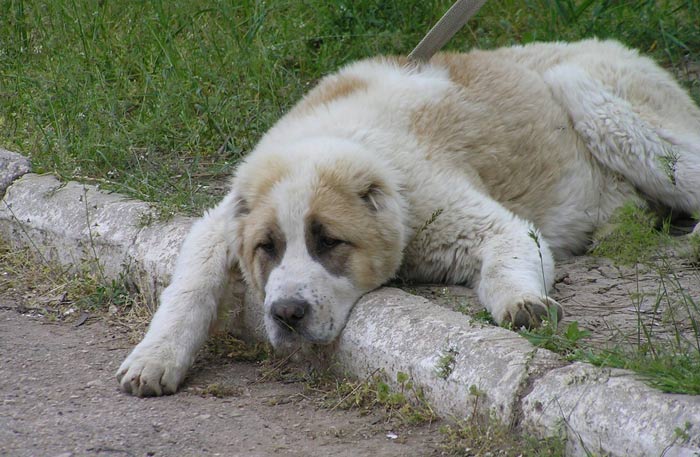
Suddenly his owner appeared. “I’m really sorry about this – he’s usually so shy with strangers. He has never done this before.” I said, “It’s all right – I really like dogs.” The owner removed the dog and I heard him being ordered into the car. I was outside my downstairs flat, packing my own car, which was parked behind the dog owner’s car. The dog owner was finishing a visit to the upstairs flatters. I felt something on my leg. Looking down – the dog was back! Standing next to me with one front paw extended, resting on my leg. I was really baffled. His owner was calling him and he moved away for a second, then came back, rearing himself up on his hind legs, balancing himself with one front paw on my leg – and looked up into my eyes with a puzzled, slightly hurt expression. That was too much. I patted him. Really properly. I scratched his neck and everything – and he was ecstatic! He wagged his tail so hard and licked me as far as he could reach. Then his flustered owner appeared, grabbed him and shut him into her car, apologising profusely, “He has never done this before. I’m so sorry.” Out of the back window the dog was looking at me and I waved to him. He looked at me adoringly and wagged violently back.
Back at my car, packing it for an outing, I heard the dog owner and upstairs flat lady talking about it, bewildered about the dog’s behaviour. “He has never been here before except for that time you went away when you first got him...” The penny dropped.
All of a sudden memories flooded in and I flushed hotly with embarrassment. I had been out-polited by a dog!
A little over a year before, I had uprooted my life from Hamilton and moved to Auckland. The small downstairs flat had been available immediately and I started looking for a premises to open a café in. In the meantime I was taking a small business course and getting the requisite hygiene certificate and behind-the-scenes organising and planning necessary for such a venture. I was also doing voluntary work for the Sri Chinmoy Centre, flyering for their free meditation classes – sitting in on those same classes and even teaching some classes myself! As well as errands – like delivering Sri Chinmoy’s books to libraries all over Auckland, which helped me to orientate myself in the enormous metropolis that was my new home. (I had some terribly lost – but ultimately beneficial – experiences along the way!) At 2pm each day I would arrive back to my flat, prepare some lunch and a cuppa, and enjoy it sitting on the back step, having some peace.
One day shortly after arriving in Auckland, I sat on my step and heard a small mournful yodel. Upon investigation, it was a tiny puppy. Having no idea where it could’ve come from, I called it and it came over. After a hug and a small comforting suck on my fingers, it fell asleep in my arms. It was out cold for a full 20 minutes, then it awoke and made it’s stumbly way upstairs. Obviously the people in the flat upstairs had very recently acquired it – but in my eyes (having had a lot to do with puppies during my childhood) it was just a spot young (by maybe a week or two) to be removed from it’s mother. I thought nothing more of it until the next day when he came for a pat, a cuddle and another 20 minute nap in my arms. At exactly the same time every day for two weeks, that was the routine. And then he came no more. And I missed him. Fearing something had happened to him, I asked the upstairs flat. They had only been looking after him for a friend who had been called overseas suddenly, immediately after acquiring him. So that was it. I sent the puppy my love and goodwill in my prayers and that was that. Until now, over a year later, when the grown puppy had shown more courtesy than I had, and remembered me!
So again he was remembered in my prayers, only this time I felt more confidence in his future. As the polite and alert little gentleman he has turned out to be, he will go far.
Return to: The Homepage of Toshala Elliott
Mein Xylophon und ich
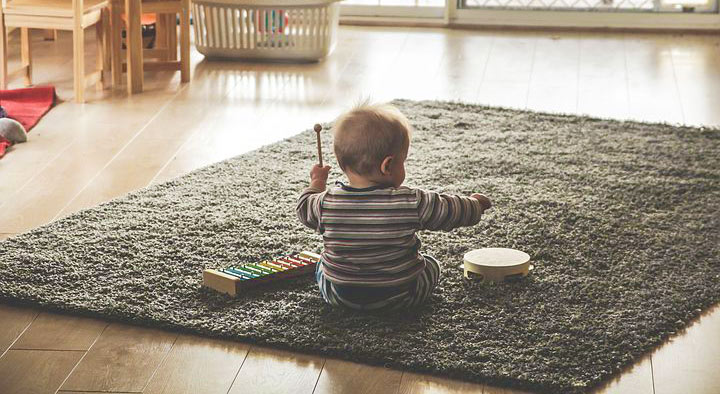
Als ich Schülerin von Sri Chinmoy wurde, hatte ich schon sehr früh einen engen Bezug zu seiner Musik. Tatsächlich war es so, dass mir das Singen spiritueller Lieder viel leichter fiel als die stille Meditation. Ich war damals in Salzburg – der Stadt der Musik – und auch im Center waren viele Musiker. Das hat mich inspiriert nicht nur zu singen, sondern auch ein passendes Instrument für mich zu suchen.
Meine Wahl fiel dabei ursprünglich auf das indische Harmonium, ein Begleitinstrument mit Tastatur und Blasebalg (vereinfacht ausgedrückt), das ein wenig wie eine Orgel funktioniert und mit dem man verschiedene Grundtöne erzeugen kann.
Kurz bevor ich jedoch eines kaufen wollte, geschah etwas Lustiges. Ich war in einem anderen Centre zu Gast und eine meiner Freundinnen lieh mir ihr Harmonium, damit ich das gemeinschaftliche Singen mit begleiten konnte. Ich konnte schon einige Begleitakkorde und auch das Melodiespielen viel mir leicht. Nur an diesem Abend war es so, dass ich jedes mal aufschreckte, egal, was ich spielte. Es war ganz komisch. Ich spielte zwar die richtigen Noten, aber es klang immer schräg und gefiel mir gar nicht.
Ich fand nur eine einzige Antwort auf dieses seltsame Phänomen: Das scheint wohl doch nicht das richtige Instrument zu sein. Wie ich dann dazu kam, mich für ein Xylophon zu entscheiden, weiß ich nicht mehr so genau. Vielleicht waren meine Kindheitserinnerungen wieder wach. Ich habe lange Zeit im Schulorchester Xylophonbegleitung gespielt.
Jedenfalls fand ich mich ein paar Wochen später mit einer sehr musikalischen Freundin auf einer Musikmesse ein, um zu schauen, was es an Xylophonen gibt. Ursprünglich schwebte mir eines aus Palisander vor, das sind die, mit den Holzstäben. Aber beim Ausprobieren gefiel mir ein großes Altmetallophon mit hellem Klang am besten. Natürlich hatte ich teuer gewählt, es war ein Konzertxylophon und eigentlich war mein Budget sehr begrenzt. Schließlich hatte ich als Student kein regelmäßiges Einkommen.
Ich wusste aber auch, dass ich eine langfristige Investition tätige und es immer bereuen werde, wenn ich jetzt sparen würde. Und so kaufte ich es.
Es ist ein wunderbares Instrument und ich liebe es, mich in die Reinheit seines Klanges zu versenken. Ich staune immer noch, dass ich nach so vielen Jahren immer noch neue Klangvariationen kreieren kann und mir dieses Instrument nie zu langweilig wurde. Wenn es mir mal nicht so gut geht, ist Xylophon-Spielen die beste Medizin für mich.
Mein Xylophon ist mit mir schon viel gereist, vor allem auf den zahlreichen Touren mit meiner Musikgruppe Silence-Hearts. Sein Klang hat viele Menschen berührt und vor allem Kinder begeistert. Die kommen gern nach dem Konzert und dürfen natürlich mal selbst ausprobieren.
Leider ist es kein Instrument, das man einfach mal so in die Tasche steckt. Ich habe mir von einem Schreiner damals zwei Holzkisten machen lassen, damit es jeden Transport übersteht, aber damit füllt man oft bereits zwei Drittel eines Kofferraums. Zug fahren ist gänzlich unmöglich. Ich kann immer nur eine Box tragen und wenn man dann noch Gepäck dabei hat, geht das einfach nicht.
Oftmals muss ich höhere Kosten für ein Auto in Kauf nehmen, das groß genug ist, oder mir werden die Arme lang, wenn ich es von einem Parkplatz zu einem Konzertort trage. Das sind so die Momente, in denen ich mich frage, warum ich mir diesen Aufwand antue. Aber sobald der Klang meines Xylophons dann im Konzertsaal erklingt, weiß ich, dass es kein besseres Instrument für mich geben kann, und sein Zauber jeden Aufwand rechtfertigt.

Ich war idealistisch und wollte die Welt verändern
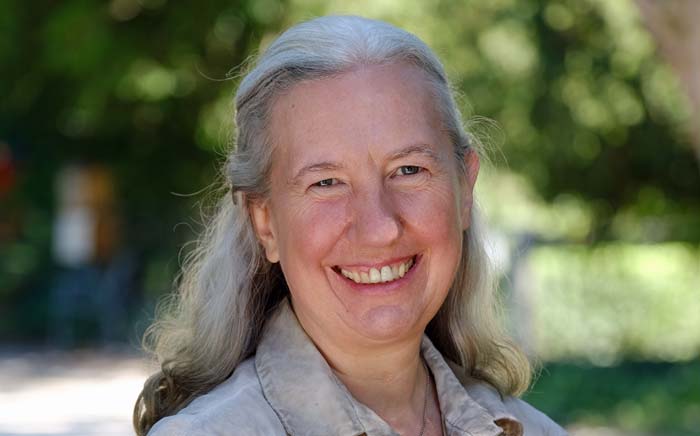
Ende 1990 habe ich mich dafür entschieden, Schülerin von Sri Chinmoy zu werden. Diese Entscheidung hat meinem Leben endlich den Sinn gegeben, den ich immer gesucht habe.
Ich war immer idealistisch und wollte die Welt verändern. Ich war daher stets nach außen gerichtet. Als leitende Funktionärin einer Jugendpartei hatte ich aber häufig die Erfahrung gemacht, wie wenig ich doch trotz einer angesehenen Position erreichen kann.
Es war ein großer Schritt für mich, mich nach innen zu richten anstatt ständig im Außen eine Veränderung herbei zu führen. Da ich stets im außen gesucht hatte, fiel es mir schwer mich auf mein Inneres zu konzentrieren. Aber ich war konsequent und legte kurz nach meiner Entscheidung für diesen Weg alle politischen Ämter nieder.
Ich habe diese radikale Änderung nie bereut. Meditation hat mein Leben seither unendlich bereichert. Ich spüre nicht nur einen Sinn, in dem was ich tue sondern habe auch entdeckt, wie ich wirklich bin.
Nein, ich bin keine Heilige und ich führe ein sehr normales Leben, in dem ich genau wie alle anderen Menschen, mit vielen Problemen – oder sagen wir lieber Herausforderungen – konfrontiert werde. Aber mit der Meditation und natürlich der Unterstützung durch meinen Meister habe ich ein effektives Werkzeug an die Hand bekommen, um mein Leben mit einer sehr optimistischen Haltung zu meistern.
The Overlaugh Poem
This is a True, Absolutely 100% Real Life Poem of something that actually happened to Toshala on Meditation Night. (Don’t try this at home).
Return to: The Homepage of Toshala Elliott
Sri Chinmoy — Inspiration behind My Photography
A Photographer’s Personal Perspective - by Prashputita A. Greco

Source of my inspiration, and provider of encouragement to continue and transcend my previous best efforts, my meditation teacher, Sri Chinmoy, suddenly left this earth-plane to enjoy a well-deserved rest after a lifetime of ceaseless self-giving in the pursuit of serving the world and helping create a better life for all. An extremely difficult photographic subject — with enormous variation of expressions in a matter of an instant, and dynamic speed in all of his movements and actions, as well as huge diversity of activities under photographically challenging conditions — Sri Chinmoy gave me the challenge and the impetus to continue studying photography and bettering my previous results. Sri Chinmoy also provided specific directions to me in improving my work, whether it was the intense photojournalistic assignments, or the meditative journeys into landscapes and nature.
From the first time I met Sri Chinmoy, he encouraged my photographic efforts. Sri Chinmoy used to affectionately refer to me as: “The boy who takes pictures.”.
Sri Chinmoy was resident in the Sri Aurobindo ashram (Pondicherry, South India) when Henri Cartier-Bresson went there on assignment with the Magnum Photos Agency. Sri Chinmoy once recounted that: “He [Henri Cartier-Bresson] was so discreet: you never knew when he was taking a picture.” (He would keep his camera hidden behind a white handkerchief until the last possible moment). I count myself as very fortunate and blessed to have been a meditation student of Sri Chinmoy the past 21 years of my 47 years on earth. Responsibility and pressure came with the role of being one of the official photographers during Sri Chinmoy’s non-stop stream of activities, in New York and many other countries of the world. Yet, this was a tremendous privilege for me, and a boon, because it forced me to further advance myself, and my photographic capacities, skills and awareness.
Sri Chinmoy read all my published articles in Australian Photography magazine. A few years ago, in reference to my published views on digital cameras, with a twinkle in his eye and a mischievous grin, he suddenly turned to me in a quiet moment during an intensely hectic day, and said: “You take the nicest pictures with the oldest cameras: no digital!”.
His lifetime of achievements is incomprehensible to the mind. I shall remain eternally grateful for the blessingful opportunities which were given me in helping to document some of this remarkable human being’s activities and accomplishments. It was necessary to be on my best behaviour, particularly at the large functions, especially when VIPs, and dignitaries or even Royalty were in attendance! Even more, in my becoming a better person, I also became a better photographer.
While I have the gift of life, I intend to make the most of it, in every possible way. This includes doing all that I can in pursuing this hobby (avocation?) of photography, which — for me — serves not only as a metaphor for life, but also as a way of enriching and improving life, and furthering myself. In praise of the digital revolution, this has made photography easier and more accessible for many people, with arguably greater options to express themselves and their creativity. Although the “perfect picture” might never be obtained, it is the striving towards that goal, and bettering your previous best, which gives joy and fulfilment.
Experiences in life have taught me not to take anything or anyone for granted, not to be surprised by anything which happens, and also to follow my inner urges. Why it is necessary to do certain things when they don’t seem logical at the time may only become apparent many years later. Thankfully, I had given my utmost effort in discharging my duties as a photographer during the functions and celebrations for Sri Chinmoy’s birthday in August of 2007, which have turned out to be his last. I felt happy with my endeavours, and Sri Chinmoy kept saying nice things about my work, both to myself, and the distinguished guests. I also remembered to take RAW images as well as the fast-production JPEGs. There had been a vague feeling, sometimes surfacing into my awareness, that I wouldn’t have the opportunity in future to be taking any more of these photos.
Over 1600 books of Sri Chinmoy’s poems, essays, talks, lectures, stories and plays have been published. In the last published book of poems, made available for sale just the night before he left the mortal coil the next morning, the final poem reads: “My physical death is not the end of my life — I am an eternal journey.”. To learn more, see www.SriChinmoy.org. Some of my pictures of Sri Chinmoy are at http://www.gallery.srichinmoycentre.org/members/prashphutita
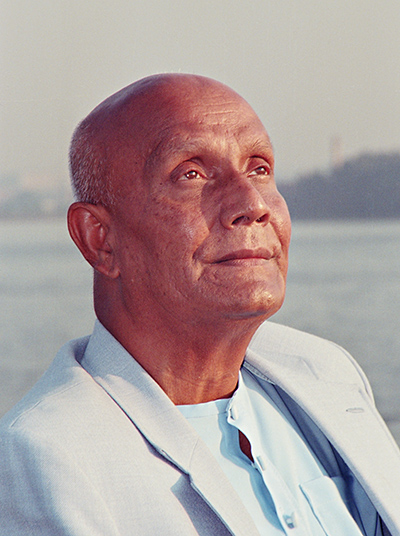
One of my favourite images of Sri Chinmoy (below) was taken August 1996 on a crowded ferry headed for the Statue of Liberty. I particularly like the confluence of sky, land, and water, as well as the meditative mood, which is one of the many aspects of Sri Chinmoy which I most wish to remember him for.
When Daylight Comes
When daylight comes
you roam the crinkled shores
stride out to a beckoning emptiness.
Wednesday’s sun flares up
from the crook of grey hills.
Your footprints weave
the virgin wastes like an aimless drunk,
beetle across this wilderness of rumpled dunes.
The sands are a map
and last night’s other lives
have left their feeble tracks and tiny stories:
claw prints of a bittern
soft paws, a rabbit under moonlight,
stitch marks of a swift predator–
millipede, night hunter on the prowl–
the strutting bold stride of a pheasant.
And here a tiny death–
last nocturne of a beetle
a black eight-oared boat toiling
the mineral heaving dunes
it's final furrowed wake in a
moonscape’s wrinkled swells
till shipwrecked here,
speared by a beak at dawn.
Sunrise scatters golden light.
Frail thing of flesh, you lift
stick arms in supplication
captive to a sky of cirrus charms
eyes raised up
to it’s tousled random beauty.
Might some grace yet come?
Subdued by sea mists
the dawn sun stares,
a tamed red Gorgon’s eye.
You come here sometimes
comforted by seas that measure time.
– Jogyata.

- ‹ previous
- 90 of 125
- next ›

Except where explicitly stated otherwise, the contents of this site are licensed under a Creative Commons Attribution-NonCommercial-NoDerivs 3.0 Unported License. read more »
SriChinmoyCentre.org is a Vasudeva Server project.