
Conscious Living
While many people choosing a vegetarian diet do so primarily for reasons of health or animal ethics, another viewpoint favouring both vegan and vegetarian nutrition is demonstrated in the lifestyle of many practitioners of meditation and supported by a persuasive body of spiritual teachings.
 A number of humanity's most respected meditation masters have taught that our diet has an impact on the development of our consciousness – the clarity or restlessness of our minds, the expansion and refinement of awareness and the functioning of our subtle body and nerves.
Many health and healing disciplines have their own language to describe this phenomenon – Ayurvedic medicine, for example, talks about the rajasic, tamasic and sattvic qualities of food – but in the realm of meditation diet can and does significantly alter the depth and subtlety of our experiences and the purification of our entire being.
In 1974 contemporary meditation Master Sri Chinmoy wrote a popular book called Colour Kingdom which identified the spiritual qualities and properties of specific colours. It described at length the principle that everything in the physical world – even colour – carries a specific vibration, energy and consciousness which in some way shapes our experiences in life. By extension and even more powerfully, the food we eat significantly adds to or subtracts from the quality of our inner spiritual life and impacts on the subtle world of our consciousness.
Comments spiritual teacher Sri Chinmoy, whose 7,000 meditation students worldwide are all vegetarian and often vegan;
"The vegetarian diet plays a most important role in the spiritual life. Purity is of paramount importance for an aspirant. This purity we must establish in the physical, the vital and the mental. When we eat meat and fish, the animal consciousness enters into us – our nerves become more agitated and restless, and this can interfere with our meditation. But the mild qualities of fruits and vegetables, on the other hand, help us to establish in our inner life as well as in our outer life, the qualities of sweetness, softness, simplicity and purity. So, if we are vegetarians, it helps our inner being to strengthen its own existence. Inwardly, we are praying and meditating; outwardly, the food we are taking from Mother Earth is helping us too, giving us not only energy but also aspiration."
"At one time the animal consciousness was necessary for forward movement. If we had not had animal qualities, we would have remained inert, like trees, or we would have remained in the stone consciousness where there is no growth or movement. But the animal consciousness also contains many unillumined and destructive qualities. Now we have entered into the spiritual life, so the role of the animal consciousness is no longer necessary in our life. From the animal consciousness we have entered into the human consciousness and now we are trying to enter into the divine consciousness."
Many people feel that eating meat gives them strength and nutrients unavailable to people on a vegetarian diet. But nutritional research does not support this view – indeed, a growing body of credible research supports the opposite point of view. Often, too, even one's ideas about meat – the power of the mind! – confer strength. But as Sri Chinmoy comments, "It is not meat but the spiritual energy pervading one's body that gives one strength. That energy comes from meditation as well as from proper nourishment. The strength that one can get from aspiration and meditation is infinitely more powerful than the strength one can get from meat."
"If one has aspiration, the vegetarian diet will help considerably: the body's purity will help one's inner aspiration to become more intense and more soulful. But again, if one is not a vegetarian, that does not mean that one will not make spiritual progress or will not be able to realise God."
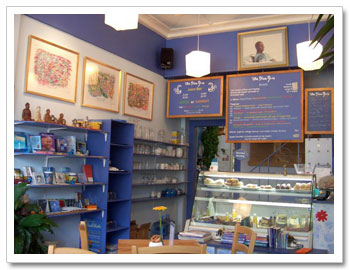
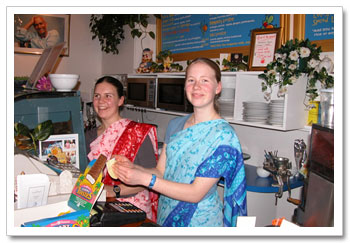 Here in New Zealand, the Sri Chinmoy Centre offers vegan and vegetarian cuisine at their cafés and restaurants in Auckland (The Blue Bird) and Christchurch (The Lotus-Heart) and globally at dozens of small cafés, restaurants and food enterprises run by students of Sri Chinmoy. A popular 'Conscious Living' course is offered in New Zealand which introduces fundamental life skills for well-being based around nutrition, exercise and meditation.
A living spiritual Master much recognised for his lifelong work for world harmony, Sri Chinmoy has touched and inspired the lives of countless people globally through hundreds of published books; concerts of meditative music; humanitarian aid; and pioneering the world's longest, largest participation torch relay for world harmony ever seen – World Harmony Run.
If you are interested in exploring meditation as a wonderful lifeskill or familiarising yourself with Sri Chinmoy's teachings on diet and consciousness, look out for our free 'Conscious Living' and meditation workshops offered by the Sri Chinmoy Centre in New Zealand.
– Jogyata.

Some Reflections On Running
What a wonderful feature of our spiritual path the focus on physical wellbeing – especially running – is!
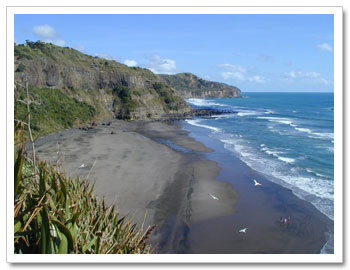 I'm so grateful that here in Auckland we have so many wild and beautiful places – mountains, forests, lovely stretches of coastline – that offer peace and solace and a refuge to the spirit. Cradled in the vastness of ocean and sky, how can we not feel gratitude on those lovely morning runs as we stride down the wilderness of beach that stretches out to a far horizon.
This week has been 'aspiration week' in the Auckland Sri Chinmoy Centre, an invitation to each of our members to set and reach new goals, enjoy open nights and new activities in our meditation Centre and generally rekindle our aspiration. I have set running goals – not an easy task in this cold winter! – and I am delighted with the results already. This morning two of us met up at 5:15 am and drove 45 minutes through a wet and rainy pre-dawn gloom to a large area of forest on our west coast – a wilderness of pines and native forest inhabited by deer, the odd wild boar and lots of small wild life. We ran for 30 minutes along the blackness of roads, the sound of the sea in our ears and light rain on our faces, then as darkness receded we ventured into the forest and onto some of the narrow game trails that wind for miles through these hills. At one point two large black stags erupted out of a clearing in front of us, the white tines of their antlers gleaming in the rainy dawn and the flick-flicker of their white rumps receding away through the trees.
 I was feeling such joy, exulting in an almost primeval sense of well-being and filled with gratitude at this enduring gift of speed and delight as we silently traversed the dark forest. We felt like indigenous man, all the artifice of civilisation gone, jubilant in the simplicity of life itself and the joy of being. Ninety minutes later we came out through dunes filled with tall ferns and grasses, crested a ridge of black sand and then out onto the beach where we swam in the freezing sea – the cold ocean filled us with a sense of physical and mental prana, the healing touch of nature, and we made our way back, bare feet in the rising tide, along the empty sweep of coastline.
This 'aspiration week' Sri Chinmoy's writings have provided a wealth of illumining insights into the benefits of exercise – and the unique benefits conferred by running in particular. One recurring theme is the principal of holistic living – the inter-relationship between mind, body, spirit. The runner can enhance his or her physical achievements by tapping into an inner power source, while the meditator can achieve a greater proficiency and stillness by first establishing a foundation of well-being, and of clarity in the mind, which running confers.
Consider some of these little 'gold nuggets' by Sri Chinmoy:
"When it is a matter of running, all the members of the family – the body, vital, mind and heart – have to work together. It is like a family party. The head of the family has invited all of the family members to come and eat. Through running, the soul wants to offer a feast to all it's children. What running is doing is keeping the body, vital, mind and heart fit, so that the soul can get complete happiness. The soul is happy when it sees that all it's children have come to enjoy the feast.
"We try to synthesize and harmonize the outer life and the inner life. The outer life is like a beautiful flower and the inner life it's fragrance. If there is no fragrance then we cannot appreciate the flower. Again, if there is no flower how can there be any fragrance?"
"The body's capacity and the soul's capacity, the body's speed and the soul's speed go together. The outer running reminds us of something higher and deeper – the soul – which is running along Eternity's Road. Running and physical fitness help us both in our inner life of aspiration and in our outer life of activity."
Sri Chinmoy demonstrates in his own life, particularly through his weightlifting, the truth of his comments on the relationship between power and strength.
"Strength is predominantly in the physical, with the physical and for the physical. Power has a higher and deeper source. Strength is an outer achievement. Power is an inner achievement. If there is a tug-of-war between strength and power, power will always win, for the source of power is infinitely greater than the physical strength that any human being can have. Power can be used in the physical, but it is not bound there. It's home is high, very high in the loftiest regions of the infinite Consciousness."
On the responsiveness of the body to the cosmic energy within Sri Chinmoy comments:
"We can draw upon the cosmic energy by entering into our deeper consciousness, the all-pervading consciousness, which is here, there, everywhere. It is the inmost consciousness that touches the springs of the cosmic energy. If we can have a free access to our inmost consciousness, the cosmic energy is bound to come to the fore. If you go deep within it comes like a spring, a never – failing spring. And when it comes it permeates the whole body."
And here is an unusual insight:
"Running has it's own inner value. While you run, each breath that you take is connected with a higher reality. While you are jogging, if you are in a good consciousness your breath is being blessed by a higher inner breath... each breath will connect you with a higher, deeper inner reality."
Sri Chinmoy encourages seekers on his own path to run each day, in so doing maintaining the body-temple as a perfect vehicle for the inner journey. Running cultivates aspiration, dynamism, physical excellence, clarity of mind, happiness, will power and determination – exactly the qualities needed for the inner-running toward the goal of God Realisation.
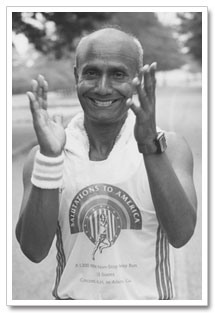 In one charming analogy he comments:
"Unless you touch something everyday it does not shine. Often I have told people to touch the furniture in their homes everyday. As soon as you touch something it gets new life... If you have good health, if you touch your health everyday it gets new life. By giving attention to something you give new life to it."
Sri Chinmoy's writings are filled also with references to happiness and self-transcendence:
"True happiness comes only from our increasing sense of perfection, which we can achieve only through self-transcendence. Self-transcendence gives us joy in boundless measure. When we transcend ourselves we do not compete with others but with ourselves. And each time we surpass our previous achievements we get joy."
"How I wish all human beings would run faster than the fastest, with unimaginable speed towards Eternity's ever-transcending Goal. Once we reach the highest transcendental Height with our fastest speed and consciously begin serving our Supreme Pilot at every moment, at that time we can and we shall create and absolutely new creation. At that time there will be only one reality, one song; the song of self-transcendence."
– Jogyata.
The Role of the Guru
There is, somewhere in the scriptures of India, an image of a very large lake to which, every 5,000 years, a bird flies and carries off a single drop of water in its beak.
It is said that the length of time it takes for the bird to empty the lake does not even begin to describe the eternity of lives it takes for a human being to achieve his ultimate destiny, which is to become Self-realised, to establish his final oneness with God.
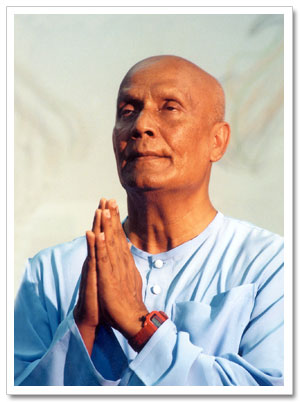 For many the thought of such an immense journey through endless cycles of suffering and experience is a depressing one – but there are two consoling comments to be made. For those who are consciously aspiring towards that final goal the lake is already almost empty, that long journey largely behind them; and then there is in each age and century a small number of guides who, having made the journey themselves, have come back to help us. They inspire us, remind us of our true destiny and purpose and awaken our longing and aspiration. This is the role of the Guru.
In the West there is often resistance to the idea of having a guru, but the presence in one's life of a living teacher is an immense opportunity and privilege. The guru accomplishes many things for us, accelerating our progress and shortening the time till our own realisation by many incarnations. Consider some of his or her functions:
Meditation
In accepting a disciple the guru undertakes the responsibility of leading that soul to God, and becomes one's 'eternity's friend'. My own guru Sri Chinmoy writes: "I wish to say that once you become a disciple and enter into my boat, then it is the problem of the boatman to take you to the golden shore. When I accept a disciple I concentrate on his soul and give the soul some inner meditation. I bring the soul forward and then the soul actually meditates in and through the seeker – in this way the disciple is bound to receive my inner instruction."
Every morning between 2am-6am this master meditates on all of his disciples around the world – guiding each one individually, specifically. "When I meditate on my disciples, I motivate and inspire each individual according to his acceptance of me and according to his capacity to receive and manifest the light that I am giving him."
Other masters of this century have also stressed the importance of meditation as the access bridge between themselves and their disciples, and stressed that no matter how far away physically they may be, they know their disciple's thoughts, feelings and consciousness. Referring to disciples in other parts of the world Sri Chinmoy writes that when a person concentrates on him, "immediately one of my inner beings or emanations comes to me and brings it to the attention of my physical mind. I may not know the name of the person, I may never have seen him in this life, but his soul comes to me and brings the face and physical form of the person right in front of me..."
And then further on: "Whether you are meditating in your master's physical presence or somewhere else is unimportant. No matter where you are, if you meditate soulfully you are bound to get his inner guidance. And this inner guidance, which is his inner oneness with you, will last forever and forever."
In this form of bhakti yoga the disciple meditates with his guru or on a photograph of his guru in order to tune in with that higher level of consciousness – this attunement is an essential part of discipleship. At the same time this attunement and devotion is impersonal, directed towards the guru's universal state of awareness and the qualities of that level of attainment rather than towards any human personality. When a God-realised spiritual Master enters into his highest consciousness, he is one with the Divinity within him. The human individual is entirely merged with God. To identify with this highest meditation of the master is to have a direct experience of the consciousness which is the goal of one's own inner search. This is not meditation on a human individual, but rather meditation on the Divine Consciousness, which is using the human as an instrument to reveal itself.
Acknowledging his role as a mere instrument, the guru steers devotion away from himself towards God – while in comprehending that God-Realisation actually means oneness with God, the disciple strives to please his Guru, for his guru's approval is therefore also God's approval.
Difficulties
 The acceleration that takes place in one's spiritual progress through the presence of the guru also means a karmic speeding-up, an intensification of all aspects of one's life – a cleansing, but sometimes difficult process whose benefits may await you beyond the limits of your current understanding.
My own extended visits with my guru, although occasions of great joy, have also precipitated all kinds of confrontations with the negative qualities inherent in human nature. These conflicts are an essential part of spiritual regeneration and their intensification offers an important opportunity to make rapid progress. The Guru has a catalytic effect in this way, for whatever negative characteristics we have repressed because they do not conform to our conscious ideal of ourselves, are surely and swiftly brought to our attention, to be faced and finally transcended.
The removal of these karmic fetters seems to be aided in many diverse ways by different masters – sometimes occultly or through physical contact or blessing; through food, even, or in the case of one master, Shirdi Sai Baba, by continuously handling small coins that his disciples had owned, extracting the negative condition from his devotees into himself. In India too, one sometimes sees devotees touching a guru's feet with their heads: in her biography of Meher Baba, Jean Adriel describes this as 'laying upon him the burden of their samskaras – those subtle impressions of thought, emotion and action, which bind the individual soul to recurrent earthly lives'.
Surrender and Obedience
For most Westerners surrender and obedience are two major stumbling blocks on the path of devotional yoga: to non-disciples the mere thought of an unconditional devotion to another person is abhorrent. We cherish our notion of freedom – even while knowing that our freedom is really only self-indulgence. But `real freedom `__ is something much higher, a freedom from suffering, attachment, ignorance and a life guided not by the pursuit of pleasure but by the very soul itself. And spiritual surrender, too, is not the surrender of a slave to the master, but a process of attunement with our own highest Self, our own Divinity, of which the guru is an outward representation. It is the human form which he must take that stands in the way of our recognition.
In relinquishing his own desires and cravings and surrendering his egoic self, the disciple is not surrendering to another limited finite ego, but to an embodiment of infinite truth, compassion and love, whose only motive is the disciples realisation. "I have to help you," Sri Chinmoy once said, "to serve mankind is the only reason I am here on earth." And so the master leads his disciples through ever deepening levels of understanding and love until finally, no trace of ego remains. "When the ego disappears", writes one teacher "there arises the knowledge of the True Self; one's consciousness is then that of the eternal and infinite 'I am,' in which there is no separateness, and which includes all life."
Progress
It is said that one incarnation spent with one's guru is equal to a multitude of incarnations of normal progress. His presence awakens our soul's longing for its creator so that all other worldly attachments are consumed in the wake of this one ascending urge to know God. The guru is the inspirer who reminds us of our real destiny, and who awakens the vast storehouse of energy and dedication that normally lies dormant within. As the agent of our transformation his call to perfection is drastic and uncompromising. He gives direction to this striving, kindling our aspiration again and again and pointing always to the farthest horizon. "Our goal," my teacher writes, "is always to go beyond, beyond, beyond. There are no limits to our capacity because we each have the infinite Divine within us."
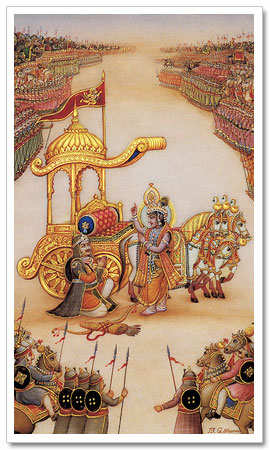 In each age the guru comes to make man aware of his divinity, to free man from his bondage and to lift him to a higher plane of being. The disciples effort in transcending and purifying his own nature is not confined to a passive and stoic endurance of challenges encountered with his guru, but extends actively into every area of his life – meditation, service, every aspect of his existence is his sadhana. He comes to welcome difficulties as a reflection of his own attachments or expectations, and learns not to cling, to let go of these parts of himself. He begins to realise that his life is really an extended workshop on God-Realisation, and that every hardship or problem simply presents him with another opportunity to achieve progress through surrender and desirelessness. His life becomes a meditation in action, increasingly centred in the consciousness that is growing within him. His guru's own compassion and detachment is taking root in his heart. This is the karma yoga of the Bhagavad Gita when Sri Krishna urges Arjuna to , 'Do what you do but dedicate the fruits of your action to me.' Sri Krishna's words to Arjuna are the words of every Realised spiritual master to his disciples and sum up the thrilling and immortal promise each guru makes...
Lord Krishna to Arjuna...
"Give Me your whole heart, sacrifice all for Me,
Bow to Me only, and you shall find Me.
This is My promise who loves you so dearly.
Give up then thy earthly duties,
Surrender thyself to Me only.
Do not be anxious;
I will absolve thee from all thy sin."
– from the Bhagavad Gita.
– Jogyata.
China – Three Impressions
Impression One:
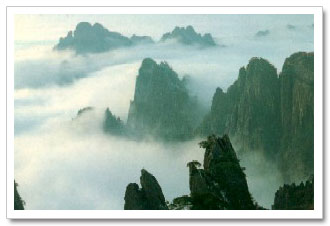 You are standing on the Yellow Mountains in eastern China, 6,000 feet up in the clouds, waiting in silence for the dawn. Around you a small group of your friends are dim figures in the mist, their breath forming white plumes in the cold air.
Huge feathery snowflakes are falling in slow motion like the softest down of giant geese, and you catch one in your outstretched palm to marvel at it's beauty. Below you on the steep mountainsides you have just climbed, giant bamboos bow under the weight of snow and the pines are Christmas trees of white, each needle a stalactite of crystalline beauty. You stamp your feet on the icy path and your cheap crampons grate on the granite slabs.
Now suddenly the mountain clouds are parting and there before you, materialising like phantoms from the mist, the fabled peaks and granite turrets painted down through the centuries in countless water colours and Chinese scrolls, rearing up into the dawn sky like so many lonely sentinels.
We were here to explore an ancient culture, twenty members from the New Zealand Sri Chinmoy Centre joining our international family and Sri Chinmoy himself on a six week visit to China. Bejing, Xian, Nanjing... Confucianism, Taoism, Buddhism. We would travel to many places and see many remarkable things. On the Great Wall near Bejing Sri Chinmoy would play the esraj in a spontaneous concert, the meditative sounds of this most haunting of musical instruments a perfect mirror of these endless jumbled hills and ancient landscapes.
Standing on those great ramparts, immersed in the silence of mountains and spirit of place, I was imagining the great armies of invasion and conquest marching across these remote wastes over the long sweep of centuries; marveling at the ambitions of the great rulers and Emperors and their dreams of dynasty. How perfectly Sri Chinmoy's music evoked these great struggles and sagas of our race.
In Qingdao in the half-light of dawn, we held running races two mornings of each week on the icy beachfront promenade above the freezing sea. In our function room later, Sri Chinmoy would personally award the fastest and often read out the times of all competitors, encouraging us not to grow old. Perfecting body and mind through running and meditation to better nourish the life of spirit. To realise God – the penultimate goal of all human life – every part of our being has to become surrendered and obedient to the divine task-master, the soul, the base metals of ignorance alchemising into the gold of a radiant Self.
And each morning, secluded in our function room like disciples or monks of old in their ashrams and temples, we would repeat the solemn and soulful prayer-chants of Sri Chinmoy, eyes half-closed in meditation. Here is a gem from Thursday, January 14, 2005:
O Lord Supreme,
Do dissolve me
Into Your Infinity's ecstasy.
O Lord Supreme,
Do dissolve me
Into Your Eternity's nothingness.
You can chant it slowly over and over as we did, like a Vedic mantra, or you can imagine you were there with us, hearing Sri Chinmoy deliver these lovely words with his unforgettable voice, a voice saturated in the consciousness of God.
Impression Two:
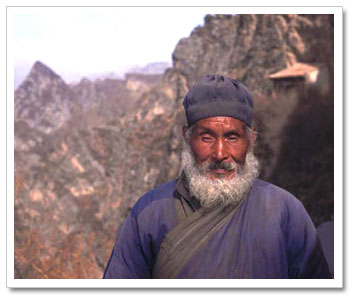 You catch the bus bound for Nanjing from the town of Huangshan, a six-hour ride that takes you at first through mountain passes and steep forested hills then out onto wide plains terraced with small fields and neat rows of crops. In the wintering fields, plastic bags flap on bamboo poles a poor man's scarecrow – and the pale green plains recede away into far-off silhouettes of mountains. You sketch a panda on your notepad and hand it to the old man across the aisle, pointing to the distant hills – are there any of those vanishing bears still left up there? – and he cackles with delight. His eyes twinkle and smile at you and looking into his face you know he is a survivor from a world you will never know or understand. Is he one of the old Taoist monks who took refuge in the mountains during the Revolution?
Now you are passing through ramshackle small towns where vegetable stands, bicycle shops, butchered animals and clothing spill out onto the footpaths and streets; onward through small villages where women wash clothes in brackish ponds and streams and dogs lie in the dust.
You doze and wake to find yourself at a dilapidated rest stop. Outside, the driver cradles a small puppy in his arms and the passengers crowd around him, clapping and smiling at his gentleness and taking turns posing for photos. The old Taoist stands alone, singing a song full of pathos, his eyes closed. He is free of all self-consciousness and dissembling and you envy him the depth of his feeling. Then onwards, south through fading light and industrial estates and fallow empty fields and far ahead in the growing darkness the lights of Nanjing are waiting for you, twinkling and pulsing like the heartbeat of this vastness land.
Like a lamp shining through a thin veil of cloth, the light of God shines through a realised Master, through every action, every moment of their life. They spread like a giant tree the pollen of enlightenment and if this pollen falls on you, your life will never be the same. Look at what happened to me this morning. At 6:30 am I was standing on the eighteenth floor of our hotel in Xian when the elevator door opened and there was Sri Chinmoy, standing alone in the lift. He beckoned to me without speaking and I joined him on the ride to the lobby. What is it about such an encounter that makes this so unforgettable? In the 20 seconds of our downward ride in the elevator, Sri Chinmoy simply looked at me smiling and meditating on my soul. Suddenly I felt breathless with the feeling of spirit, filled with light, elevated to another realm of being. My consciousness was catapulted upwards like a dove tossed into the sky to fly, and all day long a feeling of profound peace and stillness lingered inside me. How strongly I could feel my own soul! I could hardly speak and rushed back to my room to meditate. It is hard to describe such things. This is one of the things that a spiritual master can do for you in the twinkling of an eye.
Impression Three:
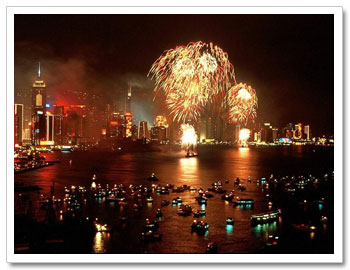 When you first hear the rolling thunder you stumble from your bed to the window and peer out into a midnight sky bright with splashes of colour and light. You go downstairs, out into the street, and the air is blue and pungent with smoke and fireworks are exploding across every part of the night sky, across the battlements of the old city wall and the high-rise apartment blocks, across the river that ferried troops at dawn during the wars and insurrections, across the downtown canyons with their skyscrapers and neon lights.
You think to yourself, why am I so comfortable here, why is it so familiar, have I been here before in some forgotten time and you turn away from the growing sounds of New Year revelry and the dancers in the hotel lobby draped in dragon costumes, leaping and swaying to the banging of drums and music and you walk along the nearly empty streets while the fireworks crackle in the alleys and explode over your head and all of your unlived lives are stirring inside you, all your secret longings squeeze your heart, and all your nostalgia for what you will never be and do tumbles down on your head like the spent casings of falling skyrockets.
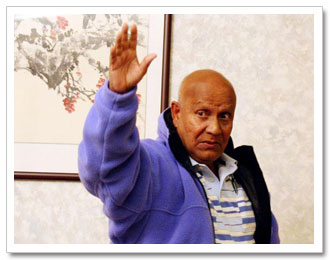 I remember well our last day in Nanjing. Those who have not already departed wait in the hotel lobby, spread out along the fifty metre route that Sri Chinmoy will walk from the elevator to the waiting van and the first leg of his long journey home. At 6:15 am he emerges from the lift, sees the gauntlet of his students awaiting him. He accepts this and begins walking very slowly, with tiny steps down the parallel lines, looking at every single person in turn for four or five seconds. "I hope I can see you all at least once in this incarnation," he had said of disciples living in far off countries, "so I can expedite your progress, your soul's journey." Many here come from such places – when will they see him again? – and this moment is intense and poignant. To each face Sri Chinmoy turns, smiling yet concentrated, a lingering, loving, farewell benediction, wordless yet powerful with the full force of an inner blessing. Yes, expediting the progress of the soul. Other hotel guests stand motionless, sensing that something sacred is taking place. In some part of their being they too will benefit from this encounter. The pollen of God, spreading to every heart and life. At the end of the line, Sri Chinmoy turns and waves one last time, not with a sense of goodbye but casually – to the Master there is no separation, time and space are creations of the mind, part real, part illusion. Then he steps into the van and is gone.
– Jogyata.
The Colouring Book
In the 60s my three sisters and I were children growing up in a small New Zealand town by the sea.
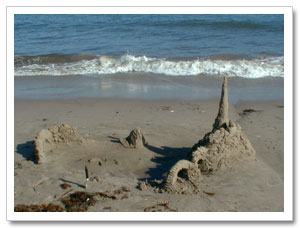 My father liked the simple ways and always walked or bicycled to work, shunning the enchantments promised by an emerging new age of television and motorcars. Our home became a fortress sand-castle, defiant against the rising tide of technology – eventually the ramparts crumbled and my father capitulated to the incoming tides of change. Years later though, he would remind us with great pride that we had been the last house in our suburb to get TV.
In this new world, evening scrabble, cards and colouring books were replaced with television and the old bicycle eventually surrendered to a gleaming Ford Prefect motorcar. Scrabble was a huge loss to me – I excelled at concealing essential letters in my clothing, at outrageous inventions with the English language and endless intrigue. And our picture books – with pursed lips, brows furrowed with a child’s concentration, how devotedly we would colour in the black and white sketches with our crayons and pens. Later I came to see how much of a metaphor this pastime was – how much the distinct, theme qualities of our nature would colour in and determine the flavours and experiences of our lives.
 I was last to leave our happy childhood home. The bus that would take me out of my parents' lives finally pulled out of the station, and I was peering out of the window, the first sorrows of adulthood filling my eyes. There they were, weeping inconsolably at the departure of their last child, holding each other helplessly by the arms. And years later we children would come together again, silent and weeping before the solemn and sad mystery of their deaths.
So began a long 13 year odyssey, the journey of discovery that we all make in one form or another as we colour in the storybooks of our lives. And discovering as we all sooner or later do that there is absolutely nothing out there, no place, no person, no possession, that can make us lastingly happy. In my own wanderings – that long fruitless detour across the parched deserts of worldliness that would lead to this understanding – I would often hear, whispering in my mind, the words of the Greek poet Cavafy, "No ship exists to take you from yourself..." and T. S. Elliot's sombre words would echo in refrain: "We shall not cease from exploration and the end of all our exploring will be to arrive where we started and know the place for the first time..."
Yes, the longing to see everything clearly as it is, without ego, mind, thought or the colouring book crayons of a consciousness unillumined yet by spirit and true understanding.
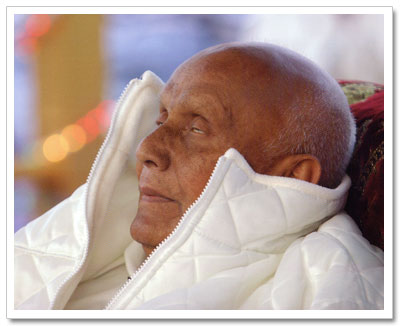 Then in 1980, standing in a busy street in South Australia, I saw for the first time a face that would become dear to my life and a guiding beacon in my journey. It was a framed smiling face of Sri Chinmoy, there in a café window, and in that one random moment my life would change forever.
Nudged by a grace-filled universe, I shortly after became a student of Sri Chinmoy – what that meant I hardly knew or cared – and thus began a new and marvelous re-colouring of my life.
Very gradually, meditation ushered in a new calm and purpose to a willful, restless mind; and out of the deepening stillness of my practice there emerged a new sense of Self, deeper and greater than any of the selves I had been and known. Exercise, especially during the early, intense years of athletics and running when Sri Chinmoy himself would often accompany us, made the body strong and filled with aspiration. And how I devoured, hour upon hour, the many books of insight, wisdom and inspiration that flowed out of this teacher's remarkably creative life.
Yet it was Sri Chinmoy's own presence and those wonderful moments in his company that were the highpoints in this new adventure. How hard it would have been to experience those wonderful breakthroughs and heights of consciousness on our own, how difficult to believe in the possibility of enlightenment without seeing it first in another, how unlikely an enduring belief in God without seeing, there in human form before you, this great yogi clearly and unmistakably immersed in the divine.
 The brush strokes of this new life were filled with the colours and fragrances of the inner world – the soul's delight, felt in the silence of meditation; the heart's expanding love and it's growing concern for others; a new sense of purpose as every part of the being, magnetised by the energies of spirit, swung towards the pole of liberation. A sense too of gratitude, both for this great journey of awakening and to the guide who was leading our footsteps safely along the path. "My Lord," Sri Chinmoy wrote in one of his poems, "You have given me two things absolutely unparalleled. A map of the eternal journey and the courage for the immortal traveling."
Years later, I would come across an old box of childhood things, mementoes and treasures from a distant past – an old shawl, some favourite poems of my mother, a silver broach, the sepia brown photos of unknown grandparents – and there among the heirlooms and memories, one of our old colouring books, still with its' bright colours and poignant innocence. Feeling now the beautiful and hidden perfection of life and marveling at the long journey of the soul with its' many selves and guises; peering intently at the colours I had used, trying to understand how far I might have come; how far I might have to go to reach journey's end. Here, back at my own starting point I remembered once again the words from Elliot's poem, and how the end of all our exploring will be "to arrive where we started and know the place for the first time... Through the unknown, remembered gate when the last of earth left to discover is that which was the beginning..."
How grateful I am to all the teachers of my life whose knowledge has encouraged me along my way. How grateful I am to my own teacher, Sri Chinmoy, the brightest polestar in my life sky, who colours in my journey with the bright things of the soul and leads me through that doorway of spirit – the 'unknown, remembered gate' – on the great quest for God.
– Jogyata.
Tales of Enlightenment
 I can recall only one occasion in my life when, ever so briefly, I fondly imagined that I was about to become enlightened. It was way back in 1978 and I was sitting in the cold winter sunshine on the shores of Rabbit Island, near Nelson in New Zealand, looking out across the great sweep of tidal flats and water that stretched out beneath an immense vault of blue sky.
For some months I had been soaking up the little gold nuggets of Zen Buddhist teachings and now, beguiled by a soothing breeze and the calm emptiness of sky and sea, I began to feel some otherworldly, existential joy stirring deep inside me. It was an inner ecstasy, a glimpse of the soul's delight and its freedom from all of the things of this world, and I hunkered down in the warm sand and the afternoon sun to wait for this great joy to engulf me entirely. Seated in some absolute stillness – a frail monk peering into eternity – I watched as out of the matrix of silence, the beautiful pageantry of life unfolded – the simultaneity of a million events, lives, causes, all interconnected in the river of being and time. High up against the blue sea birds crossed the sky then vanished into the void, the sounds of the waves lapping very quietly, a soft persistent cadence. Ego, mind, body all fell away – I felt I was only spirit, enraptured in my new-found oneness with all of life.
 Alas, as the hours wore on my euphoria receded, along with my expectation of an enlightenment experience, and I realised that I was about to rejoin the great Multitudes of the Unenlightened. The tide had come in and one of my discarded shoes, mocking my dismay, bobbed past me in the tide, enjoying its own brief liberation from worldly constraints. But the doorway had opened and I would never forget this sweet feeling of the inner life, like the distant memory of a happy childhood awoken by the fragrance, half a lifetime later, of a single tiny flower.
And years later as well, Sri Chinmoy's lovely words would validate my experience when, in response to someone's question "When will I realise God?" he replied; "How do you know that you have not realised God? Everybody here has realised God. But there is something called conscious realisation of God and something called unconscious realisation of God. Unconscious realisation you already have – now you have to realise God consciously."
Sri Chinmoy then tempered these reassuring observations with a final delightful proviso. "There is an earthly calendar and there is a Heavenly calendar. In terms of Heavenly time, you will realise God very soon. In terms of earthly time, perhaps you will have to wait for a few more years."
– Jogyata.
Related Links
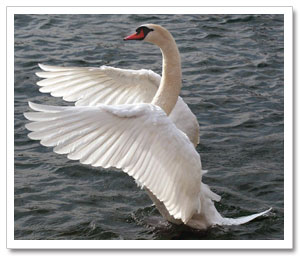
- Swan: Realisation
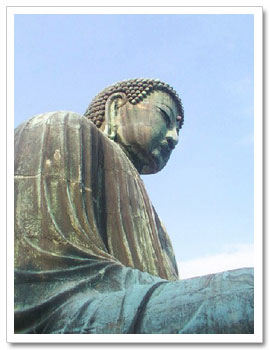
- The Great Buddha and pictures of the Great Buddha (Diabatsu), Kamakura
Notes From A Diary - August 2004
Experiences and impressions while visiting Sri Chinmoy in New York.
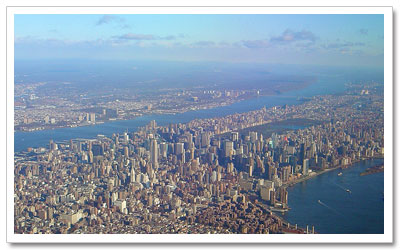 Midsummer in New York. Our small contingent of runners from the Sri Chinmoy Marathon Team in New Zealand are about to touch down at JFK Airport for two weeks of races, musical performances, meditations, even an amateur circus! Out of the plane window the evening lights and urban canyons of Manhattan recede away along famous avenues into haze, then we're banking across sprawling suburbs, sweeps of ocean, then touchdown. The baggage carousel is dotted with familiar faces from our global family – 1,000 students of spiritual teacher Sri Chinmoy, drawn from over 40 countries are converging on New York to compete in our annual Self-Transcendence Marathon.
Now my host and long-time local friend bundles me into his car and I'm whisked along a busy expressway into a quiet street in Queens, home for the next fortnight – then sleep, much needed after the 22 hour journey from Auckland.
Friday, August 25th
Marathon day! My alarm clock sounds at 4am after 3 hours of light sleep and I wander a few blocks through the empty streets to join others for the one and a half hour ride upstate. At dawn we disembark sleepily from a convoy of ageing yellow buses – before us now a calm lake, three miles in circumference, oak-fringed and dotted with small groups of waterfowl. Sri Chinmoy arrives, climbs slowly onto a small dais at race start. Against a backdrop of still trees he stands quietly in meditation, bringing to the excitement of our 900 strong field of runners a sudden quiet, an intensity of purpose, a sense of sacred journey. We all know the trials that are to come and the silence that has now fallen is not a perfunctory one, a mere absence of voices, but a drawing to the fore in each of us of the inner resources, the power and grace of spirit.
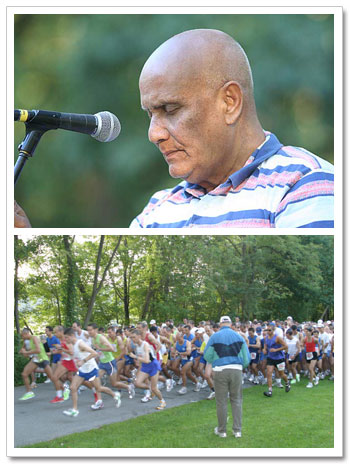 For this pastoral scene with it's pleasant vistas of water and shady canopies of green boughs will soon go unnoticed as the miles of the marathon take their toll. Once past the limits of our training and preparation, we will each confront our private demons of failing body, mind or will – and then attempt to transcend these in our striving to excel.
Seated race-side in a low chair, Sri Chinmoy watches us run by, pride, love, concern and encouragement in his face – I love this recurring encounter and my steps quicken each lap as I see and pass by this inspirational figure and feel his silent blessing, the huge force of his relentless spirit. His words ring in my heart, a mantra of self-transcendence – "There are no limits to our capacity because we each have the infinite Divine within us." Undertrained, I am spent by 20 miles and now begins my own test of character and grit.
Yet it is here at the very limits of body, mind and will that the gateway into another world lies open, beckons, a world beyond the everyday comforts which so constrain the flight of spirit. At this intersection of self and Self, man and God, body and soul, where flesh cries out to spirit and the finite touches the infinite, here it is that we peer into a mystic realm and glimpse the deeper capacities within us, a region where inner power and cosmic energy can be accessed and revive a failing body.
Now at journey's end, people are cheering and clapping each runner and I wobble over the finish line – someone places cell salts and a drink in my hand and I lie on the grass in a cocoon of gratitude and relief, staring up into a great vault of blue sky. I am reminded of the Chinese proverb: "Every treasure is guarded by dragons" and now the marathon behind me and dragons banished, the treasure of a quiet jubilation fills my heart.
Later at an evening function, showered and sumptuously fed, we all pass by a microphone and announce our marathon times – some have taken an epic seven hours to complete the 42 kilometres but Sri Chinmoy treats first and last alike, appreciating the winners prowess and dedication as much as applauding the unflagging determination and will of those last to finish. That night we all sleep like babies.
August 27
Today is Sri Chinmoy's birthday, a high point in our lives and always a day to remember. We are invited down, country by country to file past the seated Master and I slip into a long procession as we slowly shuffle forward. Thirteen hundred people are here, the men in white – thankfully, for the temperature is rising – the women in a bright multitude of colours and wearing saris on this special occasion, a traditional garment honouring the sacredness of spirituality itself.
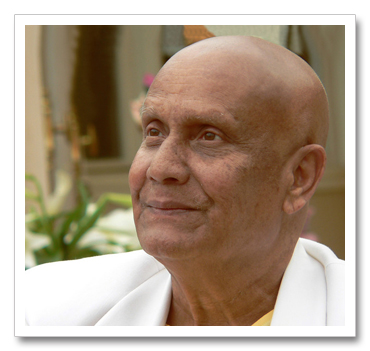 In the absolute silence of this meditation we are stilling our minds, summoning our deepest receptivity, preparing ourselves for this moment when our hunger for happiness, freedom, enlightenment, grace – whatever aspiration each of us has and brings – is seen, responded to, perhaps fulfilled in this encounter with a true man of God. "A moment with the Beloved" goes the proverb, "and the river changes it's course". Yes, the beatitude of a compassionate glance, the capacity of a genuine spiritual Master to remove the karmic fetters and obstructions of millennia – the samskaras spoken of in the Buddhist texts – can change the course of a life in a fleeting moment. We all know this and bring to the solemnity and sacredness of this occasion our highest sincerity and aspiration.
Now suddenly I am looking into the eyes, the face, the extraordinary beauty of a human consciousness that has merged entirely with God and gone, quite simply, beyond all human comprehension. Inside my mind, like a bell, I hear the vedic mantra Tat twam asi – 'That thou art' – or what I have within, or what I shall become. The thought is comforting and looking for what seems like an age into the calm and loving eyes – eyes that see into every part of my being – I try to feel that in Sri Chinmoy I am seeing the highest possibility of myself. Yes, to see in another the highest flowering of the Divine is to more fully understand the final end of one's own life quest. Beyond all book knowledge, all speculation, all discussion, there, in front of you, a face steeped in God, a being at the end of all journeying, at the summit height of all striving. Deeply moved I slowly walk away, feeling inside me the lovely benediction of the Master's lingering smile and with it the promise of my own liberation. One day, yes, we too shall fulfill our promise to realise and reveal God on earth.
2pm – Lunch is served
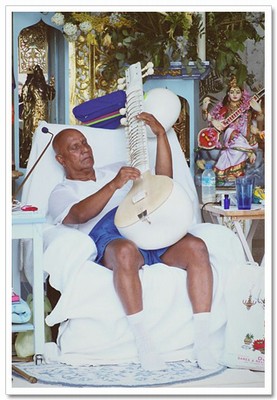 Platters of Indian curry, rice, mango lassi and delicious sweets. And now a lovely concert, with Sri Chinmoy performing on sitar, esraj and piano. These solo performances invite audiences beyond a merely passive entertainment into an interactive oneness where performer and listener are co-participants in something they each help to create. Here the outpouring of a music saturated with the serene consciousness of meditation, offered to an audience willingly still in mind and open of heart, creates an energy and a force for inner peace that is tangible But Sri Chinmoy's music is also known for it's wonderful revelations of power – and this afternoon we would witness this firsthand. Seated in front of a grand piano Sri Chinmoy paused as though awaiting or invoking a higher force. Watching, I felt a moments profound admiration at the extraordinary inner poise that he clearly had – and would need – to perform a twenty minute spontaneous piano improvisation in front of 1,300 people, with absolutely nothing other than God-reliance as his guide. Sri Chinmoy himself would simply be an instrument and the music flowing through him would come from a higher world. Like the wind passing through an empty flute, or the sap rising up into the branches of a tree, he would simply convey a current of sound, energy and beauty as a channel of the Divine. Face still, body upright and full of a calm repose he began to play, hands flying over the keys in a cascade of sound. Resounding chords and sweeping arpeggios followed moments of sublime and barely audible sweetness – fingers, arms, elbows, fists were used, thundering away in glorious abandonment in an unfettered fountain of creativity. He was brushing aside the constraints and conventions of Western music and dazzling us with a demonstration of an absolute freedom from all form, all mind. This was pure creativity, music flowing directly from the Source.
That night, some beautiful tributes from world leaders are read out honouring Sri Chinmoy's birthday and his forty years of service in the West. Many are profoundly moving and show a deep appreciation of this most remarkable of lives.
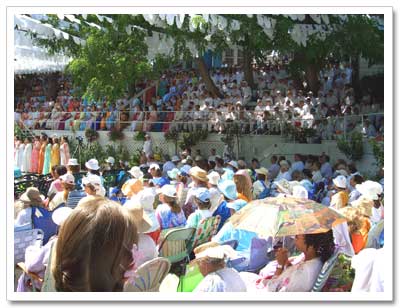 The days fly by – there is a sense of existing in some dimension of time that is not of this world, existing in a haven of spiritual energy and light created by the aspiration of a thousand seekers and the grace of a single illumined master. We feel too a sense of urgency and velocity – two intense weeks here can offer the benefits and progress that only many years of meditation and unguided effort might yield on one's own. And such a blend of modernity – sports, fitness, activity, dynamism – with ancient disciplines – prayer, chanting, a bhakti's focused devotion to the goal, a striving in meditation's silence to more fully unveil the secrets of the soul.
Now departure day arrives and van loads of Sri Chinmoy's students are vanishing out to regional airports and dispersing across the globe to far-away, often remote cities, to lives rooted in other customs. How strong the sense of unity amidst this multiplicity of faces, languages, cultures. For we are a family in spirit and the bonds that join us so often run deeper than those of physical kinship or propinquity. We share the same commitment to the ageless quest that lies at the heart of all human life and raises it up above the ordinary into the realm of the sacred – the quest for God realisation. "There is my life" wrote novelist Lawrence Durrell, "and there is the life of my life." Yes, this journey of awakening is the life of our lives. Leaving the Aspiration Ground for the last time to catch my own flight home, I do not say goodbye to anyone. My Indian cab driver tells me a joke and I ask him "Do you know Sri Chinmoy, he is from your country?" He replies "Oh yes, Guru Chinmoy, he is the great saint from India. It is good to have him in our midst."
– Jogyata.
- ‹ previous
- 117 of 125
- next ›

Except where explicitly stated otherwise, the contents of this site are licensed under a Creative Commons Attribution-NonCommercial-NoDerivs 3.0 Unported License. read more »
SriChinmoyCentre.org is a Vasudeva Server project.