
Soul Birds Take Flight
This article was originally published by an art magazine in New Zealand. The art reviewer that came to visit our exhibition of Sri Chinmoy's artwork and music was very taken with the beauty and serenity of the gallery.
 The bright blue door that I had been given directions to in Central Auckland had only a simple gold sign on the door – Jharna Kala Gallery – and I opened it and climbed the two flights of stairs to this latest and most unusual of Auckland's many galleries. Artist Barnaby McBryde had described the paintings and drawings I was about to view as "a mammoth and magnificent accomplishment for world harmony" and I was intrigued!
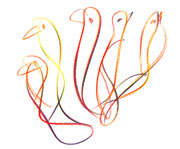
Upstairs I stepped into a large, brightly lit room – varnished wooden floors, the gentle sounds of a flute and on the pale blue walls one of the most extraordinary collections of artwork I had ever seen. These were a selection of avian images from the pen of mystic artist and recent New Zealand visitor Sri Chinmoy, whose huge legacy of many thousand acrylic paintings and – brace yourselves – several million pen and ink bird sketches forms one of the most prolific and monumental achievements in modern art.
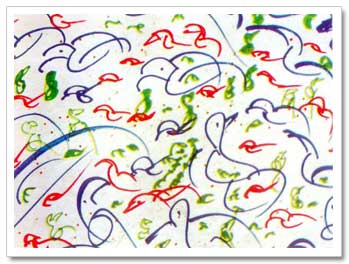
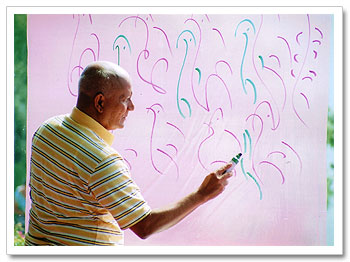 "Jharna Kala," my host explained, "means 'fountain art' in Bengali – a spontaneous creative flow arising out of an inner stillness." I was reminded of the 'no-mind' meditative brush strokes of the Zen monk calligraphers, the moment of insight and inspiration rapidly captured and never retouched. On the gallery walls a selection of some 10,000 of Sri Chinmoy's charming bird sketches were arrayed – some in flight, some in repose – each depicting the imagery and choreography of the human soul. They ranged in size from tiny miniatures, materialising on the page with a calm lyrical sweep of the pen, to large canvases rich with bright vibrant colours. The ink strokes were those of a master hand, deftly captured soul birds each with its own personality, hovering alone or in harmonious groups in an inner sky.
For centuries, I was told, the bird image has appeared in both eastern and western art as a symbol of the flight towards liberation, happiness and freedom that lies at the heart of human life. Quotations from Sri Chinmoy's own comments on his art reinforced this perception:
"Birds have a very special significance; they embody freedom. We see a bird flying in the sky, and it reminds us of our own inner freedom. Inside each of us there is an inner existence we call the soul. The soul, like a bird, flies in the sky of Infinity. The birds we see flying in the sky remind us of our own soul-bird flying in the sky of Infinity. While looking at the birds, feel that you yourself are a bird; you are your soul-bird flying in the sky of infinite light, infinite peace and infinite bliss."
 Sri Chinmoy's vast body of creative works is unified by an underlying spiritual theme; the artist believes it is the blossoming of our spirituality and the oneness-wisdom-goodness of the human heart that hold the keys to a better, brighter future for all mankind.
At the end of my slow perambulation around the gallery I am beginning to feel a smile on my face and can feel unmistakably that I have been touched and charmed by this mystical inner universe, where avian landscapes so perfectly capture the soul's inner freedom and joy. This exhibition is truly delightful and moves the very heart with its simplicity, joyfulness and beauty.
At the door I read through a comment sheet from others who – in other such galleries both around New Zealand and on six continents – have shared this same experience. There are inspired remarks from two of our former Prime Ministers, a handful of city mayors, several sports celebrities and a raft of global leaders and statesmen. Clearly Sri Chinmoy's art has touched a universal chord.
Leaving, I pause to read a last comment from this most humble of artists, Sri Chinmoy himself:
"These birds will be able to offer happiness to each and every human being – conscious happiness, illumining happiness and fulfilling happiness. The joy, the ecstasy, the delight they have and they are have a free access to each and every human being's heart."
– Jogyata.

Notes From A Diary – April 2004
Experiences and impressions while visiting Sri Chinmoy in New York.
5:20 am
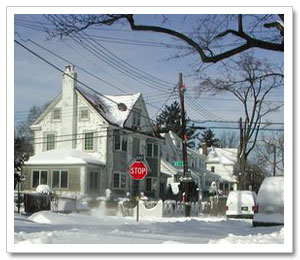 The first alarm clock goes off in the darkness and people begin to stir. There are 13 of us staying in this small New York house in Jamaica, Queens and space is at a premium. So is the hot water – enough for only ten showers – and outside it's been snowing. The prospect of a cold shower inspires much good-natured rivalry and beds are quickly emptied – then the stillness of the 6am meditation descends upon the house. Now candles one by one are lighting the darkness and the fragrance of incense fills the air – in their individual circles of light the disciples begin the morning meditation, indistinguishable black silhouettes illumined against the candle flames. In a two-mile radius of this New York street some 800 visiting disciples of Sri Chinmoy are also beginning their day, drawn from over fifty countries to the wintering streets of this often daunting city to benefit from the presence of this great living Master. 'A moment with the Beloved,' goes the saying, 'and the river changes it's course.'
Sri Chinmoy will also be meditating and probably has been most of the night – the thought is comforting, as of some infinitely loving being watching over his children and extending to the whole of humanity an unfathomable and divine concern.
7:00 am
After meditation I run 3 miles with two Australian friends, navigating the icy, sleeping suburbs and a gauntlet of snowballs from other disciples. The outer running cultivates dynamism, well-being and clarity of mind. It expedites the inner running, the urge towards progress and a final promising liberation or enlightenment. There is an exhilarating sprint finish, more snowballs and playfulness – some New Zealanders from our Auckland Centre have found their way onto an overhead balcony and in concealment launch a fusillade of snowballs, scoring some direct hits. We are forced to retreat into our local diner, The Smile of The Beyond, already jammed with disciples and steamy with warmth and food smells.
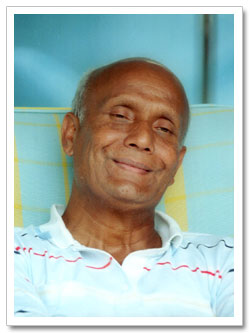
 Overhead on the wall some lines from one of Sri Chinmoy's poems which inspired the name of this restaurant catch my eye: 'His smile is the fragrance of the Soul. His smile is the Smile of the Beyond.' Already it feels good to be here, a sense of coming home.
9:30 am
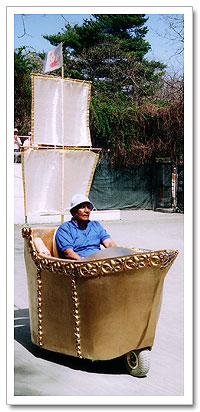
The sun is out, bright and cold, and the streets are turning to slush. Anticipating spring, squirrels are materialising everywhere in the high overhead boughs, scampering and leaping across impossible spaces in games of aerial pursuit. Down below on the Aspiration Ground – once an outdoor tennis court but now a place devoted solely to spiritual practicessuch as singing and meditation – Sri Chinmoy has taken a seat inside a small motorised cart framed in the shape of a Golden Boat. Built by his New Zealand students and transported piece by piece to New York, the charming miniaturised replica boat is a gift honouring Sri Chinmoy's 40 years of service to mankind. The boat is an apt metaphor of the inner, spiritual boat (the Path), of the Boatman (the Guru), and of the journey across life's ocean to the shores of God-realisation.
Eyes half closed in a meditative trance, the Boatman steers his Golden Boat in calm, slow sweeps, circling the court and summoning a profound stillness. Eight hundred people silently observe and meditate. Such moments when the seeker's aspiration and the Master's inner guidance intersect offer rare opportunities for breakthrough meditation experiences – the Aspiration Ground is almost breathless in a silent intensity of purpose.
1:00 pm
 In this early afternoon Sri Chinmoy calls us down from our seats to form three long lines in front of him – this is a walking meditation, always a high-point in our visits to New York. Each column of disciples is to choose one song and to sing this aloud as we slowly file past the seated master. The mantric song-chants and the slow meditative pace of the walking generate a sense of sacred ritual – and the Master's searching, momentary concentration on each of his disciples as they slowly file by inspires in each an intense, mounting aspiration. Here the timeless and hallowed Guru-disciple relationship reaches its penultimate expression – for these moments where Sri Chinmoy meditates on the soul of each disciple expedite our development and progress to an unimaginable degree.
The hot afternoon sun and the shuffling procession of feet are now stirring up a thin, grey dust – looking down at my brown feet in their tattered sandals, I am reminded suddenly of the dust and heat of some other place and time, the image floating up and tugging at the edges of memory, an ever so faint echo from some irretrievable past. We were seekers from some timeless inner landscape and I could feel my soul's memory of the long centuries spent in the search for enlightenment and the quest for God. Captivated by this feeling I was stumbling in the wake of the singers, body barely upright, intoning the mantric cadences of song and the words of the immortal melody 'Dak eseche, dak eseche – call has come, call has come, Lord Supreme's call.'
Some were singing with great power, the song a war-cry, others were whispering, as though barely able to speak. We were embodiments of the eternal seeker, the quest for God which lies at the heart of all human experience – and the moment evoked the timeless quest for self-knowledge, enacted in a thousand dusty ashrams, temples, places of pilgrimage everywhere where the spirit of man is awakening.
Then a long AUM sounded from Sri Chinmoy and our voices, one by one, fell silent. Reluctant to forsake my meditative tranquility and utter detachment from body and mind I sat on a nearby bench, eyes closed. It had been a lovely finish to my week with my teacher.
3:00 pm
Later, prior to my departure for the airport, Sri Chinmoy invites those who are leaving today to file by, and we walk past the smiling, reclining figure for a last valedictory blessing. I like this wordless and unsentimental farewell, reminding us that for a God-realised Master there is no separation. "In true oneness," Sri Chinmoy once said, "there is no coming or going, no giving or receiving." Armed with the knowledge and feeling that the Guru and disciple are always together and one, I leave for the airport. My new journey will outwardly take me to the farthest end of the world but inwardly is simply another step in the fulfilment of the soul's promise to serve God.
Later
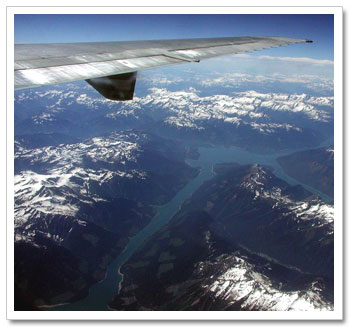 35,000 feet above the snow drenched mountains of Colorado. I jot down the opening lines of a poem I might someday write, but doze before much comes out. The words sprawl lazily across my notebook, then trail off the page as sleep comes...
SOMETIMES...
Sometimes I feel like a slingshot, hurled,
Flung far into the void.
At last come to rest on some distant shore.
Sometimes I feel like a banner unfurled,
Hoisted aloft, heraldic,
Your victory to proclaim in some distant war.
Sometimes I feel like a child, curled,
Asleep in your arms, Beloved
Dreaming of promises made I can't ignore
Hearing You say "Awake! You must do more!"
Dreaming of promises made in lives before...
– Jogyata.
A Spiritual Lion Comes Again
An article written for an Auckland Indian community newspaper in 1989 prior to Sri Chinmoy's visit to New Zealand later that year.
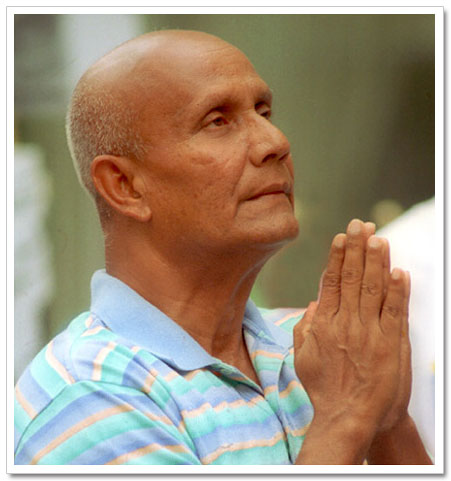 Members of Auckland's Indian community will be delighted at the prospect of a visit to New Zealand this year by one of India's most remarkable spiritual Masters, Sri Chinmoy.
58-year-old Sri Chinmoy has been compared to Swami Vivekananda, who brought the message of India's spirituality to the 1893 Parliament of the World's Religions in the United States. Both were children of Bengal, both Kshatriyas, both spiritual warriors and both expatriates who embodied and spread India's priceless spiritual wisdom around the world.
If Swami Vivekananda planted the seed of India's spirituality in the West, then perhaps it can be said that Sri Chinmoy has tilled the soil and is nurturing the garden, spreading and teaching the same precepts as his peer and predecessor.
Sri Chinmoy first visited New Zealand in 1987, when he offered a Peace Concert of his own compositions to a capacity crowd at Auckland's Logan Campbell Centre. He also performed on the Auckland Town Hall pipe organ, and listeners were spellbound by his inspirational masterpieces which left a deep and meditative silence in the Town Hall before the standing ovation that followed. A creative genius whose 7000 compositions to date have all flowed from the silence of meditation, Sri Chinmoy offers his music as an experience of inner peace.
His works of art – entitled Jharna-Kala or 'fountain-art' – are also meditative in origin and of profuse variety and number, some 140,000 exhibits that again offer a glimpse into the higher, serene worlds of consciousness.
Sri Chinmoy's dedication to outer peace has resulted this year in a flood of tributes from the international community – an acknowledgement of 25 years of self-offering to humanity – and won him the title of the 20th Century’s First Global Man.
Plans for Sri Chinmoy's 1990 visit to Auckland and Wellington are well underway and members of New Zealand's Indian community will again have the opportunity to hear and see one of their country's most remarkable spiritual giants.
"Wherever there is aspiration," Sri Chinmoy has said "there I must go."
– Jogyata.
Sri Chinmoy’s 74 Flute Concert
The following is a short article written for the New Zealand based international flute magazine Flute Focus in 2005.
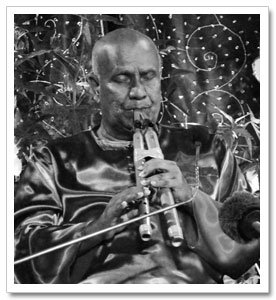 Meditation master and musician-composer Sri Chinmoy celebrated his 74th birthday last August with a number of unusual accomplishments. In addition to an epic outdoor concert featuring performances on 74 pianos – a grueling three hours long but a sheer delight to over 1,000 guests and students from some 45 countries – Sri Chinmoy also played next day on a total of 74 flutes.
The accomplished flautist who often performs on a number of New Zealand made instruments had assembled over 90 flutes for the occasion, mostly sent by students who in various parts of the world had heard of this project and wished to support it.
Surrounded by an amazing and colourful array of multifarious flutes – wooden flutes, ceramic flutes, metallic flutes of all shapes, colours and sizes – Sri Chinmoy played each for several minutes in a second marathon concert. In the following days, he also sang 74 of his own songs written in his native Bengali language, and some 200 songs written in English.
A four time New Zealand visitor who has enchanted audiences here with his free concerts of meditative music, Sri Chinmoy has amassed an enormous musical legacy of more than 18,000 published songs, offering these to countless people globally in over 700 concerts dedicated to world harmony.
– Jogyata.
Related Links:
Ultra Races and Guinness Records
The following is an article written for a New Zealand athletics magazine in 2005.
The Sri Chinmoy Marathon Team has had a good year. 30,000 Kiwi school kids participated in the New Zealand leg of the Sri Chinmoy Marathon Team sponsored World Harmony Run, a 70 nation torch relay dedicated to fostering international friendship through sport, and up and down the country everyone's looking forward to a bigger and better 2006 version next May. And Auckland members earlier travelled to New York to help in one the worlds most gruelling and mind-boggling sports events, the Sri Chinmoy Marathon Team's , an event he calls 'gluggling'. During his first attempt a tiny parrot fish kept biting him on the nose – distracted, he dropped a ball at 16 minutes and had to start again!
Some of Ashrita's other records include the fastest mile pushing an orange with his nose; the longest time balancing on a Swiss ball (3 hours, 30 minutes); the fastest mile on a pogo stick; and the most milk crates ever balanced on anyone's chin! Oh, and don't forget he balanced a milk bottle on his head continuously for 81 miles of race-walking; pogosticked up the 1,900 steps of Toronto's CN Tower; somersaulted the entire twelve and a quarter mile length of Paul Revere's ride in Massachusetts; and had to be helped off the Oprah Winfrey Show by paramedics when he consumed on camera some of the world's hottest chilli peppers.
In Auckland the Sri Chinmoy Marathon Team hosted New Zealand's national 24 hour track race at the Millennium Stadium – two competitors joined an elite race-walkers global fraternity, the Centurion's Club, exceeding the entry qualifying distance of 100 miles within 24 hours. And in Canberra, aided by some of our Kiwi team, the Australian Sri Chinmoy Marathon Team organised three of the biggest triathlons in the southern hemisphere, including the gruelling three day Ultra-Triathlon in which competitors complete a 15 km swim, 400 km cycle leg, and 100 km run!
In New York, Marathon Team founder Sri Chinmoy, 74 years old and still incredibly strong, met world marathon champions Paul Tergat (2:04:55), Paula Radcliffe (2:15:25) and Tegla Loroupe (2:20:43) and presented each with a special award honouring their achievements in running. Sri Chinmoy has long maintained that a human being will some day complete a sub two hour marathon! - and believes that the main barrier is not a physical but a spiritual one.
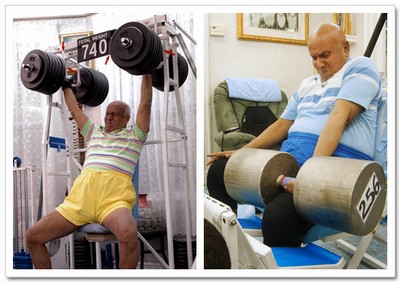 Athletes have long known of the relationship between mind-body-spirit in sporting success – the principle of holistics – and practitioners of yoga, meditation and multi-day sports events have for centuries explored this principle to gain an edge and transcend their physical limitations. Recently Sri Chinmoy attracted renewed interest and attention in the mind-body connection with several astonishing feats of his own. He hoisted two huge dumbbells weighing 740lbs overhead from their cradle on a custom-built exercise machine, then went on to wrist curl – 10 times with each arm – a record 256lb dumbbell.
"Out of all the weightlifters and champion bodybuilders I have seen," respected weightlifting authority and Mr Olympia Contest Chairman Wayne DeMilia commented, "Sri Chinmoy is the only one I have ever seen wrist curl a 200 pound dumbbell." And Jim Smith, Registrar of the British Amateur Weight Lifters Association said, "The strongest men in the world are seeing that a 74-year-old man is curling with one arm much more than twice the weight that the world's best bodybuilders and weightlifters can curl with two arms."
Why does Sri Chinmoy bother to lift these super-heavy weights at what he describes as 'the ripe old age of 74'? In his own words:
"What I wish to show by these feats of strength is that prayer and meditation can definitely increase one's outer capacities. I hope that by doing this I will be able to inspire many people to pray and meditate sincerely as part of their regular daily routine... The physical body has to become a pure and perfect instrument of the spirit. I am doing these lifts with the physical body, but the strength and power are coming from within – from an inner source."
Sri Chinmoy's recent weightlifting achievements encourage us not to grow old, to dare to tackle new challenges, to believe in our own unlimited potential – the fullness in life, he tell us, is in dreaming and manifesting the impossible dreams.
– Jogyata.
Sri Chinmoy – Into The Unknown
The following is an article that was written in 1990.
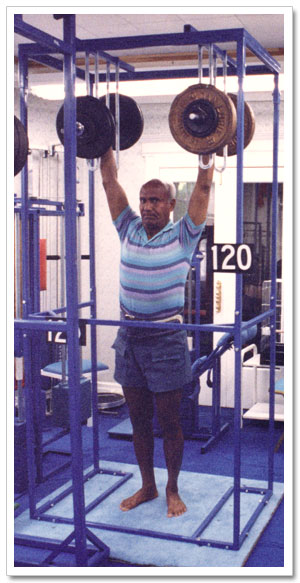 It is a few minutes before 5.30am. The Indian meditation teacher Sri Chinmoy quietly walks into his light blue living room which, strewn with barbells and weightlifting machines, looks more like a gym.
After several minutes of prayer and meditation the 75-year-old spiritual master positions himself beneath two giant dumbbells suspended from metal frames, each one equivalent to his own body weight of 150 pounds.
Grasping a dumbbell in each hand, he pauses again, drawing upon inner reserves beyond the physical before straining upwards against their combined weight. A loud, humming groan accompanies his effort, as, freed from gravity the dumbbells rise up into the air.
After holding the weights aloft for five seconds, he lets them return to their metal harness – a loud clang bounces off the walls before the room returns to silence.
This latest recent effort represents a further attempt by Sri Chinmoy to demonstrate that mind and spirit can move mountains.
"Physical energy has only one source and that source is spiritual energy. As long as we remain conscious only of the body, we are not aware of this. But when we go deep within through meditation, we see that spiritual energy is the source of physical, vital and mental energy," says Sri Chinmoy of his remarkable effort.
"What I have done in weightlifting offers a golden opportunity for people who remain only in the body and do not care for the spiritual to see what can be done on the physical plane by virtue of the spiritual. And people who have spiritual awareness, who practice prayer and meditation-life, will see how spirituality can become part and parcel of physical activity."
This synthesis of outer fitness and inner search is present throughout the teachings and activities of the spiritual Master, sports philosopher and master athlete, Sri Chinmoy. The qualities needed to attain a difficult physical goal are the same ones needed for the training of the spirit. We all have unlimited potential, he says. To bring these capacities to the fore, we need faith, discipline and the determination never, never to give up.
Sri Chinmoy is unique among Eastern spiritual Masters in emphasising the importance of sports in the spiritual life. His yoga encompasses not only profound mystical philosophy, but also physical fitness, a full acceptance of ordinary life, a vision for world harmony, and a deep involvement in poetry, art and music.
 The cornerstone of this yoga is the principle of aspiration – the urge to transcend, to reach for something higher and more fulfilling. This continual movement toward greater perfection, Sri Chinmoy believes, is the creative and energising force of the universe – the electrical current that runs God’s cosmic game. Our purpose in life, he teaches, is to plug into this divine current and allow it to guide our lives so we can ultimately transform ourselves and the world.
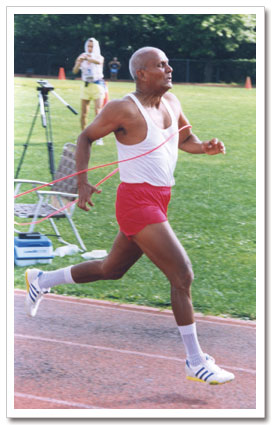
Sri Chinmoy is not a mere philosopher, he's a living philosophy, for if nothing else, he practices what he preaches. To see him struggling along with his students in a 26-mile marathon, or the 47-mile ultra-marathon he holds each year on his birthday, is convincing proof that this master is one with his followers.
His international Sri Chinmoy Marathon Team, which now sponsors more than 500 races a year, is more than a classy running club. It's one of the flagships of his spiritual vision. It's motto – Run and become. Become and run. Run to succeed in the outer world. Become to proceed in the inner world – is a call to both body and spirit to strive for something beyond themselves, a personal best on the race course and in life as well.
This athletic view of life, with its constant drive for self-transcendance, finds its consummate expression in Sri Chinmoy himself. During the 24 years he has lived in the U.S. he has written more 1000 books of spiritual poetry, plays, stories and philosophical essays, composed several thousand devotional songs and completed some 250,000 paintings and drawings – visions, he says of higher worlds he has experienced during meditation.
Sri Chinmoy attributes all of his accomplishments to God's Grace: speaking of his recent weightlifting he commented:
"Great champions are of the opinion that 70 to 75 percent of weightlifting is mental preparation. But in my case, 100 percent is due to God's Grace and God's Compassion. Without my prayer-life and meditation-life, I am sure I could not lift more than 60 pounds."
– Jogyata.
Running with the Torch in New Zealand
This article was written in 1993 following the New Zealand leg of the World Harmony Run that year.
On Sunday evening incoming black clouds cover the Waitakere Ranges west of Auckland, hinting at rain, but on Monday morning the sky is clear for the beginning of the World Harmony Run in New Zealand.
We have planned a three-day Auckland wide relay, then three days of regional runs through each of the four largest cities to the South. Final destination – Wellington; our capital and southernmost point of World Harmony Run '93.
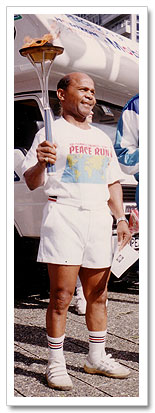 Precious McKenzie, power-lifting legend, meets us at our opening ceremony in Manukau, where 600 children stand to cheer the diminutive local hero. In this southern city, with its alliance of Polynesian, Maori and European New Zealand cultures, the issue of peace has immediate relevance. A household name, Precious gives the Harmony Run's theme of oneness a solid credibility.
Bald-headed for many years, Precious points with friendly irreverence to the equally bald headmaster and claims that they share the same barber. Everywhere there is laughter, smiling faces, smiling eyes. As he talks and jokes the barriers are tumbling down and we are dissolving into an easy familiarity. He is reaching out with his heart and offering the message of the Harmony Run in a powerful and memorable way.
Day two calls for a hectic tour of twelve schools in West Auckland. There are relay races, cultural items and songs; posters and banners are displayed, and the torch is touched by thousands of small hands.
A national children's TV show sends a camera crew and celebrity presenter along for a whole day. The programme will be seen by most of the country's youth, appropriately, for tomorrow's harmony grows in the hearts of today's children.
Our celebrities bring something unique and fresh to the Harmony Run, a special way of touching the children and making the message of the relay accessible and grounded in real life. The children know and love these faces from their favourite soaps and dramas – and here they are in person, talking about the Harmony Run.
Actor Tom Kline from 'Shortland Street' invites 700 schoolchildren to close their eyes and to feel that peace is a light in their hearts. ‘Now offer this light to your friends, to everyone in the room, now to the kids in Sarajevo, kids in Russia, kids in Somalia, kids who have no homes, no parents, no love. Feel something for them. They're part of our family too.’
At first awkward, the kids are suddenly moved – the Harmony Run comes to life, its message clearly felt. They rush to hold the torch. TV sports commentator Darren Young gets the tougher kids to 'high-five' with the person next to him and make a new friend. Pandemonium reigns as 700 children slap hands. They'll remember the fun and laughter after the day is over and something else will be left too, a seed of understanding.
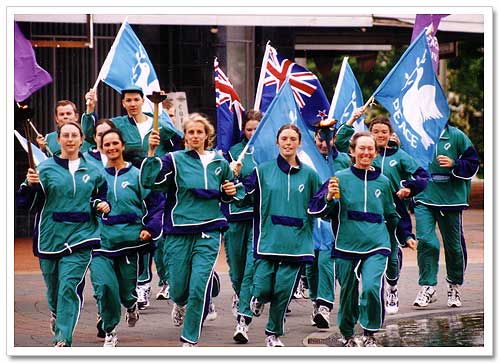 At the middle of the next day we reach the great volcanic plateau. Snow-covered wintering mountains rise up on the horizon, a vast blue lake stretches before us and on all sides are the pale blue, faraway silhouettes of further mountain ranges. Everyone wants to run with the torch across these beautiful landscapes and soon our whole team is out on the road.
Later that evening we learn that Wellington will become a Sri Chinmoy Peace Capital – the fourth in the world. It's one of many New Zealand cities that have been dedicated to peace and honours both the real contribution of the World Harmony Run to New Zealand and the vision of its founder, Sri Chinmoy, for whom peace is both a supreme reality and highest achievement.
It's a wonderful finale to our Harmony Run. We feel privileged to carry the torch for this emerging new world of peace and to be a part of the global Harmony Run with its supreme and timeless message.
Returning to Auckland, we stop by a mountain lake to enjoy the immense silence. There on a small sign we place our last Harmony Run aphorism where it flutters like a small, triumphant flag. Someone will read it.
Peace in the oneness-world-home is the supreme fulfillment of humanity's birthless and deathless promise to God.
– Sri Chinmoy.
– Jogyata.
- ‹ previous
- 118 of 125
- next ›

Except where explicitly stated otherwise, the contents of this site are licensed under a Creative Commons Attribution-NonCommercial-NoDerivs 3.0 Unported License. read more »
SriChinmoyCentre.org is a Vasudeva Server project.