
Introducing: The Blue Bird vegetarian café
In The Beginning...
The Kettledrum Café first opened its doors to the public on 15th March, 1995.
Several months of hard work preceded this phenomenon, starting with finally summoning up the courage to tell my Dad that I was not going to be taking up an overseas post-doctoral fellowship after all but was instead going to walk away from my career and many years of training to open a café in Auckland. He just looked at me and said, "So do you need any appliances for this?" Just like that. No big deal.
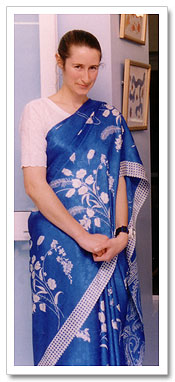
Toshala at The Kettledrum
Buoyed by Sri Chinmoy's encouragement, in August of 1994, to open a café representing the Sri Chinmoy Centre, I moved to Auckland from Hamilton and took a short business course, then obtained a hygiene certificate so that everything would be above board and 'proper.'
The next thing was the actual location of the shop and I decided on a small mall in Elliott Street initially because it was tiny and affordable. And, looking back, it was a good place to cut our teeth on and hone our skills for although I was a keen amateur cooky-type and enthusiastic foodie, I had no idea how to run a business and had never worked in a café or restaurant before. Two very good friends, Subarata and Jogyata, chose all of the decorations, the crockery, tables and chairs, etc, whilst I organised (ergonomically, of course!), and decked out, the kitchen.
There are some rare and special people on this earth who are extremely generous and even when they have nothing at all to call their own – they will still give you everything. Subarata only owned one (albeit battered!) pot, two plates and a fork and on the day before we opened, she walked into the Kettledrum kitchen with these in a box – she was donating her entire kitchen paraphernalia to the enterprise! She said that Jogyata and she would eat off napkins and takeaway plates from now on. Also when her sisters sent her any money from Ireland, she would buy things for the café – things that would enhance the food display or could be used to decorate something. She really liked making things look cute.
We decorated the menu boards and we also recruited others to help us set up. The day before opening I cooked all day and all night. Then the Robert Harris representative turned up with our cappuccino machine, on which he gave us a quick demonstration. He made a cappuccino, took a sip, then offered the same cup for Subarata and myself to sample from. Very quickly Subarata said, "Oh, we only drink tea!" Phew!
So then we opened and the public swarmed in. We were very busy for that week as we had two stilt-walking clowns walking around outside on 1 metre stilts, handing out leaflets about The Kettledrum. They did a very good job. Since that fateful day we were open at the Elliott Street location for two and a half years, and Sri Chinmoy came to visit us on 30th June 1995 – and liked it!
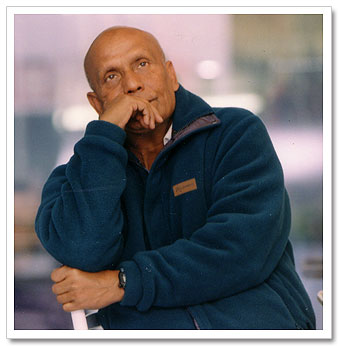
Sri Chinmoy at the Kettledrum Café in 1995
On 13th April 1997, Sri Chinmoy gave The Kettledrum the name The Blue Bird. The phrase, 'Blue Bird' is often used by poets to refer to the soul and Sri Chinmoy uses this avian metaphor in his own poetry:
REVELATION (abridged)
No more my heart shall sob or grieve.
My days and nights dissolve in God's own Light.
Above the toil of life, my soul
Is a bird of fire winging the Infinite.
– Sri Chinmoy.
From: My Flute
Full version: Revelation
This theme is also prevalent in Sri Chinmoy's art – he has drawn millions of birds in a series of drawings and paintings collectively called the 'Dream Freedom Peace Birds', which represent the light and delight of the soul and it's flight to freedom and happiness. These have been displayed in many galleries and cities throughout the world. There is a very tiny selection of these on the walls of The Blue Bird.
Eventually the Elliott Street location became too small so we moved to bigger premises at 299 Dominion Road, Mt Eden, which opened on 22nd July 1997. Again it was a team effort to set up – Subarata again as our interior decorator and purchasing officer.
Over the years we have changed and evolved – as has our menu! However two things have remained constant: we all love spirituality and are avid foodies!
Sri Chinmoy came and visited us on the 30th of November, 2002 – and liked it! On that day he wrote a song for The Blue Bird. This has been recorded by the spiritual music group Shindhu on their CD 'Shindhu 8', which is one of the recordings of Sri Chinmoy's music that we play in the café to set a spiritual theme and to offer a little of Sri Chinmoy's beautiful and peaceful world to everyone who comes in. The Blue Bird song can be heard on the About page of The Blue Bird's website.
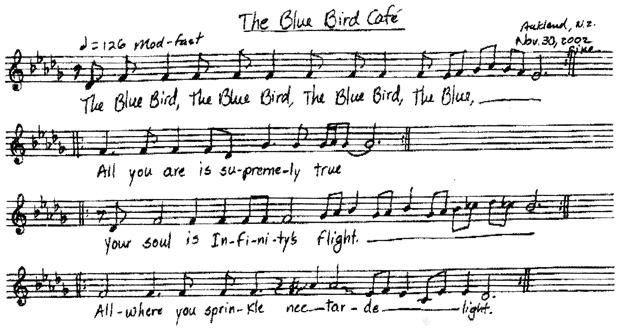
Sheet music for The Blue Bird song and Sri Chinmoy at The Blue Bird on the 30th of November, 2002.
The Blue Bird is one of the many international vegetarian cafés and restaurants owned and operated by the students of Sri Chinmoy. Each one has a distinctive name and atmosphere; they can be found in cities such as Christchurch, Melbourne, Adelaide, Brisbane, San Diego, San Francisco, Seattle, New York, Toronto, Ottawa, Halifax, Paris, Montpellier, Zurich… to name a few! There is a list of links to some of these vegetarian cafés and restaurants on the links page of The Blue Bird's website which is also home to The Blue Bird Gallery.
We believe that universal harmony begins in the heart of each individual and our goal is to nourish that harmony by offering delicious vegetarian food prepared in the spirit of love and oneness.
Return to: The Homepage of Toshala Elliott
Harkara's home page
Hallo und willkommen auf meiner Homepage! Gleich im Anschluss findet Ihr zuerst mal meinen Lieblingsaphorismus von Sri Chinmoy, meinem spirituellen Lehrer.
Vollkommenenes Glück
ist gleich
Enthusiamus
minus Erwartung.Sri Chinmoy
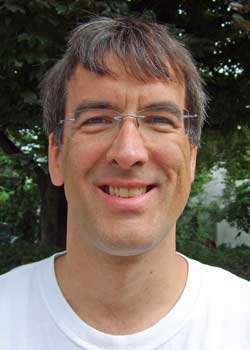 Mein Name ist Harkara und ich bin seit 1992 Schüler von Sri Chinmoy. Ich möchte auf diesen Seiten meine Erfahrungen mit Sri Chinmoy und der Meditation mit Euch teilen. Sri Chinmoy bat mich und meinen Freund Pramodan eines Tages, eine Esraj für ihn zu bauen. Die Esraj ist ein indisches Saiteninstrument, das zahlreiche Obertöne erzeugt. Das war ein echtes Abenteuer für ein deutsches Duo - einen Ingenieur und einen Feinmechaniker - ein indisches Instrument zu bauen, das bestimmte Qualitäten haben sollte. Zudem schwimme ich gerne, was mich dazu bewegt hat den Ärmelkanal schmimmend zu überqueren. Über die folgenden Links kommt Ihr zu den beiden Geschichten:
- Wie Sri Chinmoy Pramodan und mich in zwei Instrumentenbauer verwandelt hat ...
- How Sri Chinmoy transformed Pramodan and me into instrument makers ...
- Im September 2010 durchwamm ich mit einem 4-köpfigen Team den 34 km langen Ärmelkanal ...
That Thou Art
Last summer I was lucky enough to fly to Tampa Florida and attend a Harmony Concert offered by my meditation teacher, Sri Chinmoy. I also visited Consciousness-Blossoms - a restaurant that is owned and operated by Sri Chinmoy's students in Tampa. We also made two visits to the apparation of Mary, an imprint on the windows of a local office building. Leading up to this weekend, I was immersed in my Guru's book, I am Telling You a Great Secret. You Are a Fantastic Dream of God. This book mostly contains questions asked by children to Sri Chinmoy. Each question and answer was creating a powerful impression upon me. Something about the simplicity and straightforwardness of both the questions and answers deeply appealed to me. It can be found full text in the Sri Chinmoy Library if you would like to delve into it. Until I arrived in Tampa, little did I know just how strong the impression of this book truly was.
While we were at Consciousness-Blossoms, Sri Chinmoy sat and talked with us about many topics. The intimacy of our gathering in the small cafe was quite special and we had enjoyed a meal and Prasad (blessed food—a common tradition among spirtual masters) during our time there. The experience was tinged with a poignant sadness despite the peace flowing through the cafe. Two of our Guru's dear, dear friends had just died in the space of a very short time. A king from Indonesia who Sri Chinmoy met with during a Christmas trip passed away and Pir Vilayat Khan, the Sufi Master as well. He spoke movingly about them both and his students' hearts were most certainly filled with sympathy to see their dearest Guru's sadness. We sat there rapt in attention and meditation for easily over two hours.
At one point during Sri Chinmoy's talk with us, I heard something that roused me with a start and riveted my attention. Now that it is a little over a year later, I cannot remember the context of the before and after of what he said - just the simple phrase that surprised me. "And then when I worked at the ashram international library..." Because I have worked in libraries for over twenty years, this comment rang in my ears as if I just had heard that the second coming had arrived. I was floored and stared at my teacher for the longest time, never having read or heard about him working in a library prior to this moment.
What I suddenly realized was that I had been reading in the book I mentioned above that God appears to each person in the way that they can recognize and resonate with. My personal interpretation of his words was that to a cat God would be a cat, to a horse God would be a horse... and to a librarian God would be ... a librarian. Countless experiences recounted by his other students reaffirm this notion that being his student offers a powerful and remarkable opportunity to experience firsthand the omniscient aspect of God.
I was very moved that Sri Chinmoy included this special moment of self-giving to me in the midst of his personal sadness. In the twenty years that I have been his student, this constant service to his students and the world around him is the singular and only behavior that I witness him exhibiting - ever! Because I am a solitary sort of person, I found it especially comforting that I could be receiving a spiritual lesson from my teacher without anybody else even knowing it was happening. I am convinced that we could set a Guinness World Record for the longest book ever if all of these blessing moments were recorded on paper instead of just inside the "tablets of our hearts."
I expect I'll spend the rest of this lifetime and future ones as well trying to assimilate the lesson "Tat twam asi, That Thou art." But who could be luckier to have this profound lesson brought home in the simple phrase, "When I worked in the library...."
The Spirit of Kites

With tuppence for paper and strings,
you can have your own set of wings.
With your feet on the ground,
You're a bird in flight!
With your fist holding tight,
to the string of your kite!
Let's go fly a kite
Up to the highest height
Let's go fly a kite
And send it soaring
Up through the atmosphere
Up where the air is clear
Oh, let's go fly a kite!
When you send it flying up there,
all at once you're lighter than air!
You can dance on the breeze,
over houses and trees!
With your fist holding tight,
to the string your kite!
- Robert B. Sherman (from the film "Mary Poppins")
Not just a child's pastime, the history of kite flying traces back 3,000 years. Several different cultures are credited with the invention of the kite, including Malaysia, China and the South Sea Islands. With varied uses and purposes, kites embody significance in many ancient civilizations.
Credited as the first kites ever by some historians, South Sea Island kites were used as an aid in catching fish with bait and a web attached to the tail of the kite. In China, another possible birthplace of the kite, tales of kites being used to aid in military strategy date back as far as 200 BC.
In New Zealand, the Maori tribes associated divine meaning to kites. They believed that birds carried messages from men up to the Gods and they shaped their kites in the form of birds. Since kite flying was imbued with spiritual meaning, the Maori used the following ritual chant during a kite's ascent. Called the Turu Manu it translates as:
My bird, by power of charm ascending,
In the glance of an eye, like the sparrow hawk,
By this charm shall my bird arise,
My bird bestride the heavens.
Beyond the swirling waters,
Like the stars Atutahi and Rehua,
And there spread out they wings,
To the very clouds. Truly so.
In Bali, an aspect of the Hindu God Shiva is called Rare Angon and is the God of Wind and Kites. In Korea, kites are released into the sky to invoke prosperity and health when the first male child is born. In Thailand, kites were flown in the monsoon season as a way to send prayers to the monsoon gods. In several Asian countries, kites are commonly shaped in the form of Buddhist imagery - birds, turtles and dragons. In India, kings employed kite fliers and the Hindi language has over 100 words to connote the kite.
In addition to religious significance and symbolism, kites were important in scientific experiments and inventions. Kites played an important role in aviation history. They were used to launch thermometers and other meteorological devices to measure the atmosphere. Benjamin Franklin and Alexander Grahams Bell used kites in their scientific research.
Spiritual teacher Sri Chinmoy employs the imagery of the kite in The Invocation, a song he considers to be his most sacred composition out of the thousands of songs he has written. The words are "My Breath Thy Vision's Kite". When asked to comment on the meaning of this line in the song, he answered:
"Breath is the eternal life. So 'my breath' means eternal life. God's ultimate, ever-transcending Dream or Vision is the eternal life. Kite symbolises divine glory. The kite is flying, which represents the revelation or manifestation of the divine glory. God existed as the Absolute unmanifested. He wanted to manifest Himself constantly on earth so He brought down the eternal life. We see only the earthly life, which lasts sixty, seventy or eighty years; but here on earth there is also the message of eternal life. That eternal life we can find inside the heart, for that is where the soul is.
The Supreme's highest Wisdom can be seen and felt only here. The physical heart is one thing; the spiritual heart is something else. The physical heart is a tiny muscle, but the spiritual heart embodies God's entire universe. When we think of our spiritual heart, we feel it is something very tiny in comparison to the universe. But this is wrong. When we concentrate on the divine heart and feel the real divine heart, we will see that inside it the entire universe exists, that the heart is vaster than the universe itself.
Although the spiritual heart is eternal, at times it does not feel that it is; so the Supreme first enters into the heart and makes the heart feel that it is eternal, that it has eternal life. Then the Supreme starts His journey. He is going to transcend at every moment His own transcendental Reality; and while He is transcending, He is proclaiming or revealing or manifesting His divine Glory in the form of a kite."
(Excerpt from Sri Chinmoy Speaks, Part 7 - by Sri Chinmoy)
When you fly a kite, see one in the air, or just ponder its image as you sing "The Invocation," may your spirit soar as you let out more line, watching the kite knock at Heaven's door.
A Painting as a Picture of Love
"Paintings are there on the subtle plane, but we have to use paint to manifest them.
It is like a river, the river is flowing down from the subtle plane, in this case the creative plane,
and when it touches the earth, at that time it takes form and becomes creation itself."
- Sri Chinmoy
I slowly walked through the Queens, New York private gallery of paintings and drawings in Pilgrim Museum at Aspiration-Ground, taking a moment to absorb the feeling the colours and shapes created inside of me as I viewed each work. I stopped with a start before one painting by Sri Chinmoy entitled "Universal Love" with these exact words beautifully written across the bottom of painting in handwriting itself artistic. I stood mesmerized as an inner fragrance washed over me that felt comforting and familiar.
As a seeker yearning to discover truth, beauty and increasing God nearness, my spirit resonated with the depths of divine kindness, love and acceptance that seemed to pour forth from this painting. I felt as if I could have stood fixed to that spot for eternity staring into the essence imbued within this painting. Its abstract form provided the perfect invitation to follow the flow of the consciousness that unfolded in my heart. Like viewing a personal documentary, I remembered the countless sacred moments when God had awakened my sometimes-faltering steps into the breath of spirituality with the self-same quality I felt from this painting.
Transfixed, I humbly considered how this precept called "universal love" summed up the entirety of my personal journey through life. An expression of God's divine love for all of creation, the universal love energy embodied in this painting gently takes me by the hand and sleeplessly carries me to higher vistas. Like the church Sacre Coeur sitting on the hilltop of Montmartre high above Paris, universal love lifts me above the doubt, cynicism and failure left behind in the city streets far below.
I have never seen a print or postcard reproduction of this particular painting until now 4 years later when I have just purchased a print and postcard of the painting. Frm then until now I never forgot the feeling it created inside of me. Every step in my spiritual seeking resonates with this painting's essence. How I wish I could live my life permanently cradled inside this all-nourishing energy. Beautifully summing up this defining essence in my life, Sri Chinmoy states within one of his poems from The Wings Of Light, Part 8, "His God is the home of universal Love." No truer words describe my existence.
Nothing to declare? Further Impressions of Japan
Landing in New York City after an almost thirteen hour nonstop flight, I breathe a sigh of relief. Luggage finally claimed and passport stamped for my return to America, I feel that the journey is almost over. Ah yes, don't forget customs - that form filled out on the plane where I struggled to guess how much I spent on souvenirs and gifts out of the yen bought at the Tokyo airport the day I arrived. I hand the customs officer my form and he passes me through - nothing to declare. Well--- nothing except the evidence of a weakness for "Hello Kitty" dressed in kimonos on a variety of items!
Now a week has passed. Feeling infinitely more normal than a week ago Monday (that being my first day back to work), I'm alive and alert enough to appreciate that a beautiful summer day is enjoyably in progress. The weather is nothing less than perfect - 83F/28C, low humidity and a positively angelic breeze lightly blowing. Arriving home from work, I decide to wait until closer to sunset before I take a stroll on the bike path near my house.
With my camera tucked inside a waist pack, I walk along feeling so contented. Our spring and summer has been especially rainy so a simple summer breeze and sunset offer themselves as an unparalleled gift. Soon I'm chasing after a large monarch butterfly because it reminds me of Japan was teeming with butterflies and this association between the two still resonates. The butterfly fluttered away out of sight without me catching a photo of it.
I turn around and my attention is divided between the sun almost setting on the right horizon and the flock of swans up ahead in the cove on the left. Taking inventory, I count about 15 or 16 swans all grouped near a little outcropping of rock close to the path.
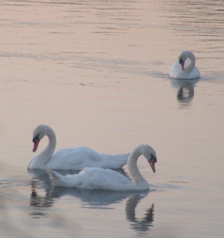 I cut off the path and up to the bank's edge, taking occasional steps back to watch the setting sun. I am feeling so completely peaceful and content because of the glorious weather. I cannot help but imagine that the swans have the same sentiment. They look more languid than usual and a number of them are using their body as a downy pillow for their head. Perhaps ever guilty of anthropomorphism, I'm utterly convinced that they are enjoying this beautiful summer evening sunset just as much as myself.
Memories tug at my awareness as I take photos of the swans as the sun is setting. My first toe in the water with photography a little over a year ago started with a fascination for photos of swans at the bike path - particularly at sunset! Now a year+ later, I delight in trying to capture their languid movements, the pink dreamy sunset tint of my surroundings and relish the fun of taking photos of them through the tall fronds of grass on the cove bank. I bask in the satisfaction of tangible progress in my swan/sunset picture-taking abilities.
Then the sun actually sets and the sky becomes a wash of pink, orange, grey, clouds and blue background sky. The colours march into the night's darkness. I watch a different kind of beginning deep inside this day's ending as the pink and orange hues descend onto the water, the swans and into my heart,
Although Mother Nature sings us a dreamy lullaby of sunset, I suddenly get rather excited! It's here! I feel it! The same peace from Japan - I still taste it and sense it all around me out on this path even though it is busy with wayfarers and despite the Providence city skyline etched by the sunset up ahead. I've been home a week back in my regular routine and now that the jet lag fog disperses the peace is still here. Hallelujah! If it could be measured in density in the air, say a part per million, it isn't as strong as Japan's inner silence but I know for certain that it would register if measured.
The sense of silence's constant renewal which I felt in Japan isn't the same, but I am thrilled that it is still lodged inside me. Nothing to declare? How false is that? I need to find that customs form and check off the box marked "other" so that I can more accurately portray what I carried home from Japan. I suppose the customs form doesn't have a section for beauty, inner peace and tranquility but I know that I have exported all of them back to America as clearly as my Hello Kitty souvenirs. I know it because I have never felt such deep contentment and peace out on the Bike Path as on this swan sunset evening.
When I look at the photos from that night added to my gallery album, it still reverberates. I do not know if it will for you as well, but a swan dressed in pink sunset colours is a pretty sight just the same. 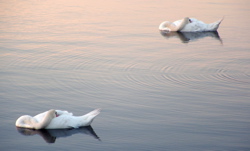 The symmetry of the two swans in 'Sunset Swans Snooze' makes them seem like twins. They looked like they were feeling just as lazy dazy as me on a summer's eve.
Now I know one doesn't have to travel to Japan to find inner silence and peace since the simple act of meditation draws from the same well. Nonetheless, Japan offered this peace thirsty traveller a blessingful dose. I will have to fill out that form all over again since after all. I have ever so much to declare. Thank-you Japan. Thank-you so much.
Local Hero
A Tribute to Patty Swift March 1, 1929-February 1, 20006
I like the man who faces what he must, With step triumphant and a heart of cheer; Who fights the daily battle without fear; Sees his hopes fail, yet keeps unfaltering trust That God is God, - that somehow, true and just His plans work out for mortals; not a tear Is shed when fortune, which the world holds dear, Falls from his grasp - better, with love, a crust Than living in dishonor: envies not, Nor loses faith in man; but does his best, Nor ever murmurs at his humbler lot; But, with a smile and words of hope, gives zest To every toiler: he alone is great Who by a life heroic conquers fate. (poem included in the service) -Sarah Knowles Bolton (1841-1916)
I pulled up my car to park on the street and knew this much be the church I was looking for because of all the cars lined up on both sides of the road. The quaint and simple New England church by the seaside of Padanaram was full to the rafters since people were even sitting in the balcony. Not one but two guest books were being lovingly signed as we entered the sanctuary.
I took a seat in a pew joining some of my library co-workers. My heart brimmed with gladness as my eyes took in the sweep of people represented at this memorial service to celebrate the life of Patty Swift - a true hero whose life had touched us each and every one. I was truly moved as I pondered that not a single person at this funeral was a relative of Patty. We were just the humble recipients of her greatness eager to pay her tribute with ones like me traveling from the next state with an inner compulsion almost beyond my ken.
Patty was a remarkable person who left her mark on all who knew her - and her presence in the town was unmistakable. Just look for the motorized wheelchair driving down the local streets with the flags attached to the back flapping in the breeze. Her physical life was fettered with cerebral palsy but she lived a gallant life against all the odds this disability presented to her.
She was born in 1929 and in the earlier stages of the disease was able to walk with braces and crutches but eventually became wheelchair bound. In her youth, schools were not equipped to serve students with special needs so her parents home schooled her. She was an only child and maintained extraordinary independence after the death of her parents. Until her passing on Feb. 1st 2006, she lived on her own with caregivers coming in to attend to her. She had a winter and summer home, ran a home-based business selling magazine subscriptions, went bowling every Sunday, took the ferry to Martha's Vineyard most every day in the summer time, had two cats for pets that she adored, managed to type, read books and serve on the board of directors of local organizations, sew beautiful needlepoint - the list goes on and on. What makes all of this so remarkable is that while her mind was brilliantly clear and wise, she was completely wheelchair bound, could barely move her hands and could barely be understood when talking.
Despite her handicaps, Patty was known to one and all as one of the friendliest, generous, loving, and happy people we have ever met. She was deeply religious and a fiercely devout God lover. Her absolute faith in God was the bedrock of her life and the gift that made her life sing across the treetops regardless of her obstacles.
Patty came regularly to the library where I work and while I did not know her intimately she touched my life. She used to tape record church sermons at the Congregational Church she belonged to and loved to listen to church hymn music. She would come almost daily into the library to sit and read or do needlepoint and we would get her set up at one of the bigger tables near the reference desk. More often than not she would have us taking all manner of goodies out of the storage pouch on the back of her wheelchair with frequent gifts of food for the library staff or food items to place in the charity food pantry basket near the door.
After we took her coat and hat off and put her book and other items on the table inevitably she would put on her headphones and listen to her church music which somewhat escaped through the player and headphones and wafted through the area for neighboring ears. Although libraries are stereotyped for demanding quiet atmospheres, no one ever stopped Patty from listening to her church music as it leaked through her headphones.
During the memorial service for Patty, Rev. Bob Boynton chose beautiful poems by poets such as George Eliot, Alfred Lord Tennyson and even a poem another regular library patron had written in tribute to Patty while she was still living. She was very involved with the church and a much beloved parishioner. At one point Rev. Boynton invited those of us sitting in the congregation to speak forth words that expressed Patty best. Courageous, brave, independent, thoughtful and many more rang out. Then individuals stood up in their place to offer a remembrance. Caretakers who knew her only briefly were nearly speechless with tears as they praised Patty. One woman who took her bowling also drove her to church and she said that Patty was eager to visit as many churches as possible - near or far.
She also provided a true role model of independent living for others with disabilities as well as being a teacher to those of us who are able-bodied in her refusal to isolate herself from the mainstream of life. She was a real pioneer and a hero. With no family at all after her parents died, she created family throughout this small town and first and foremost found family with God.
Choked with emotion, Rev. Boynton described to us how Patty loved hymns and that during her quick demise (a sudden onset of renal failure that saw her death coming less than one week from admittance to the hospital) a member of the church choir took a hymn book to St. Luke's Hospital and sang hymns to her in her final hours, not knowing even if she was conscious of what was happening. The Reverend beseeched us to think about what was it about Patty that cause someone not even related to her to offer her the hymns as her life left its mortal coil. He attributed her impact on people to her unfailing good-natured self-giving, kindness and love for others.
Patty trusted in God to take care of her despite her physical hardships. People say she never complained about her lot in life. Her impact on her community shows that God answered her faith with the care that she needed. I am personally humbled to have known someone whose life was such a dramatic gift to all who knew her. Never had I felt with such ardor that a memorial service was first and foremost a celebration of someone's life. I can only hope to dare to dream that my own life can continue to learn from heroes like Patty long after she's settled close to God in heaven.
I close with an excerpt of a long poem called "O May I Join the Choir Invisible" by George Eliot. This poem was one of the selected readings as a fitting description of Patty's life.
May I reach That purest heaven, be to other souls The cup of strength in some great agony, Enkindle generous ardor, feed pure love, Beget the smiles that have no cruelty, Be the sweet presence of a good diffus'd, And in diffusion ever more intense! So shall I join the choir invisible Whose music is the gladness of the world. -George Eliot 1867
- ‹ previous
- 100 of 125
- next ›

Except where explicitly stated otherwise, the contents of this site are licensed under a Creative Commons Attribution-NonCommercial-NoDerivs 3.0 Unported License. read more »
SriChinmoyCentre.org is a Vasudeva Server project.